Singapore chemical logistics growth still promising despite Middle East war: Katoen Natie execs

Specialty chemical producers are scaling up their plants on Jurong Island, driving demand for warehouse storage

Summarise
Sharanya Pillai
Published Wed, Apr 1, 2026 · 07:00 AM
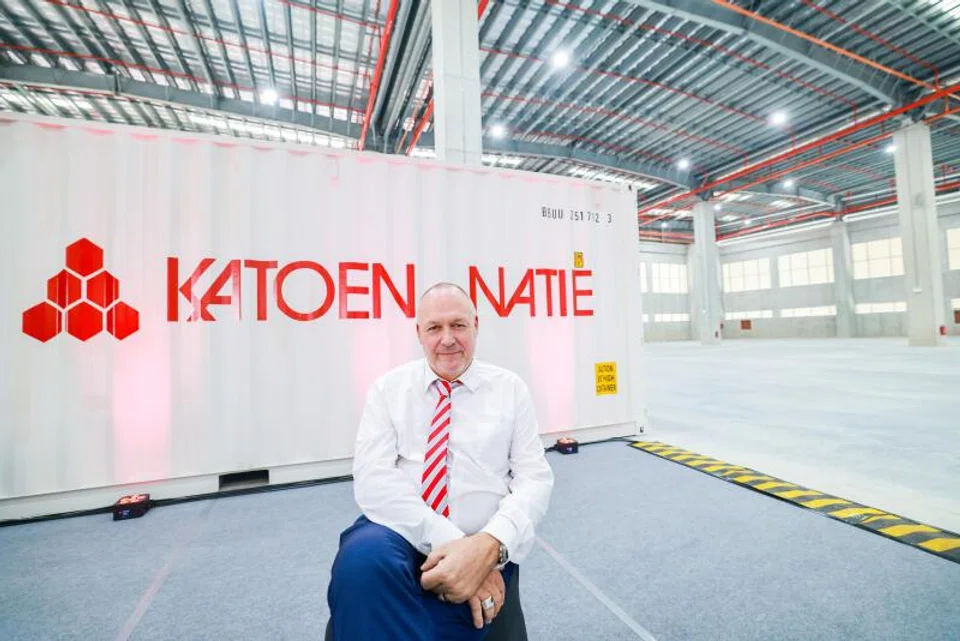
    • Past crises were "an opportunity for us to grow and reinvent ourselves", said Katoen Natie's outgoing Singapore chief executive, Koen Cardon.
    • Past crises were "an opportunity for us to grow and reinvent ourselves", said Katoen Natie's outgoing Singapore chief executive, Koen Cardon. PHOTO: LIANHE ZAOBAO

    [SINGAPORE] Demand for chemical logistics out of Singapore’s Jurong Island remains promising despite the volatility triggered by the Middle East war, top executives of Belgium’s Katoen Natie told The Business Times.

    The 172-year-old company is bullish on the Asian market, with Singapore as the “perfect hub” to link South-east Asia, India and China, said Koen Cardon, its outgoing chief executive for the city-state.

    He was speaking at the company’s Jurong Island premises on Tuesday (Mar 31), on the sidelines of unveiling a S$60 million investment to develop a 37,000 square metre warehouse.

    Cardon also announced that he is stepping down as chief executive with effect from Wednesday, after helming the company’s Singapore operations since it expanded here in 1997. He will be replaced by acting deputy chief executive Michael Tan.

    The Middle East war has hit the chemicals sector hard: the closure of the Strait of Hormuz has led to a global shortage of naphtha – a crude oil derivative required to produce petrochemicals that are then turned into plastics and other everyday products.

    The uncertainty has also led to force majeure notices and stirred concerns about “eroding” consumer sentiment, noted Cardon.

    That said, Katoen Natie takes a five to 15 year view on its investments, and is confident about its latest Jurong Island expansion.

    “This was a decision made about three years ago; we typically do not react to short term signals… Every crisis comes with opportunities; we’re financially a very strong company and we go into this business for the long term,” said Cardon.

    Katoen Natie’s Singapore operations is mainly focused on logistics solutions for polymers, but also involves metals and specialty chemicals, which have specific, high-value applications. It has about 380 employees here.

    The company’s Jurong Island customers include oil giant ExxonMobil – which is also a major producer of polymers – as well as German chemicals maker Evonik and Japan’s Mitsui Chemicals and Kuraray.

    Noting that the chemicals sector has grown 3 per cent on average annually, he added: “We always want to be ahead of the market… Sometimes there is an over-investment if the market slows down, but in general people will consume more plastic.”

    The rise of the middle class in markets such as India means greater demand for a range of products that use plastics – from packaging and water pipes, to medical devices and cars.

    Singapore also serves as a hub for shipping chemicals to as far as Mexico and other South American markets, Cardon noted.

    While the war has pushed up freight rates, many chemical companies have long-term contracts with shipping lines and are not impacted as much on short-term rate changes, he added.

    That said, with higher costs, Katoen Natie has had to relook how it operates to “do more with less”, its incoming chief executive Tan told BT at Tuesday’s event.

    It is thus investing in automation solutions, such as a S$3.1 million fully-automated storage and retrieval system.

    Tan also highlighted that specialty chemical producers are scaling up their plants in Singapore, driving demand for warehouse storage. Such players include Evonik, Kuraray and Cariflex, which last year launched the world’s biggest polyisoprene plant in Singapore.

    The priority is thus to be able to scale up in time, when the market picks up again.

    As Cardon noted during a speech at Tuesday’s event: “We have seen wars, we have seen epidemics and we have seen crises. Always, they were an opportunity for us to grow and reinvent ourselves.”