

Singapore grants approvals to import 900 MW of Malaysian solar power, including from Linggiu Reservoir facility
The awardees are Singapore’s Sembcorp Utilities and a unit of Malaysian developer Ditrolic Energy

[SINGAPORE] Singapore’s energy regulator has granted conditional approvals to two companies to import 900 megawatts (MW) of solar power from peninsular Malaysia – as the Republic races to secure clean energy imports from the region.
Sembcorp Utilities received approval to import 300 MW of power generated from a floating solar and battery storage facility at Johor’s Linggiu Reservoir – which is also a key source of Singapore’s water imports.
The other awardee is Southern Solar Alliance, a unit of Malaysian developer Ditrolic Energy Holdings. It received conditional approval to import 600 MW from a solar and battery facility in peninsular Malaysia.
Both developers aim to start commercial operations around 2029, EMA said on Friday (Aug 7).
“They will need to obtain all requisite approvals from relevant jurisdictions, conclude power purchase agreements with buyers, secure sufficient financing, and conclude various project development milestones in order to reach financial close,” the regulator said.
Sembcorp Utilities will develop a 2.2 gigawatt-peak floating solar system at Linggiu Reservoir, with up to 4.3 gigawatt-hours of battery energy storage, the unit of Singapore-listed Sembcorp Industries said in a separate release.
'%3e%3cpath%20d='M12.1475%2025.5262C13.7713%2025.4295%2014.94%2023.913%2014.94%2021.8832C14.94%2019.5359%2013.474%2018.093%2011.5917%2018.093C11.3745%2018.093%2010.9582%2018.093%2010.8393%2018.1413V25.2086L11.8891%2025.5745C11.8891%2025.5745%2012.207%2025.5262%2012.1475%2025.5262ZM11.4934%2017.6281C13.2567%2017.6281%2014.3843%2016.4292%2014.3843%2014.4501C14.3843%2012.372%2013.275%2011.2973%2011.4339%2011.2973H10.8393V17.6305H11.4934V17.6281ZM6.66078%2025.6482L7.39265%2025.5492C8.02617%2025.4502%208.26403%2025.3053%208.26403%2025.1097V11.6149C8.26403%2011.4193%208.1451%2011.3709%207.23484%2011.249L6.68137%2011.173L6.6219%2010.7588H11.9508C15.7153%2010.7588%2017.0624%2012.0797%2017.0624%2014.1578C17.0624%2015.9666%2015.7748%2017.1909%2013.4969%2017.6305V17.7041C16.111%2017.948%2017.6571%2019.5382%2017.6571%2021.7636C17.6571%2024.3318%2015.8937%2026.0417%2012.1109%2026.0417H6.60132L6.66078%2025.6482Z'%20fill='%232B2B2B'/%3e%3cpath%20d='M20.6287%2025.6505L21.5596%2025.5515C22.1725%2025.4779%2022.4104%2025.3076%2022.4104%2025.112V11.249H21.9346C20.073%2011.3479%2018.982%2013.0095%2018.408%2014.6227L18.1907%2015.5018H17.6555L18.1701%2010.7588H29.3837L29.6421%2015.4787H29.1664L28.9491%2014.6227C28.3728%2012.8645%2027.3047%2011.2743%2025.5002%2011.249H24.9856V25.1856C24.9856%2025.3812%2025.1251%2025.4548%2025.9965%2025.5515L26.7695%2025.6505L26.829%2026.0417H20.5693L20.6287%2025.6505Z'%20fill='%232B2B2B'/%3e%3c/g%3e%3cdefs%3e%3cclipPath%20id='clip0_5242_21648'%3e%3crect%20width='24'%20height='16.8'%20fill='white'%20transform='translate(6%2010)'/%3e%3c/clipPath%3e%3c/defs%3e%3c/svg%3e)
It is undertaking the development in partnership with Malaysian state-owned entity KPRJ Environment and Qua Energy, a Singapore-based renewable power developer and investor. The project will tap both existing and future subsea interconnection infrastructure.
The move reinforces Sembcorp Industries’ ability to “provide reliable and low-carbon energy solutions to support growing demand from data centres, AI-related industries and other energy-intensive sectors”, said its Singapore chief executive Koh Chiap Khiong.
“Strong momentum”
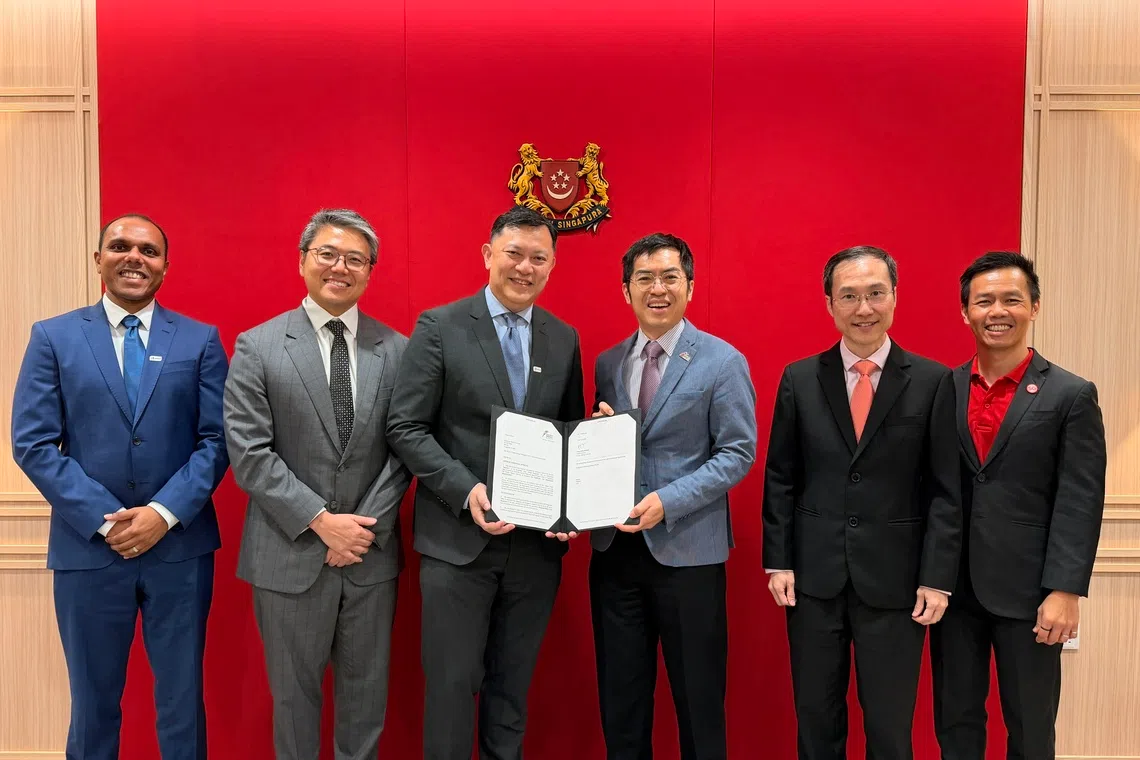
The approvals build on “strong momentum in bilateral energy cooperation between Singapore and Malaysia”, EMA said, citing how both countries are also studying a second electricity interconnection of up to 2 gigawatts (GW).
Singapore aims to import 6 GW of low-carbon electricity by 2035, which would meet about one-third of its energy demand then.
With Friday’s announcement, there are now seven projects with conditional approvals, potentially bringing in 6.25 GW of clean power into Singapore. The exporting countries include Australia, Cambodia and Vietnam.
Singapore has also awarded another six Indonesian projects conditional licences – the next step after a conditional approval towards obtaining a full licence. These projects collectively seek to import 3 GW of solar power.
The Indonesian projects have however faced delays over Jakarta’s licensing rules. In particular, the requirement that power exporters renew their permits every five years has made it challenging for developers to secure financing.
Nevertheless, in July, Indonesia’s sovereign investment agency Danantara inked several agreements with Singapore companies to advance negotiations over cross-border electricity trade.
Decoding Asia newsletter: your guide to navigating Asia in a new global order. Sign up here to get Decoding Asia newsletter. Delivered to your inbox. Free.
Copyright SPH Media. All rights reserved.
TRENDING NOW

DBS, OCBC, UOB rout lops billions off STI as inflation, rate concerns spook investors

Grab CEO’s wife Chloe Tong on life with Anthony Tan and finding her purpose

OCBC sheds S$8 billion in value as shares close nearly 6% down; analysts cautious on banks

Deal between tycoon friends sparks scrutiny of Philippine power sector

