

Singapore marine fuel sales fall 6.8% in May, likely due to cheaper bunker in China
While prices have declined, they are still much higher than before the Middle East conflict broke out

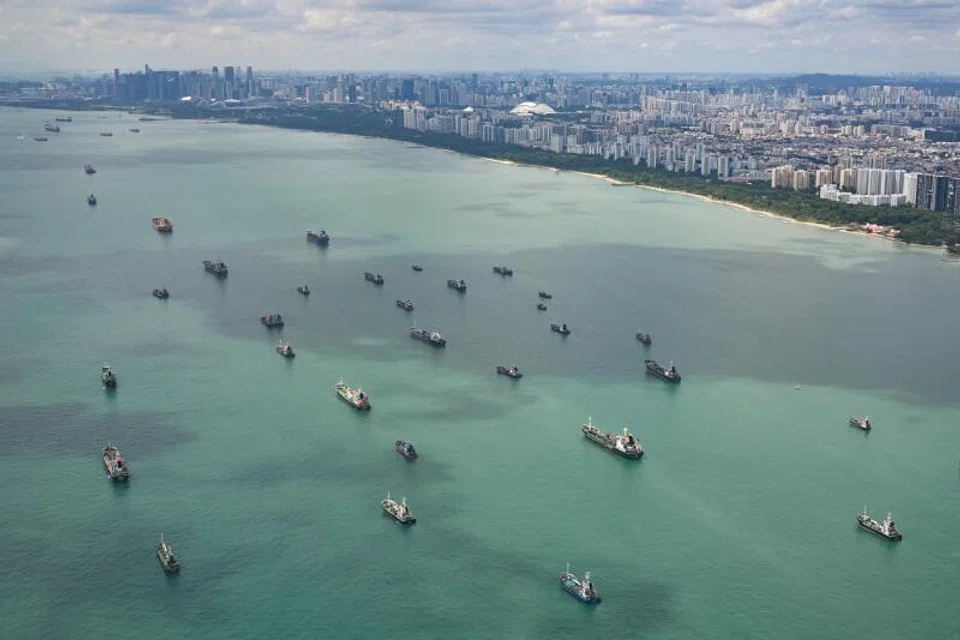
[SINGAPORE] Singapore, the world’s largest bunkering hub, booked a year-on-year decline in marine fuel sales for the second consecutive month in May, with an even bigger dip than that in April.
Sales of bunker or marine fuel slipped 6.8 per cent year on year to 4.5 million tonnes last month, compared with a 1.2 per cent drop in April.
However, sales in May were higher than April’s 4.4 million tonnes, which represented a 14-month low, statistics from the Maritime and Port Authority of Singapore (MPA) published on Monday (Jun 15) showed.
The lower bunker sales were logged despite the arrival of more oil tankers, although these vessels had less gross tonnage.
In May, 1,658 oil tankers with a total gross tonnage of 61.8 million called at Singapore, versus 1,586 vessels with a total gross tonnage of 63 million in the same month in 2025.
Gross tonnage measures the total internal volume of tankers.
However, more vessels called at Singapore for bunkering, the process of supplying fuel to ships. Last month, 3,690 vessels arrived to refuel, more than April’s 3,438 and 3,637 in May 2025.
Ivan Mathews, head of Asia-Pacific analysis at Vortexa, a data and analytics platform for energy and freight industries, told The Business Times that the lower bunker sales were most likely due to less competitive prices than those of China’s Zhoushan.
“Although more vessels called at Singapore for bunkering, average stem sizes decreased,” he said.
“This is because higher prices in Singapore caused buyers to reduce purchases on the margin, particularly for vessels plying the North Asia-South-east Asia route, as they likely would have chosen to increase stem sizes in Zhoushan instead of Singapore.”
Stem size refers to the total volume of fuel, measured in metric tonnes, supplied in a single order.
Mahua Mitra, head of marine fuels pricing for the Asia-Pacific at energy and commodity market intelligence provider Argus, pointed out that the US-Iran conflict contributed to weaker spot demand in Singapore.
This was amid elevated price volatility, tighter fuel oil availability and reduced competitiveness versus regional ports.
“The price spread between Singapore and Zhoushan widened to around US$56 a tonne on Apr 30, with Zhoushan at a discount,” she said.
“Since then, the spread has narrowed to around US$15 a tonne as Singapore bunker prices corrected in line with crude and weaker demand.”
Spot prices for bunkers delivered in Singapore spiked for key grades shortly after the US and Israel started bombing Iran on Feb 28, as the supply of crude oil flowing through the Strait of Hormuz was reduced to a trickle after Iran closed the waterway. One-fifth of global crude oil volume would have normally flowed through this passage.
Although prices have since dropped, they are still much higher than before the Middle East conflicts.
Mitra also noted that shipowners were managing the impact of higher bunker costs alongside tighter chartering margins, which led to more cautious bunkering strategies such as refuelling only minimum required volumes.
A steep backwardation structure (where spot prices are higher than forward prices) ranging between US$30 and US$80 a tonne since the US-Iran conflict began contributed to weaker near-term demand.
It saw refuelling move beyond the typical two-week window, as shipowners sought to optimise bunker procurement timing on supply availability.
Bunker inventories in Singapore, meanwhile, had declined by more than 4.5 million barrels to multi-year lows of around 14.8 million barrels by May, Mitra said. This was as imports fell by more than 20 per cent, she added.
In March, MPA told BT that Singapore’s bunker supply comes from several sources and that there was enough supply to meet demand.
Container throughput was at a record high in May, coming in at 3.9 million 20-foot-equivalent units. This was a 3 per cent increase year on year, or a 4.9 per cent rise month on month.
Tan Hua Joo, analyst at container shipping intelligence provider Linerlytica, noted that the surge was in line with a jump in global container volumes.
These were mainly driven by increased Chinese exports of artificial intelligence-related technology goods and renewable energy products including electric vehicles, solar panels, batteries and wind farm equipment, he added.
TRENDING NOW

DBS, OCBC, UOB rout lops billions off STI as inflation, rate concerns spook investors

Grab CEO’s wife Chloe Tong on life with Anthony Tan and finding her purpose

OCBC sheds S$8 billion in value as shares close nearly 6% down; analysts cautious on banks

Deal between tycoon friends sparks scrutiny of Philippine power sector

