SP Group acquires rooftop solar assets in China
The deal will help China avoid 88,000 tonnes of carbon emissions annually.
 Add BT as a preferred source
Natalie Chen
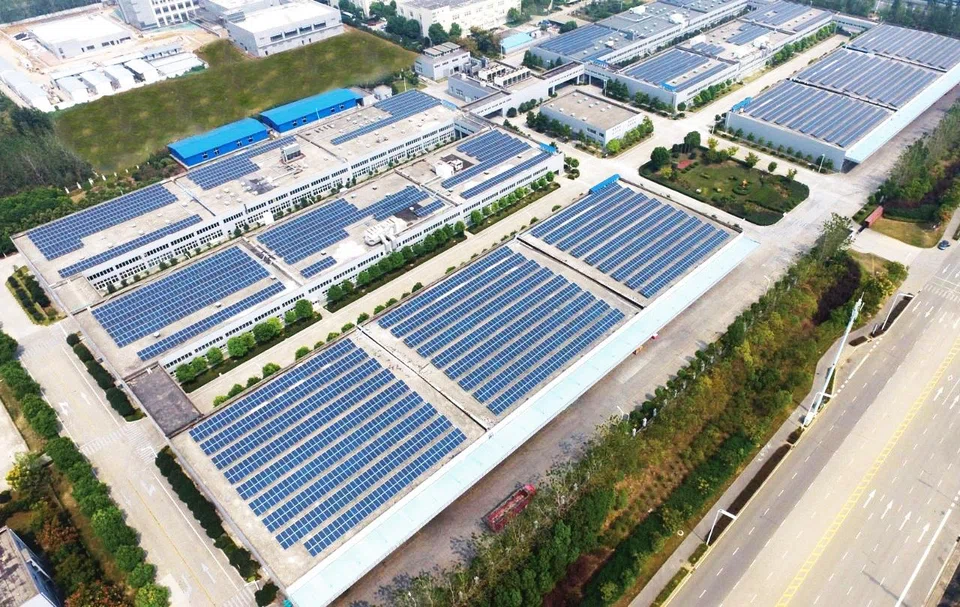
SP Group announced on Monday (Apr 10) that it has acquired up to 150 megawatts-peak (MWp) of rooftop photovoltaic (PV) assets from China’s Shanghai Unisun New Energy.
In a press release, SP Group – an energy utilities group and sustainable energy solutions provider – said that the solar assets will generate more than 150 gigawatt-hours (GWh) of green electricity annually. This will help China avoid more than 88,000 tonnes in carbon emissions each year.
The 150 MWp of rooftop PV assets are solar panels which convert light to electricity. The two companies have already completed the acquisition of the first 80 MWp of distributed PV projects for a total equity consideration of S$34 million.
These assets are installed at over 50 industrial sites in Fujian, Jiangsu, Zhejiang, and Guangdong, covering the food and beverage, automobile and textiles industries.
The transaction for the remaining 70 MWp is likely to be completed by the middle of this year.
SP Group said the acquisition is in line with its strategy towards sustainable development and decarbonisation of the industrial sector, reducing energy consumption and carbon footprint of manufacturing facilities.
“The acquisition is part of SP Group’s long-term commitment to support China’s clean energy expansion and strengthen our sustainable energy portfolio”, said Michael Zhong, SP Group China managing director.
“We look forward to accelerating the green energy transition and sustainable development for industrial parks, districts, and townships across China through deeper partnerships and value-added innovations”.
SP Group recently formed alliances with China Southern Network Financial Leasing, CGN International Financial Leasing and CIMC Capital, to jointly invest and develop sustainable energy projects in new energy development, energy storage systems and integrated energy managements.
China has pledged to peak carbon emissions by 2030 and achieve carbon neutrality by 2060, as announced by President Xi Jinping in September 2020. According to a report by the International Energy Agency in September 2021, the pace of China’s emissions reductions will be an important factor in global efforts to limit global warming to 1.5 deg C.
Decoding Asia newsletter: your guide to navigating Asia in a new global order. Sign up here to get Decoding Asia newsletter. Delivered to your inbox. Free.
Copyright SPH Media. All rights reserved.