

Time running out for Sun Cable’s grand plan to ship sunshine to Singapore

Anita Gabriel
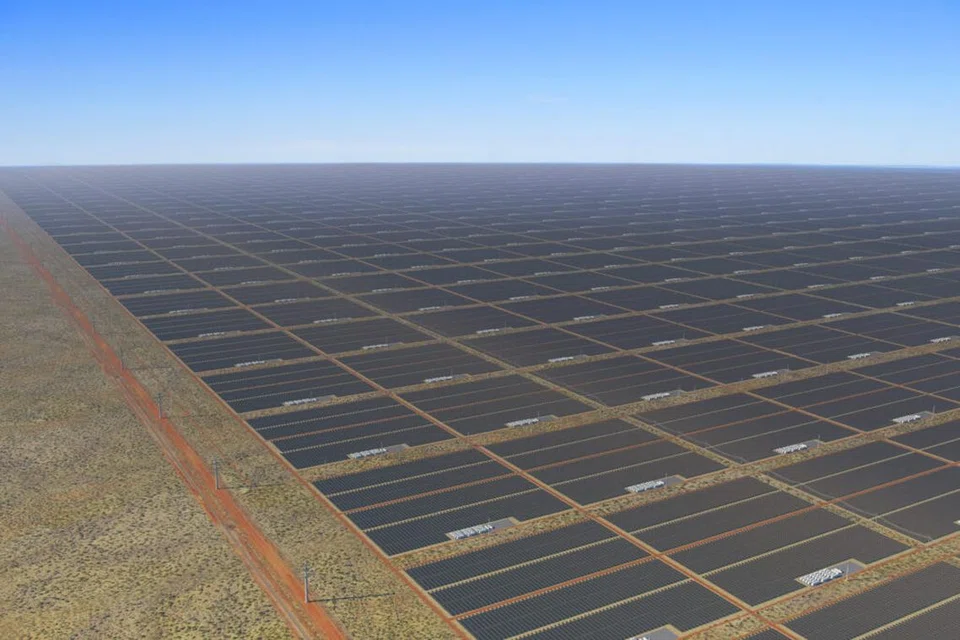
UP until a week ago, clean energy startup Sun Cable’s biggest challenge was deemed to be the monumental task of laying subsea cables that would stretch over 4,200 km to ship sunshine from the Australian outback to Singapore by snaking through Indonesian waters.
The company’s marquee A$30 billion project – a mammoth intercontinental undertaking called the Australia-Asia PowerLink – was branded audacious for its scale.
Sun Cable was aspiring to build the world’s largest solar farm and battery storage project near Elliott, a small town in Australia’s Northern Territory. The plan aimed to send solar power to Darwin and then across to Singapore via the undersea cable.
While Sun Cable, which was founded in 2018, first trumpeted its plan for the “monster” solar farm in 2019, the project only began to draw attention one year later when the Australian government awarded it “Major Project Status”. It earned the status given its potential to create thousands of jobs and inject billions into the economy.
Early in 2022, the game-changing project finally got its moment in the sun after Australian billionaires Mike Cannon-Brookes and Andrew Forrest threw their financial heft behind it. The project also managed to woo significant offtakers, which helped many sceptics warm up to its potential.
It was also in 2022 that the project in the resource-blessed Southern Hemisphere seemed to stir excitement in Singapore, a resource-constrained city-state with an ambitious decarbonisation agenda.

Sun Cable is among some 20 parties vying for an import licence in Singapore, under the city-state’s plan to import up to four gigawatts (GW) of electricity by 2035 to decarbonise its energy sector. Singapore’s power sector accounts for some 40 per cent of its total carbon emissions, and hence plays a significant role in the nation’s climate change efforts.
But Sun Cable’s grand hopes have floundered since the company said a week ago that it has entered into voluntary administration. It cited misalignment between the shareholders over its future direction and funding matters for the “difficult decision”.
News reports suggest the company’s two billionaire backers have fallen out over escalating costs and how to take the ambitious project forward. Central to the feud, it appears, is whether the project should export a portion of its solar energy to Singapore – this is also the grandest part of the project – or be solely a domestic player.
SEE ALSO
This has unfolded ahead of the project’s targeted financial close of early 2024, and as the company was in talks with Singapore on the timeline and finer points of the power link under the city-state’s second request-for-proposal (RFP) for electricity imports.
For many market watchers, the recent events may be an “I told you so” moment aimed at the company. A cross-border renewable energy project of such magnitude was never going to be free of pitfalls.
Sun Cable’s failure also underscores the complexities that Singapore faces as it embarks on a journey to import clean energy.
A refreshed alignment following Sun Cable’s collapse could yet see this green energy project taking a new, less ambitious form.
As for its ambition to sell clean energy to Singapore, the hurdles Sun Cable faced were always going to be high. Based on relative proximity, rival bidders from Indonesia, Laos, Malaysia and Thailand would be better able to provide cheaper and reliable power.
Whatever the case, the RFP to appoint licensed electricity importers issued by Singapore’s Energy Market Authority ends in December 2023. So, Sun Cable does not have much time to straighten things out and see its Australia-Singapore energy link take off.
While it would be a sweet victory for climate goals to see this radical project come to fruition, Sun Cable’s fate has been eclipsed by a shareholder spat and, less so, the widely-expected technical hurdles facing the mega project. Truth is, Sun Cable isn’t Singapore’s only bet for large-scale electricity imports. But for Sun Cable, Singapore is its only bet (so far) to meet its daring intercontinental renewable energy dream.
Decoding Asia newsletter: your guide to navigating Asia in a new global order. Sign up here to get Decoding Asia newsletter. Delivered to your inbox. Free.
Copyright SPH Media. All rights reserved.
TRENDING NOW
Nvidia CEO Jensen Huang’s confession engulfs chip giant in spying controversy
China recruited exec at Singapore data centre firm to spy on Nvidia CEO Jensen Huang: US intelligence

Higher rates, weaker spending: Is the Philippines entering stagflation?

Could Japan trigger the next global financial crisis?

