US demand for oil surges, depleting tanks in Oklahoma
 Add BT as a preferred source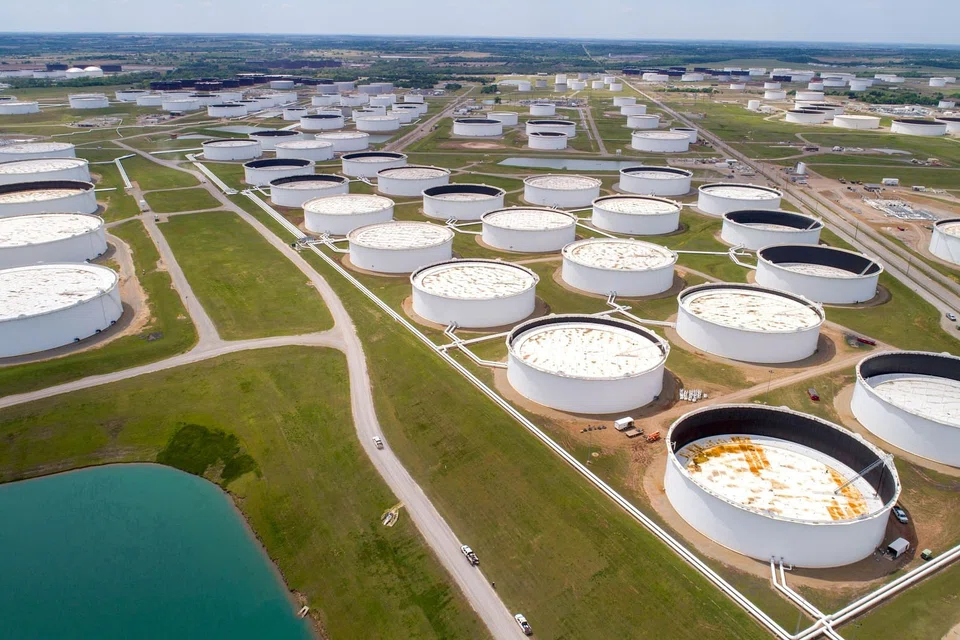
DeeperDive is a beta AI feature. Refer to full articles for the facts.
[NEW YORK] Crude oil tanks at the Cushing, Oklahoma storage and delivery hub for US crude futures are more depleted than they have been in the last 3 years, and prices of further dated oil contracts suggest they will stay lower for months.
US demand for crude among refiners making petrol and diesel has surged as the economy has recovered from the worst of the pandemic. Demand across the globe means other countries have looked to the United States for crude barrels, also boosting draws out of Cushing.
The oil hub is the largest, and for decades was the most significant storage facility for US barrels. That has changed in recent years, as activity has shifted to the US Gulf now that the United States exports roughly 3 million barrels of crude every day.
Analysts expect the draw on inventories to continue in the short-term, which could further boost US crude prices that have already climbed by about 25 per cent in the last 2 months.
The discount on US crude futures to the international Brent benchmark WTCLc1-LCOc1 should stay narrow.
"Storage at Cushing alone has the potential to really rally the market to the moon," said Bob Yawger, director of energy futures at Mizuho.
Navigate Asia in
a new global order
Get the insights delivered to your inbox.
Cushing stockpiles have dropped to 27.3 million barrels, the lowest since October 2018, the Energy Information Administration said on Wednesday (Oct 27), or about half of where inventories were at this time a year ago. By contrast, Gulf inventories were at 247 million barrels at the end of last week, compared with 224 million barrels at the same time two years ago prior to the pandemic.
Cushing inventories have fallen because of a ramp-up in US demand, which has encouraged domestic refiners to keep crude at home to provide fuel such as petrol and distillates to US consumers, said Reid I'Anson, senior commodity analyst at Kpler.
In addition, US production has been slow to recover from declines seen in 2020. At the end of 2019, the nation was producing roughly 13 million barrels of oil per day (bpd), but in recent weeks has been less than 11.5 million bpd. At the same time, product supplied by refineries - a proxy for demand - is about just 1 per cent below pre-pandemic peaks.
Even with reasonably high inventories around the country, Cushing is still important as the delivery point for the US futures contract. As inventories have declined, the spread between US crude and Brent has collapsed. The spread narrowed to roughly US$1.09 a barrel this week from US$4.47 earlier this month, which had been about the widest spread since May 2020.
In an additional sign of high short-term demand for US crude, the premium for US crude delivered this December versus December 2022 CLZ1-Z2 reached a high this week of US$12.48 per barrel, most since at least 2014, according to Refinitiv Eikon data.
In the next 3 months, Rystad Energy expects refinery runs in the United States to increase by 500,000-600,000 barrels per day. This would outpace production gains of 300,000-400,000 bpd, and keep the spread between the two benchmarks narrow.
"Only if Opec (the Organization of the Petroleum Exporting Countries) intervenes with more supply of crude or if Covid rears its ugly head again, curbing demand, this high volatility will come off," said Mukesh Sahdev, senior vice-president and head of downstream at Rystad Energy.
REUTERS
Decoding Asia newsletter: your guide to navigating Asia in a new global order. Sign up here to get Decoding Asia newsletter. Delivered to your inbox. Free.
Share with us your feedback on BT's products and services