ESR-Reit, Ara Logos propose merger with pricing favouring ESR-Reit unitholders


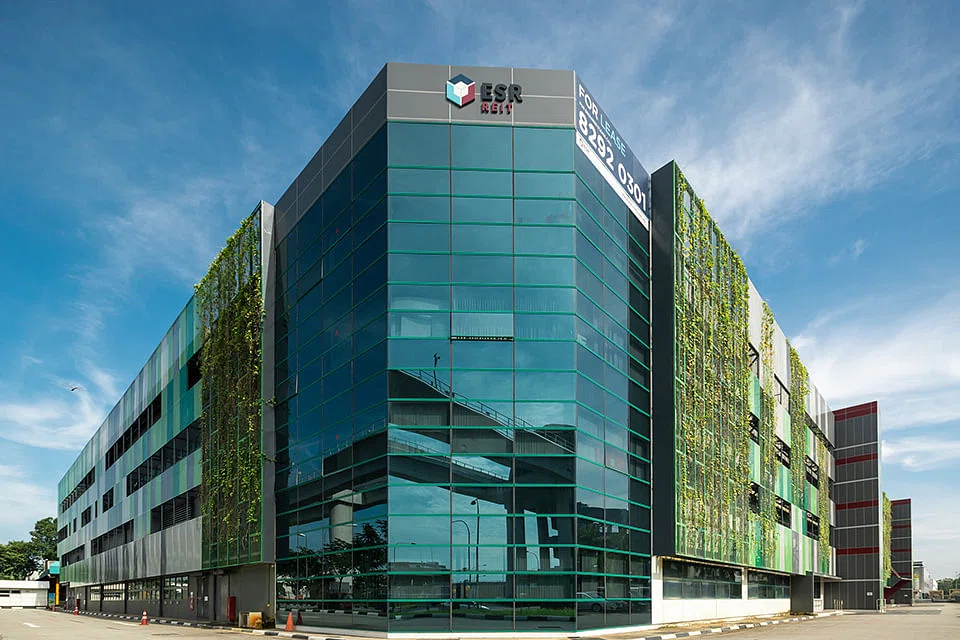
ESR-REIT and Ara Logos Logistics Trust are proposing to merge in a S$1.4 billion deal, in a move that will create a real estate investment trust (Reit) with S$5.4 billion in total assets.
Under the deal, widely anticipated after their respective sponsors announced a merger earlier this year, ESR-Reit will be renamed as ESR-Logos Reit.
The new entity will have 87 properties spread across Singapore and Australia, as well as 41 properties owned via investment funds in Australia. And with a theoretical free-float market capitalisation of S$2.5 billion, it will be among the 10 largest Reits listed here.
Nearly two thirds of the portfolio will be in what the Reits' managers dub "in-demand new economy real estate" - logistics and high-specs industrial space focused on e-commerce, high value-added manufacturing such as precision engineering, data centres and cold-storage facilities.
Adrian Chui, the chief executive officer of ESR-Reit's manager, said: "This proposed merger is transformational and accelerates the pivot of ESR-Logos Reit to new-economy sectors that are set to dominate and deliver sustainable growth. We will continue the divestment of non-core assets and recycle capital from the sale to enhance our overall portfolio quality."
Following the merger, he will become chief executive officer (CEO) of ESR-Logos Reit's manager; Karen Lee, chief executive of Ara Logos' manager, will become deputy CEO.
Unitholders of ESR-Reit will benefit from the acquisition of a portfolio on which the market has placed a premium.
Prior to the announcement, units of Ara Logos last traded at S$0.935 each, or 1.4 times book value. The counter has gained 62.6 per cent this year, partially on the back of the improving outlook for logistics properties.
The benefits of the deal are less clear-cut for unitholders of Ara Logos. The price they will be paid is S$0.95 per Ara Logos unit. But this consists of S$0.095 in cash, and 1.6765 new ESR-Reit units to be issued at S$0.51 apiece.
For illustrative purposes, this means an Ara Logos unitholder will receive S$95 in cash and 1,676 ESR-Reit units for every 1,000 Ara Logos units held. This implies a gross exchange ratio of 1.863 times.
But the issue price of S$0.51 per new ESR-Reit unit is near its 52-week high of S$0.52 recorded in September. Since then, however, the counter has fallen considerably to close at S$0.465 on Thursday, ahead of the announcement of the proposed merger.
ESR-Reit was trading at a lower price-to-book ratio of 1.2 times.
Chui defended the pricing of the ESR-Reit issue, citing a range of factors: "We looked at... (the) historical trading prices of each other, the liquidity of each (Reit), the market cap and free float of each (Reit), the cost of capital ... as well as our respective high and low prices.
"The key takeaway is that we are coming together to merge into an even larger platform. And we strongly believe in the merits of the merger," added Ara Logos' Lee. "Looking ahead, we have a very clear trajectory path to grow the Reit. With the support of a stronger sponsor, and scaling up immediately, we're very confident that we can deliver even greater value to our unitholders."
The narrative of a larger Reit being better has been used to justify other Reit mergers, but the actual result of mergers has been far less satisfying.
Data compiled by The Business Times earlier this year showed Reit mergers have generally been value-destructive for most of the five successful Reit mergers in the Singapore market.
They include the deal between ESR-Reit and Viva Industrial Trust, which was the first Reit merger here when it was completed in October 2018.
Also, Ara Logos was the smaller Reit by both total net asset value and market capitalisation. But it enjoyed a better valuation than ESR-Reit did.
The merger will, however, be accretive to the distributions per unit (DPUs) of both Reits.
Assuming the merger had been completed on Jan 1, 2020, ESR-Reit's DPU for FY2020 would have risen 5.8 per cent - to 2.935 Singapore cents from 2.775 cents. Ara Logos's DPU would have increased by 8.2 per cent to 5.512 cents, from 5.094 cents.
RHB analyst Vijay Natarajan believes the overall valuation is largely fair. He said: "The issue price and exchange ratio was determined based on the respective Reits' 52-week high and the trading volumes on those days. While there have been some concerns over issue price of S$0.51 for ESR-Reit, we note that unitholders will still be able to enjoy the potential upside from the growth upside of the combined Reit.
"Additionally, 10 per cent of the scheme consideration will be paid in cash for Ara Logos unitholders, which will help them crystalise some of the strong share price gains this year," he added. "The combined Reit will benefit from lower cost of capital, operational cost synergies and greater inorganic growth potential, which definitely outweigh the short-term pricing concerns, in our view."
The proposed merger comes just 2 months after Hong Kong-listed logistics real estate company ESR Cayman proposed to acquire the entire share capital of real estate fund manager Ara Asset Management to create a property juggernaut, with combined assets under management (AUMs) of US$131 billion.
For ESR-Logos Reit, this will mean a potential asset pipeline of over US$50 billion in new economy assets from its sponsor and another US$10 billion under development. An initial approximate US$2 billion of new economy pipeline in the Asia-Pacific is "visible and executable" to jumpstart the Reit's growth, the two Reits said in their joint statement.
In fact, access to the asset pipeline is a major incentive for the merger of the two Reits.
UOB Kay Hian analyst Jonathan Koh noted that ESR-Reit "intends to pivot its investment strategy towards acquisition of logistics assets". ESR-Reit owns 12 logistics properties in Singapore, which accounted for a quarter of the Reit's rental income in H1. It has also recently acquired a 10 per cent stake in ESR Australia Logistics Partnership.
"The overlapping investment mandates would necessitate a merger of ESR-Reit and Ara Logos to prevent conflict of interest (if ESR Cayman's acquisition of Ara Asset Management goes through)," Koh said in a recent report.
The proposed merger still requires the approval of unitholders.
ESR-Reit unitholders will have to vote on both a merger and an issuance of units to pay for Ara Logos. Both resolutions will require approval by a simple majority, meaning more than half the total number of votes cast. The resolutions will be inter-conditional. ESR Cayman, Summit Group, Mitsui and their respective associates will not be able to vote.
Ara Logos unitholders will first have to vote on a resolution to amend the trust deed. This will take approval from at least 75 per cent of all votes cast. All unitholders can vote on this resolution.
If the amendment is approved, unitholders will then vote at a scheme meeting. For the merger to take place, unitholders in favour must number more than 50 per cent of the total number of unitholders voting at the meeting. These unitholders must also represent at least 75 per cent in value of the total votes cast.
Parties that cannot vote at the scheme meeting are ESR-Reit's manager and its concert parties, common substantial unitholders of ESR-Reit and Ara Logos, and the manager of Ara Logos.