

Expected restructuring bids could test Singapore's insolvency regime
Downturn hits after laws changed to make bankruptcy rules friendlier to debtors: lawyers
Singapore
THE legal changes that have made Singapore's debt-restructuring regime friendlier to debtors could meet their biggest test yet as weaker economic conditions send more companies into distress, legal practitioners say.
A key turning point for debt restructuring in Singapore occurred in May 2017, when changes to the insolvency regime of the Companies Act came into force.
The main changes to the Act included the introduction of automatic moratoriums for debt-restructuring applications, the provision of super priority for rescue financiers, the introduction of "cram down" provisions to address the problem of minority dissenting creditor classes in certain situations, and the allowance of pre-packaged restructuring in schemes, among other things.
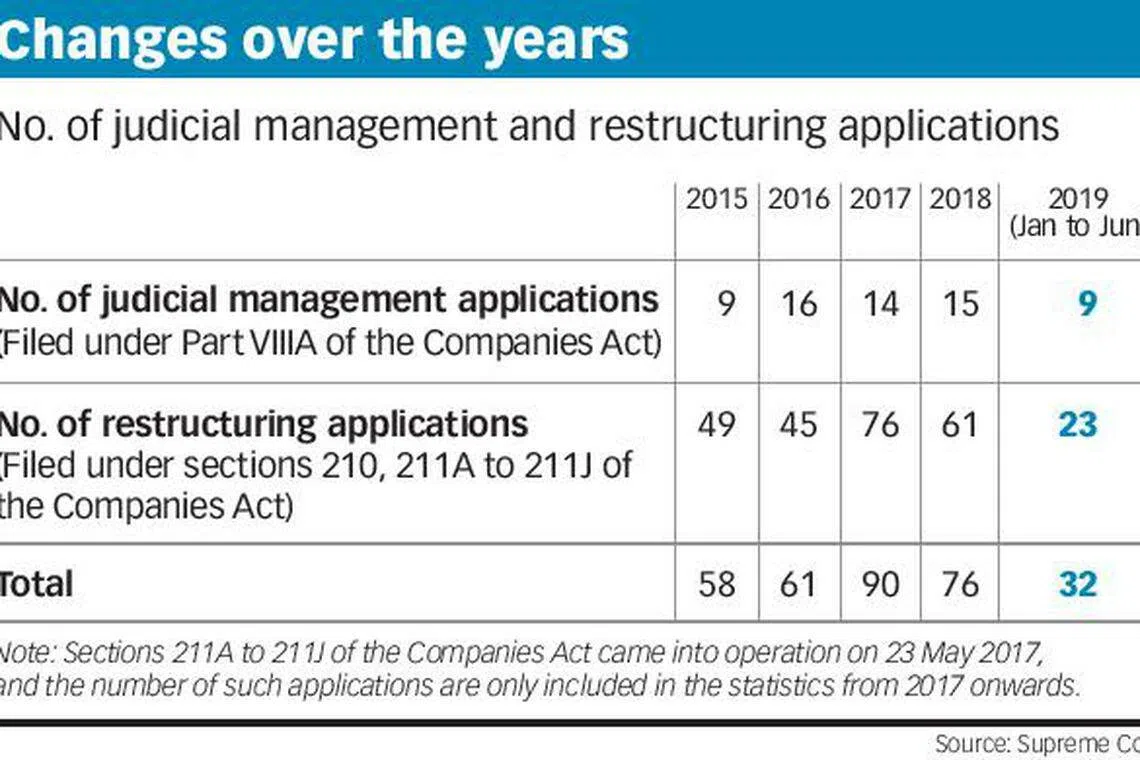
According to statistics from the Supreme Court, the number of companies going for judicial management (JM) and restructuring spiked to 90 in 2017. The number tapered to 76 in 2018, but it still exceeded 2015 and 2016 levels, when applications filed each year numbered around 60.
The first six months of 2019 saw 32 such applications.
Justin Yip, partner at Withers KhattarWong, says companies are gradually shedding the negative connotation around restructuring, even if some of them are still too ashamed to seek timely professional help.
"There is more publicity and awareness of debt restructuring today, leading to more companies using the insolvency regime to turn themselves around," he points out.
Mr Yip notes that there was significant distress in the oil and gas and offshore marine sectors in 2017, together with numerous bond defaults, which could have contributed to the surge in scheme applications and debt restructurings then.
Citing media reports warning that Singapore is facing an impending tide of bad debt on top of fears of an incoming recession, he says it is likely that Singapore could once again face a rise in defaults and corporate distress.
Just like the stability of a ship is tested in a storm, this could form "the perfect storm" to test the effectiveness of the enhanced debt-restructuring regime in helping firms to turn around.
Companies that have applied for moratoriums and schemes of arrangement since May 2017 include water treatment firm Hyflux, consumer electronics retailer TT International, local grocery start-up honestbee, travel operator Asiatravel.com, surveillance technology provider Stratech Group, construction firms Swee Hong and Ryobi Kiso, and offshore and marine firms Nam Cheong, Emas Offshore, Pacific Radiance, Viking Offshore and Marine, and Marco Polo Marine.
Danny Ong, partner at law firm Rajah & Tann, does not expect the momentum of scheme and restructuring applications to pause. Mr Ong expects more distress, no thanks to the cheap debt companies have accumulated globally in the last decade since the 2008 financial crisis. "Once the music stops, in terms of the cheap debt not being available, and companies not being able to extend the debt repayments or repay the cheap debt with even cheaper debt, that's when we'll get into trouble."
More worrying is the fact that much of these borrowings come in the form of leveraged loans extended by private equity funds, hedge funds, and other alternative funders, and do not abide by the mandated security ratios that bank lenders do, nor carry the strict financial covenants that enable banks to identify potential defaults and take swift action.
"The consequences of default of such leveraged loans are unclear because the parties that have provided funding are not necessarily transparent. Not only that, the consequences are likely to extend to the broader market, given that these loans are often on-sold in packages through collateralised loan obligations, in much the same way that the mortgage loans that triggered the 2008 financial crisis were packaged," he adds.
Overall, however, debtors should find the rules more accommodating.
Mr Ong says: "The legal framework is more debtor-friendly now, in contrast to the past when it was driven and dictated largely by creditors. The new scheme also incentivises and focuses on rehabilitation and actual restructuring, rather than cutting up the pie and saying who gets what."
According to him, it also helps that the provisions assure the rescue financier of being able to take security interest over the debtor company's property, over and above other pre-existing security interests, in the event that the rescue fails and the company goes into bankruptcy.
An example he gives is the ongoing restructuring of online travel platform Asiatravel.com, where Malaysia's Hatten Group in April this year obtained the Court's approval for super-priority for the rescue financing to be provided.
Chee Yoh Chuang, senior partner, restructuring and forensics, corporate advisory, at RSM, says his clients have benefited from the new provisions in the Companies Act, such as pre-packaged schemes of arrangement, which allow the debtor to work out a compromise with its creditors without the need to call for a physical creditors' meeting.
Subject to conditions, this regime is particularly useful in situations where there are not many creditors, which gives the debtor company the assurance of obtaining the needed level of support from creditors, thus making for a faster and more cost-effective process than before.
For instance, in 2017, RSM helped troubled heavy equipment supplier Hoe Leong do a pre-packaged scheme of arrangement to restructure debt owed to bank creditors and its controlling shareholder.
Mr Chee also observes that more companies have been applying for schemes rather than judicial management, now that schemes come with an automatic moratorium on all legal proceedings against it for 30 days upon filing of the application, akin to the moratorium that a company is entitled to in a judicial management application.
Schemes also cost considerably less to undertake, and require less compliance, while the moratorium gives the debtor breathing space to work on its restructuring, he adds.
Another change to the regime was enhanced cram-downs for schemes of arrangement, which enable the Court to approve a scheme where there are multiple classes of creditors, even if there is a class of creditors that opposes it. The provisions are based on similar cram-down mechanics in the US Bankruptcy Law.
Blossom Hing, director, corporate restructuring and workouts and dispute resolution at Drew & Napier, notes that a cram-down essentially stops minority dissenting creditors from holding up a restructuring which the majority creditors are in favour of. "If a company can't pay, a creditor can go to court and apply to wind up the company, but a cram-down will stop him from going ahead with the winding-up, so you can keep the company going where there is a majority of creditors willing to give the company more time to restructure."
She observes that the law has been changed to take away some of the negative connotation around debt restructuring. In the past, a lot of these companies would try to plug their holes and try to not let people know that they are in financial trouble. Many times, distressed companies are stuck in a vicious circle, unable to pay suppliers, and therefore unable to continue their business, perpetuating their inability to repay creditors, and therefore to borrow more.
"I think with the new change, there is a proper and measured way to resolve your debt situation, so more people are willing to come out and say: 'I have a problem'. I think the attitude towards restructuring has changed. The change in law also makes it simpler for people to seek rescue financing."
Law and Home Affairs Minister K Shanmugam said last month that there will "inevitably" be a greater need for restructuring, with Asia seeing tremendous technology and business growth in the coming decades.
In his speech at the opening of Insol, a London-based umbrella body for restructuring and insolvency associations, which set up its first overseas office at Maxwell Chambers Suites in Singapore, he cited a 2017 study by management consulting firm Oliver Wyman which predicted that S$250 billion of debt would become available for restructuring in key Asia-Pacific markets.
Mr Shanmugam said he hopes for Singapore to become one of the leading corporate debt-restructuring and insolvency centres in the world alongside London and New York.
"So far, we have received quite a number of applications to Court under the 2017 Companies Act reforms. And beyond the numbers, the changes to the laws have made a real difference."
In addition, with the impending Insolvency, Restructuring, and Dissolution Act due to come into force, lawyers here believe that the reformed regime will give financially distressed companies an even-better chance at a successful restructuring in order to get back on their feet.
The effective date of the Act has not been announced, but one way it will benefit debtors is by restrictions around the operation of ipso facto clauses, which will restrict a contracting party's ability to terminate a contract because of the company's insolvency.
This protects the debtor company's commercial contracts, which are key to its survival.






