

Far East unit ups Banyan Tree stake; Acma plans share placement
For 2025, the total buyback for consideration for more than 80 primary-listed companies totalled S$2.2 billion
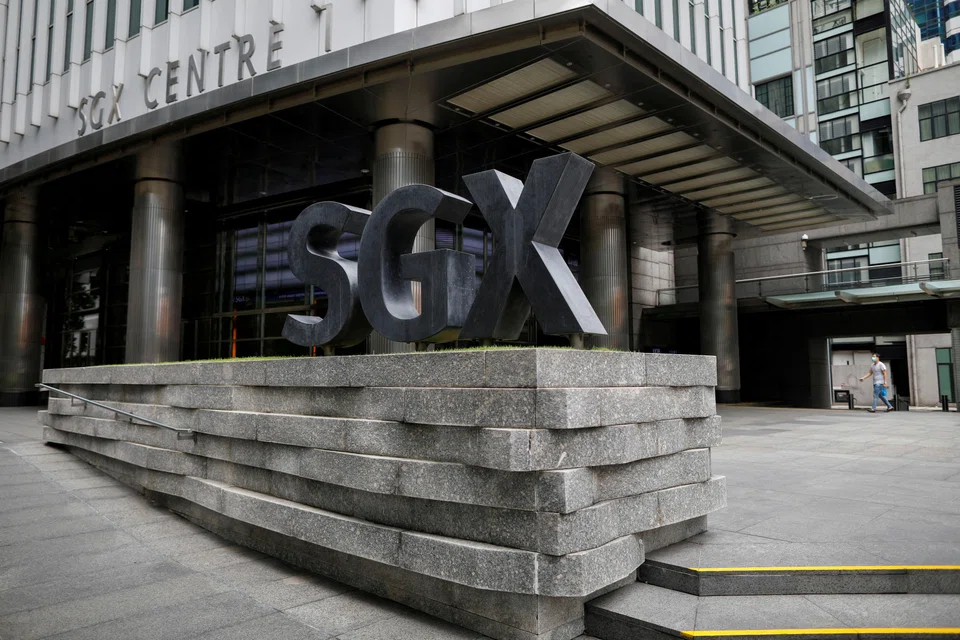
[SINGAPORE] For the abbreviated trading sessions between Dec 26 and Dec 31, institutions were net sellers of Singapore stocks, with net institutional outflow of S$134 million, extending the net outflow for 2025 to S$3.51 billion.
For the year, the Straits Times Index (STI) banks accounted for S$4.02 billion of net institutional outflow, while the remainder of the Singapore stock market booked net institutional inflow of S$510 million.
2025 institutional flows
Stocks that had the highest net institutional outflow in 2025 included UOB , OCBC , Mapletree Industrial Trust , CapitaLand Investment , Sembcorp Industries , ComfortDelGro Corporation , Genting Singapore , Mapletree Logistics Trust , Keppel DC Reit , and CapitaLand Ascendas Reit .
Meanwhile, Singtel , Keppel , City Developments Ltd , Singapore Technologies Engineering , UOL Group , Yangzijiang Financial Holding , Hongkong Land , iFAST Corporation , Jardine Matheson , and Suntec Reit led the net institutional inflow in 2025.
Share buybacks
Over the three-and-a-half trading days, 12 primary-listed companies conducted buybacks with a total consideration of S$5.6 million.
Keppel led the consideration tally with 200,000 shares acquired at an average price of S$10.32. This takes the number of shares bought back on the current mandate to 13.07 million.
As noted above, Keppel also booked the second-highest net institutional inflow across the Singapore stock market in 2025.
Secondary-listed Hongkong Land bought back 809,500 shares at an average price of S$6.99 apiece.
For 2025, the total buyback for consideration for more than 80 primary-listed companies totalled S$2.2 billion.
The full-year tally was led by UOB, OCBC, DBS, Singtel, Keppel, Sembcorp Industries, Singapore Technologies Engineering, Yangzijiang Shipbuilding (Holdings), Sats and Singapore Exchange .
Director transactions
Over the three-and-a-half trading days, more than 40 director interests and substantial shareholdings were filed.
Across more than 20 primary-listed stocks, directors or chief executive officers reported eight acquisitions and one disposal, while substantial shareholders recorded three acquisitions and two disposals.
Banyan Tree Holdings
On Dec 23, Far East Organization subsidiary Goodview Properties increased its substantial shareholding in Banyan Tree Holdings to 7.14 per cent from 6.93 per cent. It acquired 1,825,800 shares at S$0.615 apiece.
Its interest in Banyan Tree first crossed the 5 per cent threshold in August 2021, when shares of the hospitality company were trading at around S$0.31 – roughly half their current price, and crossed above the 6 per cent threshold on Nov 14.
Banyan Tree Holdings was among the cohort of Singapore-listed stocks that had significant trading turnover growth in the second half of 2025.
Its average daily turnover was close to S$650,000, quadrupling turnover from H1 2025, and more than tenfold 2024 levels. Banyan Tree also reported its H1 2025 attributable profit was S$9 million compared to S$6.2 million for H1 2024.
Ho Bee Land
On Dec 30, Ng Noi Hinoy, the spouse of Ho Bee Land executive chairman Chua Thian Poh, purchased 100,000 shares at an average price of S$2.20 per share.
This increased Chua’s deemed interest in Ho Bee Land to 75.72 per cent from 75.70 per cent.
Her previous acquisition was on Oct 17 with 120,000 shares acquired at S$2.17 per share.
On Nov 12, Ho Bee Land announced that it had acquired five residential development sites in Australia for A$96.6 million (S$83.3 million).
The sites in Queensland and Victoria will yield about 1,079 residential lots.
The projects will be funded by internal resources and bank loans.
Ho Bee Land noted the projects are in the group’s ordinary course of business, and are in line with the group’s objective of focusing on developing master-planned communities in the two Australian states.
Ho Bee Land was among the cohort of Singapore-listed stocks that had significant trading turnover growth in H2 2025, with an average daily turnover close to S$380,000, almost doubling the turnover from H1 2025 and quadrupling 2024 levels.
This followed its announcement of a net profit of S$49.8 million in H1 2025, up from S$8.8 million in H1 2024 supported by resilient recurring rental income, higher contributions from joint ventures and lower interest expenses.
Audience Analytics
Between Dec 22 and 23, Audience Analytics chairman and managing director William Ng purchased 170,000 shares, increasing his total interest to 83.87 per cent from 83.80 per cent.
This followed the acquisition of 201,1000 shares in the Catalist-listed company between Nov 6 and 7. Since Aug 26, he has increased his interest in the company from 83.58 per cent.
While maintaining a current market capitalisation of S$60 million, Audience Analytics’s 2025 trading turnover was double 2024 levels.
Audience Analytics listed in September 2021, with a S$0.30 offer price, and presently maintains a return on equity of 30 per cent and 12.5 times price/earnings ration ratio.
Accrelist
Between Dec 26 and 31, Accrelist executive chairman and managing director Terence Tea acquired 100,000 shares at S$0.048 per share.
This increased total interest in the Catalist-listed company from 29.65 per cent to 29.68 per cent.
Since Accrelist reported its H1 FY2026 (ended Sep 30) results on Nov 14, Tea has increased his total interest from 27.90 per cent.
Acma
On Dec 30, Acma proposed to place up to 8,478,199 new ordinary shares at S$0.04 each, raising about S$339,128.
The shares will be allotted to four private investors: Cui Wenyan, Peng Zhen, He Yuanxiang and Lu Shansong, who have no prior connection to the company.
The issue price was at a 29 per cent premium to the previous day’s market price, and the placement represents about 20 per cent of the existing share capital.
The placement is not underwritten, and no placement agent or commission is involved.
The shares will be issued under the general mandate approved at the FY2024 annual general meeting, and will rank equally with existing shares except for dividends declared before allotment.
Completion is subject to regulatory approvals and other conditions, and either party may terminate the agreement if these are not met.
The rationale is to improve liquidity and strengthen the company’s financial position, with proceeds mainly used for general working capital.
Acma is among the least traded stocks to be listed on SGX.
Following the disposal of the group’s China and Hong Kong plastic injection moulding and tool manufacturing operations in FY2024, the group has been exploring various alternatives to strengthen its financial position and/or the acquisition of new businesses.
King Wan Corporation
On Dec 17, King Wan Corporation entered into a subscription agreement to place 70 million new ordinary shares at S$0.05 each, raising S$3.5 million.
If approved, the shares will be allotted to three subscribers: Sek Ann Thong, Yap Bau Tan,and Christopher Tan.
After placement, the company’s issued share capital will increase to 768,353,740 shares, thus the placement shares represent about 10 per cent of the existing share capital.
The issue price was at a 3.85 per cent discount to the previous day’s market price.
King Wan Corporation noted that the placement will not be underwritten, and no placement agent was appointed.
The subscribers are investing for strategic purposes, and have no operational role in the company.
The funds raised will mainly support ongoing engineering projects and new opportunities, with 80 per cent of proceeds for project funding, and 20 per cent for working capital.
The rationale is to strengthen the company’s financial position and enhance flexibility for future growth.
On Nov 14, the provider of mechanical and engineering (M&E) services, rental services of mobile lavatories and other facilities, reported that its H1 FY2026 (ended Sep 30) profit after tax decreased to S$800,000, compared to S$2.4 million in H1 FY2025.
Based on its order book, M&E business remains the group’s core activity.
These segments will continue to generate steady income alongside portable lavatory rentals.
As at Nov 14, the group held about S$198.3 million in M&E contracts.
King Wan Corporation was among the cohort of Singapore-listed stocks that had significant trading turnover growth in H2 2025, with average daily turnover close to S$170,000, more than doubling turnover from H1 2025 and almost quadrupling 2024 levels.
Institutional investors also rotated in the stock in H2 2025, more than reversing net outflows in H1 2025.
The writer is the market strategist at Singapore Exchange (SGX). To read SGX’s market research reports, visit sgx.com/research
Decoding Asia newsletter: your guide to navigating Asia in a new global order. Sign up here to get Decoding Asia newsletter. Delivered to your inbox. Free.
Share with us your feedback on BT's products and services
TRENDING NOW

Once staunchly pro-China, Malaysian Chinese businesses are now distancing themselves from Beijing

Looking beyond looming CEO succession, should UOB potentially pursue a transformative merger?

Could stablecoins be the future of money?

Grab CEO’s wife Chloe Tong on life with Anthony Tan and finding her purpose

