Firmer rates, wealth gains likely to lift Singapore banks’ Q2 results
Local banks are in focus this week as investors look for clues on whether Q2 tailwinds can extend into the year

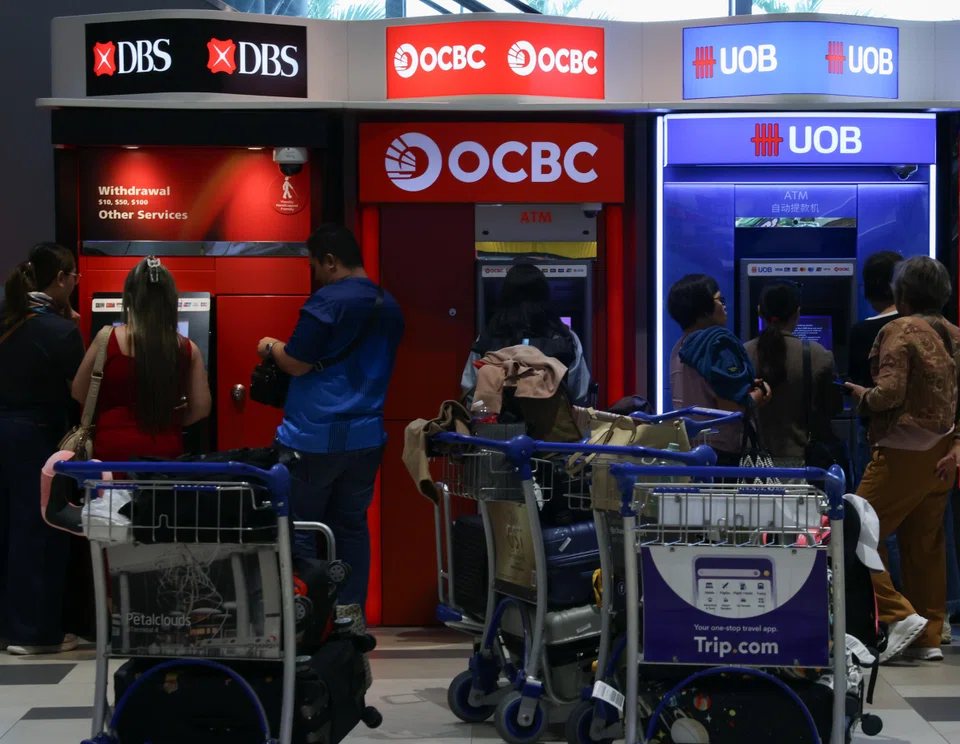
[SINGAPORE] Singapore’s banks are expected to report resilient second-quarter earnings this week, buoyed by higher interest rates, robust loan growth and strong wealth management income.
Investors will be watching for signs that pressure on net interest margins (NIMs) has yet to fully ease and whether earnings momentum can be sustained in the second half of 2026, said analysts.
DBS kicks off the reporting season on Aug 6, followed by OCBC and UOB on Aug 7.
Industry watchers expect to see a slowdown in margin compression after Singapore interest rates rose for the second consecutive month in June, while lending growth remained strong.
At the same time, buoyant equity markets and volatile trading conditions should support non-interest income through wealth management and treasury activities, they added.
NIMs, loan growth in focus
Singapore’s three-month Singapore Overnight Rate Average (Sora) was up one basis point on month to 1.07 per cent in June.
This was after six quarters during which flushed Singapore dollar liquidity and persistent belief in US dollar weakness kept front-end Singdollar rates low, said DBS Group Research analyst Lim Rui Wen.
This could slow the quarter-on-quarter decline in NIMs, although she cautions that the trend is “not yet over”.
For Glenn Thum, research manager at Phillip Securities Research, the “single most important line” to watch is how NIMs fare against what the banks have guided.
Specifically, he noted that UOB had previously guided its 2026 NIM to be 1.75 to 1.80 per cent, but already reported a 1.82 per cent NIM in the first quarter.
“Any beat there resets the whole sector narrative,” he said.
Loan growth in the local banking system was also strong in the second quarter.
In May, Singapore’s banking system loans grew 8.7 per cent on year, which could lead to the banks raising their loan growth guidance, Thum said.
Thilan Wickramasinghe, head of Singapore research and regional financials at Maybank Investment Banking Group, added: “We will be watching how this has translated into market share for each bank and looking for indicators on the sustainability of this momentum.”
Still, analysts cautioned against being overly optimistic.
Thum warned that a US rate hike will likely come because of reignited concerns of oil-driven inflation, which will result in slower loan growth and higher credit cost.
Citi analyst Tan Yong Hong also said markets may have been “euphoric” in pricing in NIM upside from the recent Sora rebound, noting that Singapore continues to have excess liquidity while spot Sora has since gone down.
Tan expects the banks will guide for asset yield pressure, given that they have limited room to reprice their cost of funds lower.
He sees greater downside risks for UOB and OCBC than DBS, which has given consistent guidance. He has a “buy” call on DBS.
He downgraded his call on OCBC to “neutral” on Jul 30, noting that its growth prospects are largely priced in.
Earlier in July, he also put a 30-day downside catalyst watch on UOB, as he expects the market had been “overly optimistic” on a turnaround of UOB’s non-interest income and asset quality.
Non-interest income “heavy lifting”
Analysts also expect non-interest income to provide a meaningful boost to earnings in the second quarter.
Maybank’s Wickramasinghe expects non-interest income to “do some heavy lifting” while DBS’ Lim said that the low cost of funding and ongoing volatility likely supported markets trading revenue.
Strong equity markets are also likely to support growth in wealth assets under management (AUM) alongside net new money inflows, Lim added.
Thum noted that the opportunity with wealth income is that it carries “little credit risk and spills over into treasury and bancassurance”.
But the risk is that fee income is a leveraged bet on markets, so a risk-asset drawdown would hit it hard, he said.
Wickramasinghe flagged that investors should pay attention to how much client wealth has been deployed into investments rather than remaining in cash, as that would provide a better gauge of underlying client sentiment, rather than just safe-haven demand.
For Jonathan Koh, director of research at UOB Kay Hian, the banks will likely post strong double-digit growth in wealth management fees for Q2, accentuated by a low base in the same period last year.
However, the banks may “tone down their expectations” on growth in wealth management for the rest of 2026, due to the recent pullback in technology stocks and the “on-and-off” nature of the Middle East conflict.
Even so, Koh has an “overweight” call on the banking sector, noting that the banks “deserve to trade at a premium for their structural resilience”.
He added that the sustainability of the banks’ dividend payouts is supported by their resilient earnings, strong capital adequacy and discipline in capital management.
Lim also noted that Singapore banks continue to benefit from robust dividend yields and strong investor sentiment, though she remains watchful on asset quality.
In particular, UOB will likely continue to be weighed by its higher quarter-on-quarter operating expenses, as well as its exposure to commercial real estate loans, Lim said.
DBS has a “buy” call on OCBC and “hold” on UOB.
Phillip’s Thum added that one-off gains from asset sales could possibly flatter UOB’s headline earnings.
Thum previously upgraded his call on the sector to “accumulate” from “neutral”, citing stronger-than-expected loan growth, bottoming rates and attractive dividends yields.
At market close on Monday (Aug 3), DBS gained 0.6 per cent or S$0.43 at S$74.45, OCBC fell 0.9 per cent or S$0.26 to S$28.87, and UOB lost 0.8 per cent or S$0.36 at S$43.04.