First Reit's problematic rent structure with master lessee brought to fore
THE dilutive rights issue proposed by the manager of First Reit last Monday to raise some S$158 million at a 50 per cent discount is a painful but necessary remedy to its persistent problems of tenant concentration and excessive rental support given by its master lessee Lippo Karawaci (LK).
Just as a tide going out reveals those who have been swimming naked, so Covid-19 also surfaced problems with First Reit's rental structure with LK.
LK itself has been plagued with weak operating cash flows and an inability to divest assets since a few years ago when its parent Lippo Group's US$21 billion Meikarta property project near Jakarta got embroiled in alleged bribery.
LK's financial problems had driven it to sell the manager of First Reit to OUE and OUE Lippo Healthcare in 2018, thus causing it to lose its former position as sponsor of the trust. Over time, LK has completely offloaded its stake in First Reit as well.
This, too, is problematic as LK no longer has aligned interests to help the underlying performance of the Reit.
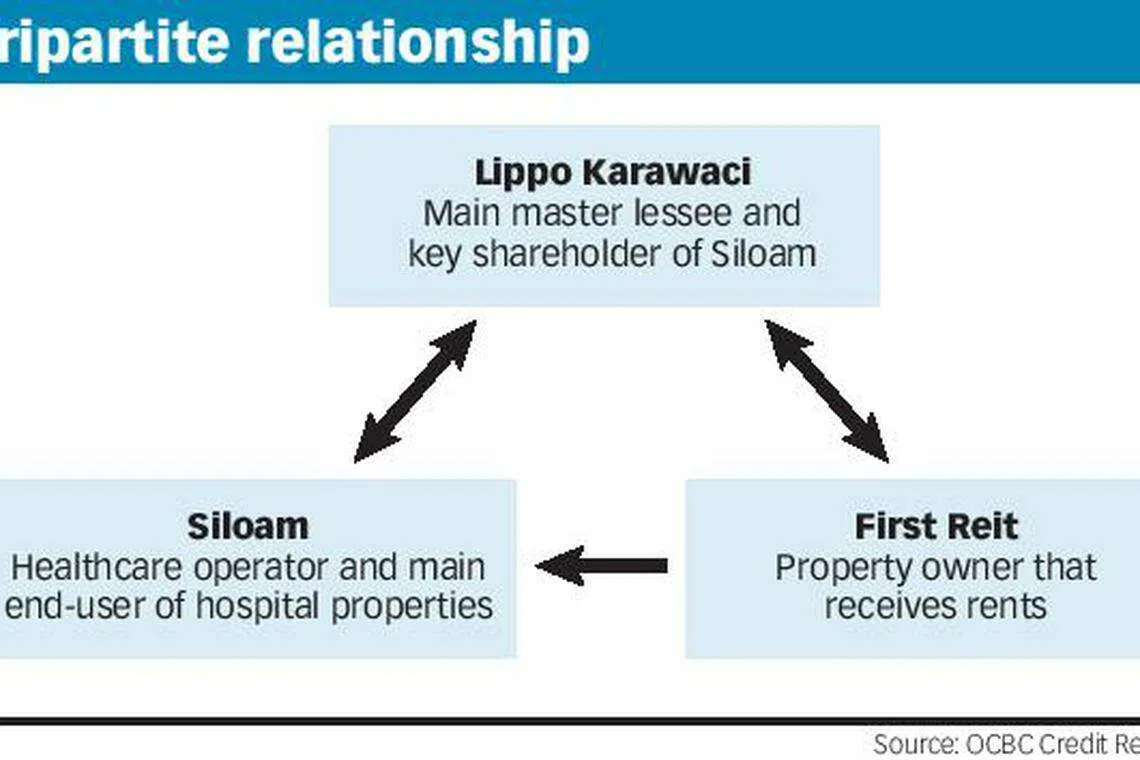
First Reit's rental structure is such that PT Siloam International Hospitals operates all of First Reit's hospitals in Indonesia and pays rents to LK in Indonesian rupiah. LK then tops it up before paying the rents to the Reit in Singapore dollars (SGD).
LK and its subsidiaries contribute about four-fifths of First Reit's total rental income. Yet, Siloam only pays around 20 per cent of the rental income received by First Reit, with the remaining of the rents topped up by LK.
Things took a turn for the worse with Covid-19 last year. The pandemic significantly impacted Siloam's revenues and led to a drastic decline in patient volumes across Indonesia. Revenues in some hospitals were down as much as 40 to 50 per cent from a year ago, and LK said it expected the impact to be significant and structural over the medium term.
While it might be surprising that hospitals could suffer in a pandemic, one analyst said safe distancing measures have constrained their capacity, and the treatment of Covid-19 patients "won't make a hospital profitable".
The pandemic also caused people to defer elective medical procedures, while hospitals also faced a surge in manpower and safety equipment costs. Indonesian media also reported delays in the government's reimbursement to hospitals for the cost of treating Covid-19 patients, which disrupted many operators' cash flows.
Making things worse was the rupiah's depreciation against the SGD in 2019. The rental support agreements have a currency peg component, which further pressurised LK to offer even more support to make up for the forex translation losses. These factors have made LK's rental subsidies for Siloam unsustainable.
LK said last June that a lease restructuring was critically needed.
With a number of LK's hospital leases making up about a quarter of the Reit's portfolio gross floor area coming due this December, LK has proposed to pay its rent in rupiah instead of SGD, and suggested for the rent to be calculated not based on 'base rent plus variable incentive', but just the higher of base or performance-based rent. Base rents of LK's hospitals will also be cut by about 37 per cent to S$50.9 million per annum.
The only upside for unitholders is that the rental escalation per annum will not be capped at 2 per cent of Singapore's CPI increase but a flat 4.5 per cent each year. This essentially reduces LK's current rents with a "promise" for future increases.
If unitholders okay the lease restructuring proposal ahead of the Jan 19 extraordinary general meeting, they can expect the Reit to experience a significant hit to its net property income and distribution per unit next year.
Other alternatives?
OCBC credit analysts Seow Zhi Qi and Ezien Hoo had noted in a Sept 2019 report that it is unlikely for the Reit to find a new master lessee that is also linked to a hospital operator, given the unique use of the healthcare properties.
Unlike a commercial tenant in arrears which can be easily evicted and replaced, the replacement of a hospital operator in this case is more challenging because the landlord cannot risk a loss or mix-up of patient records, among other complexities.
"Barring OUE stepping in to financially support LK and/or Siloam, we think the main way First Reit may get new master lessees is if Siloam gets sold to a new party," they said. They added that the Reit is constrained by whom it can lease the properties and may need to accept terms that are less favourable.
This may mean that unitholders' hands are tied in voting for or against the restructuring of the master lease agreements. The terms are painful to accept, but there are few other alternatives for the Reit.
Meanwhile, for the renounceable rights issue, unitholders can choose to sell their rights if they do not wish to take part, in which case their unitholding will be diluted. OUE and related parties have agreed to absorb the units not taken.
To be sure, the rights issue does not require unitholders' approval. It is carried out as a condition of the Reit's S$260 million refinancing facility. But the manager has said that the lease restructuring must be approved to enable the manager to proceed with the rights issue, as that will provide certainty of the valuations and cash flows of First Reit's assets.
More gloom may also lie ahead for holders of First Reit's 5.68 per cent perpetuals which face their first call in July 2021. The street believes that they will not be called, given First Reit's tight liquidity and lack of other large and and timely funding source. When contacted, the manager said it is still considering its options.
If the Reit does not call on the perps, the coupon rate will reset to about 4.39 per cent, the sum of the five-year SGD swap offer rate and initial spread of 392.5 basis points, Tan Chu Ren, fixed income analyst at Bondsupermart, said.
Perp holders are faced with a fork in the road - realising heavy losses if they sell or holding onto the bonds with a chance of default. But Mr Tan recommends perp holders to continue holding on to the security, as their current prices, at their expected yields to next call, still look attractive.
"The highest concern for bondholders would be whether First Reit will default on the bonds. The default risk lies on LK, as a LK default would result in an immediate loss of about 72 per cent of First Reit's rental income and a chain of problems."
But he believes that First Reit will eventually issue new debt to call the existing perp, although that might take years, after the Covid-19 storm has passed.