

Flagging investor interest may make 2024 a fine vintage year for private markets
Even so, experts say a consistent allocation strategy works better than trying to time the market


WEAKER sentiment has lowered asset valuations in some parts of the private markets, suggesting that now is a good time to invest. Experts caution, however, that because of the way private market funds call capital and invest it, a consistent allocation strategy works better than trying to time the market.
Much like a fine wine, a private equity investment improves over time and under a skilled hand, said Walter Zhang, head of private markets investor relations for Asia at Indosuez Wealth Management.
“Vintage is one of the key factors to assess in making the soundest decisions,” he added. “Funds across different vintages are exposed to different economic cycles with varying investment and exit environments, leading to fund performance dispersion across vintages.”
Sean Yoo, partner and Asia-Pacific head at investment manager Federated Hermes, noted that private equity funds formed in years immediately after the global financial crisis had better performance.
While this could be because valuations are lower in such periods, there is also greater risk. Sanket Sinha, managing director and global head of asset management for investment group Lighthouse Canton, said investments in downturns “can potentially also see higher chances of failure if the investee companies are unable to recover from the troughs”.
Data from private markets specialist Preqin, meanwhile, showed significant underperformance of private equity funds from 2021.
“This is due to the higher deployment of investments at market peak when valuations were high,” said Angela Lai, vice-president and head of Asia-Pacific and valuations at Preqin.
That year, interest in private equity funds hit a peak. Flush with money, such funds were bidding up asset prices. As the frenzy faded, these same funds struggled to find attractive exit opportunities.
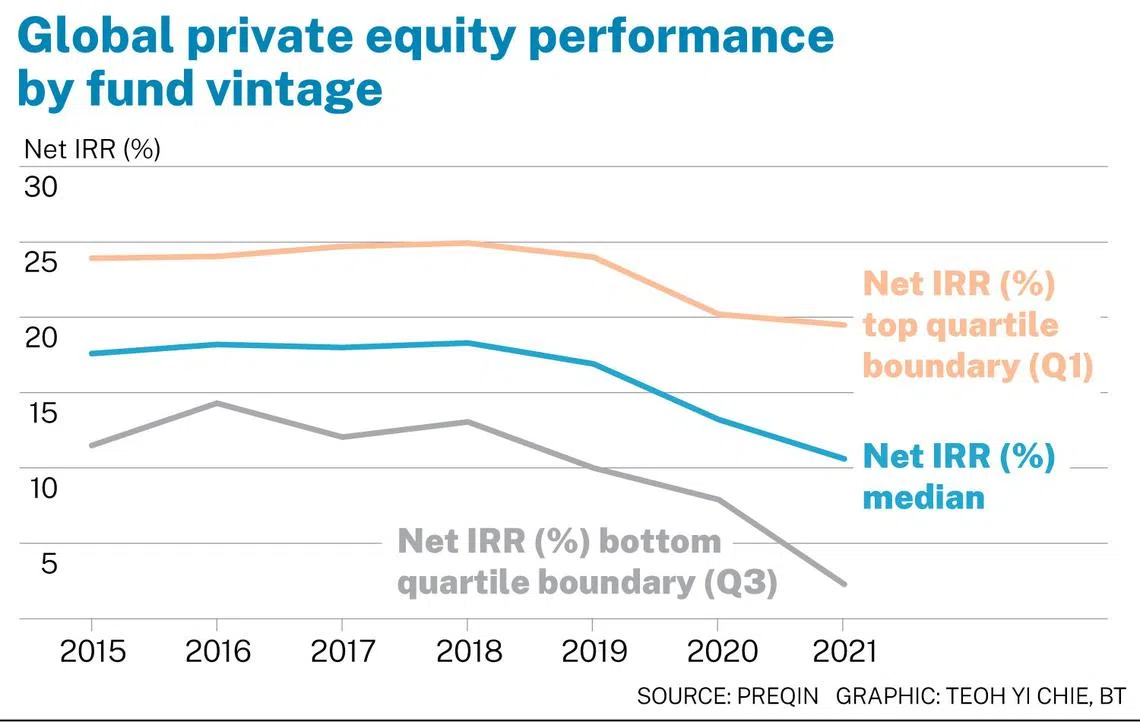
The 2021 vintage is still young, of course, which means the portfolio is almost entirely unrealised. Returns could still improve from here, Lai said, although they could also worsen.
She noted that to protect their portfolios, some investors may now be thinking of “rebalancing to add the newer vintages, such as the current ones still open to investment, since they may capture opportunities at lower entry points”.

Flagging interest in private equity has some market watchers predicting golden vintages for 2023, 2024 and even 2025.
“If you look at the overall capital that is going into private markets, we’re definitely off the spike years,” said Audrey The, managing director at investment advisory Cambridge Associates. “We would describe it as a more reasonable time in terms of valuations and rational behaviour.”
Fund vintage is not a straightforward investment factor, though. The general partners (GPs) who manage a private markets fund usually raise money from limited partners (LPs) without providing a complete picture of what the money will be invested in, or when it will be fully invested.
Sometimes, a fund might already be seeded with a few investments. At other times, the LPs commit money to a blind pool, and the GPs merely inform the LPs of some targets they have in mind.
“In any vintage year, the manager is investing across three to five years,” The said. “It’s very hard to time the private markets. Even if you commit to a manager, you’re still giving that manager… that decision on when to call capital.”
The’s role involves designing, building and overseeing private investment portfolios for institutional and private clients. In that role, she said Cambridge Associates will “still lean into areas where we see relatively more attractive pockets of opportunity”.

Manager selection, however, is also important. This includes understanding a manager’s discipline and deployment pace historically.
Zhang of Indosuez added that macroeconomic trends or economic cycles might stretch beyond the deployment period of a single fund, which means that timing the entry point into the private markets can be quite challenging.
“Instead of looking for the right entry point for a single allocation, we believe that it is important for clients to keep a regular investment pace in private markets to ensure vintage diversification,” he said. “This would provide clients with diversified exposure to different economic cycles.”

Michelle Shi, head of alternative investment solutions for Asia-Pacific at UBS Global Wealth Management, has similar advice for clients.
“It is not possible to predict the success of any specific vintage year,” she said, adding that investors are better off building their private market portfolios with consistent allocations across the years. “This would help to manage risk, optimise returns and (create) a balanced investment portfolio under various market conditions.”
At Federated Hermes, Yoo said that the approach is also to diversify across geographies – which would automatically diversify the economic cycle exposure of a portfolio to some extent.
Frank Danieli, head of credit and lending at alternative asset manager MA Financial, said that in the private credit space, investors will need to adapt based on the type of fund they select.
“For closed-end funds focused on more opportunistic styles of credit, vintage really matters. Throughout a cycle, there will be years with greater depth of opportunity and greater dislocation that astute investors can capitalise on,” he said.

Some private credit funds, however, focus on what the industry calls “performing credit”. The objective is to deliver stable premiums to public market credit through the cycle, stepping in to fill lending voids.
Danieli said performing credit now makes up more than half of total private credit assets under management globally, with different fund structures emerging – including semi-liquid open-ended structures.
“Vintage matters less than the types of lending being undertaken, portfolio scale, proprietary origination channels and manager capabilities to operate in different conditions, including workout capabilities to see a portfolio through more difficult macroeconomic environments,” he said.
TRENDING NOW

Inside Jensen Huang’s last hours as Nvidia CEO

Higher rates, weaker spending: Is the Philippines entering stagflation?

‘I’ll be buying more’: Singapore investors pour into Nvidia shares on Jensen Huang’s exit

Demand, tech capabilities position Apac and AI as Skyscanner’s next growth frontiers: CEO Bryan Batista

