Flight to quality, dividends lift DBS and OCBC to all-time highs, but analysts warn valuations look expensive
Among Singapore banks, UOB lags peers as investors await greater earnings clarity

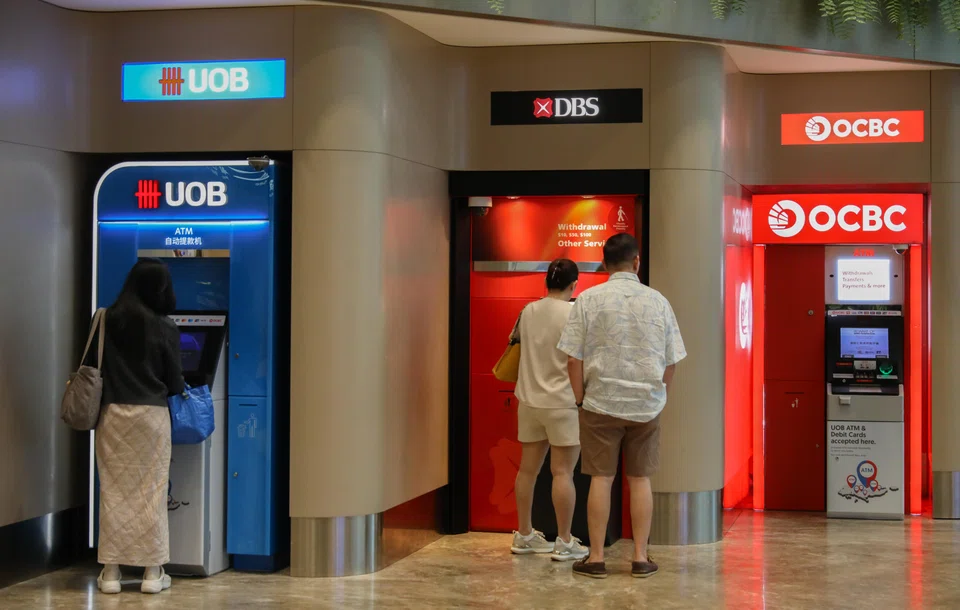
[SINGAPORE] Attractive dividend yields have pushed DBS and OCBC to fresh all-time highs, and will likely continue to support share prices going forward, even as analysts warn that valuations at the two lenders are starting to look stretched.
Both banks crossed their respective price targets following a rally earlier this week, prompting some analysts to caution that further upside may be limited.
Meanwhile, analysts are mostly neutral on UOB , as they expect investors need more clarity following a negative earnings surprise in the third quarter.
Share prices of DBS and OCBC hit all-time highs yet again in the first few days of 2026. DBS rose to as much as S$58.80 on Wednesday (Jan 7). OCBC crossed S$20 for the first time a day earlier, reaching as high as S$20.25 on Wednesday.
On Thursday, DBS closed at S$57.34 and OCBC at S$20.17. According to a Bloomberg analyst consensus as at Jan 7, their respective 12-month price targets were S$58.13 and S$19.65.
Some 55.6 per cent of analysts had “buy” calls on DBS, while 61.1 per cent had “buy” calls on OCBC.
The story at UOB is a different one, however, with the counter having “hold” calls from 64.7 per cent of analysts in the Bloomberg consensus.
UOB took a hit after the bank took pre-emptive general allowances in its Q3 results, but has been steadily rising since.
The counter closed at S$36.01 on Wednesday, above its 12-month price target of S$35.97 but below its peak share price of S$39.20 in February 2025.
Flight to quality
Analysts noted that DBS and OCBC have benefited from the flight to quality to Singapore-dollar assets in recent months.
Jayden Vantarakis, head of Asean equity research at Macquarie Capital, said that while equity markets have generally been positive, investors view the Singapore dollar as a strong asset to hold in the current volatile environment, especially given strong macroeconomic data.
Lorraine Tan, director of Asia equity research at Morningstar, said that with interest rates expected to fall, quality companies with attractive dividend yields are being seen as a proxy to holding Singapore government bonds.
She views the current share prices of DBS and OCBC as “quite rich” on an intrinsic valuation basis. Nevertheless, their dividend yields at around 5 per cent remain attractive.
“We also think that both have room to continue share buybacks, although dividend payouts may stay at the current level,” Tan said. “This still should lead to dividend growth as long as earnings are stable.”
Thilan Wickramasinghe, head of research at Maybank Securities, said that furthermore, the market is likely factoring in the fact that earnings momentum for 2026 will not be as negative as was expected earlier.
While falling interest rates will contract margins, lower rates and a domestic construction boom should drive credit demand and support non-interest income growth, he said.
For OCBC in particular, CGS International analyst Tay Wee Kuang said investors are likely holding out for their second-half dividend.
The bank had a 50 per cent payout ratio in H1 2025, which means their committed 60 per cent payout ratio for 2025 will likely be back-loaded into the second half, Tay said.
Investors may also be optimistic about plans that OCBC’s new chief executive Tan Teck Long will bring, he added.
But Wickramasinghe said UOB is excluded from these near-term benefits due to bank-specific higher cost assumptions.
This is mainly from ongoing consumer banking investments, which dilute productivity gains and delay earnings per share upside, he noted.
Macquarie’s Vantarakis said investors are also still unsure whether UOB’s higher provision episode from its Q3 results is over.
“Earnings drive dividends, and investors are seeking yield; this has created less clarity for UOB,” he said.
“We think the market will want to see proof of improving asset quality before the shares rerate and catch up to peers.”
Dividend yields
Looking ahead, the Singapore banks will continue to do well as they still provide attractive yields at current prices, analysts said.
Nevertheless, an analyst from RHB said the dividend yield spread that the sector offers over the government bond yield is approaching the long-term mean level, which may reduce the overall attractiveness of the sector.
Vantarakis said DBS appears overvalued, adding that investors may be underestimating the earnings headwinds from falling interest rates this year.
Against this backdrop, Morningstar’s Tan expects Singapore real estate investment trusts (Reits) to have better upside value than the banks at this stage in the cycle.
In particular, she pointed to Keppel Reit as a beneficiary of tightening supply in high-quality office space in Singapore, while Mapletree Industrial Trust is well-placed to ride secular growth in data centres.