

F&N to switch to sustainable packaging produced by its subsidiary

Janice Lim
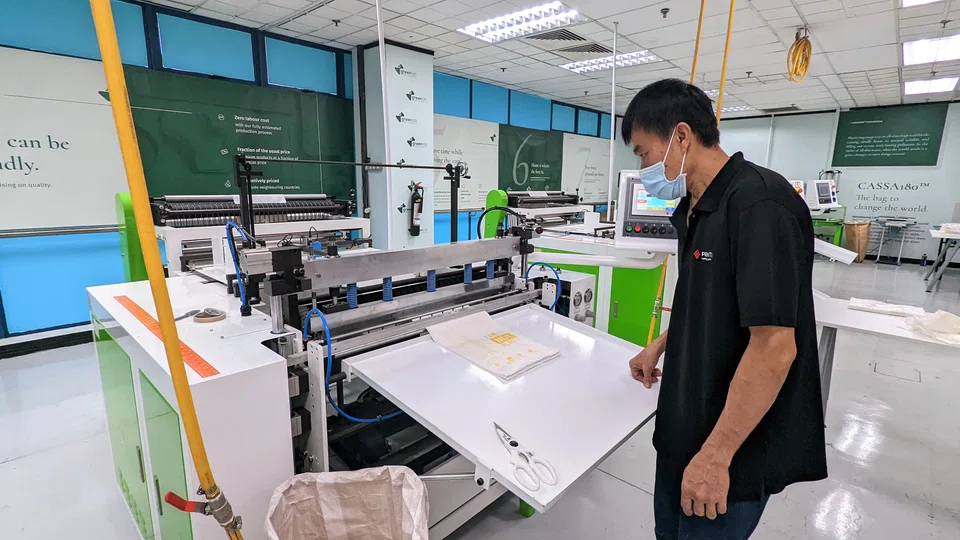
DRINKS manufacturer Fraser and Neave (F&N) will be switching the packaging of its in-house brands and products to sustainable alternatives produced by its indirect subsidiary, Print Lab, F&N chief executive officer Hui Choon Kit has said.
“We see that as an advantage. Consumers who care see it as an advantage,” he added.
Some of these alternatives include a plastic bag substitute made entirely out of the roots of the cassava plant, paper bags that are recyclable or sustainably sourced, as well as compostable food packaging, all of which are produced in a new eco-friendly manufacturing plant called the Green Lab.
Launched on Thursday (May 12), the 200,000 sq ft facility in Tuas will be able to produce a maximum of 250 million Kraft paper bags, as well as between 25 and 50 million cassava bags every year, said Muralikrishnan Rangan, the co-founder of the facility.
Bags made from cassava can decompose in 180 seconds when immersed in boiling water, or in 180 days when buried underground, he said.
He declined to reveal the amount invested into the facility, except that it was “sizable”. New machines were purchased to manufacture the cassava bags and the Kraft paper bags; other machines, previously used to print magazines and books, were re-tooled for the production of eco-friendly packaging.
The Green Lab is a collaboration between printing company Print Lab (of which Rangan is group chief executive) and digital printing service Times Printers, a member of Times Publishing Group.
Times Publishing, which is wholly owned by beverage company Fraser and Neave, bought a 60 per cent stake in Print Lab in March 2019 for S$24.5 million.
Speaking to The Business Times on Thursday after the launch of the facility, F&N’s Hui said some of the company’s brands are finalising the technical aspects of the switch to green alternatives. He declined to name the products that are changing their packaging for competitive reasons, but said F&N aims to switch to recyclable materials for more than 90 per cent of its packaging.
Besides the brands under F&N, Siew Peng Yim, chief executive officer of Times Publishing, said Print Lab and Times Publishing are looking into partnership opportunities with brands in the wider TCC Group, a beverage and real estate conglomerate based in Thailand. F&N and its subsidiaries are part of its network of companies.
Hui said F&N is working to supply Green Lab’s products to “large food and beverage companies” — some of whom are partners of F&N. Green Lab is thus a stockist for these companies, he said; he declined to name the companies.
Efforts are being made to push the message that made-in-Singapore packaging can be cost-effective because of the use of automation. Traditionally, companies import their packaging materials from countries such as China.
Rangan said that besides the reduced impact on the environment, having made-in-Singapore packaging would help relieve the supply crunch triggered by the Covid-19 pandemic.
Companies are now moving away from having one major production plant and shipping their output to the rest of the world; instead, they are looking into setting up several scattered facilities to reduce the lag time from warehousing to shipping.
“When you buy from China or Vietnam, there is a carbon footprint, and together right now with the disruption in global supply chain, all these affects how these materials are being transported,” said Siew.






