

Frasers Centrepoint Trust rides on resilience of prime suburban malls in Singapore
CEO of FCT’s manager says big is better to keep ahead of competition, sees progressive wage model increasing propensity to spend in catchment areas

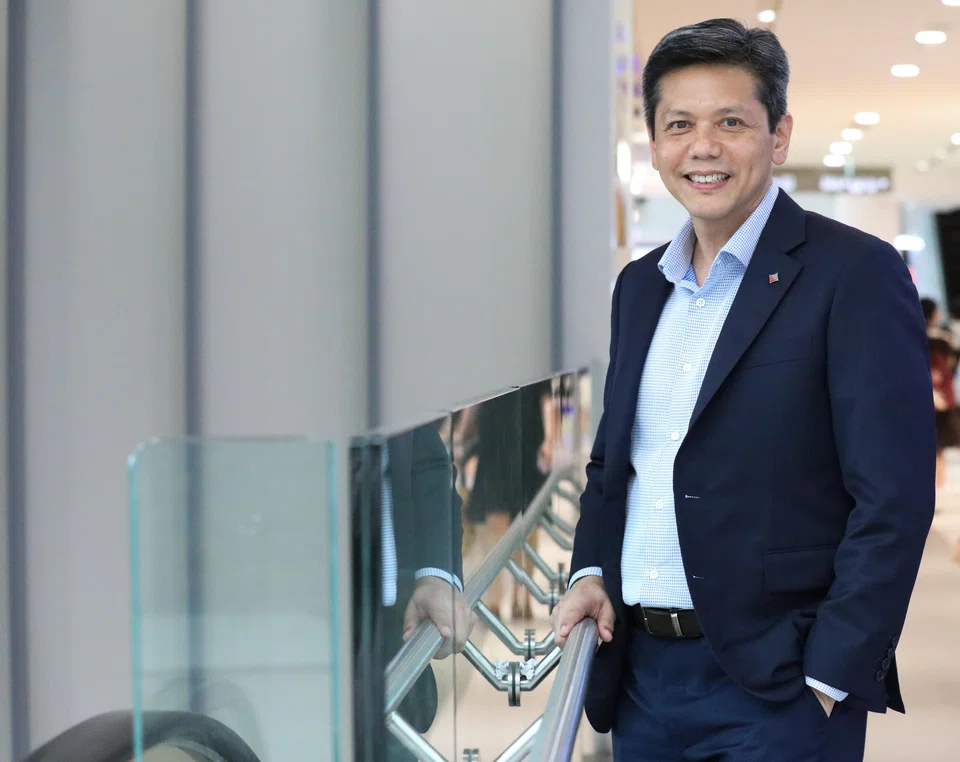
RICHARD Ng, the chief executive officer of the manager of Frasers Centrepoint Trust (FCT) , has seen a proliferation of malls in Singapore, including those that are part of integrated developments, over the past two decades.
Amid greater competition among malls, the real estate investment trust (Reit) has focused on investing in suburban shopping centres that are located next to, above or very near an MRT station – and in some cases, a bus interchange as well. It has also decided to concentrate on big malls, using sheer size to gain a wider catchment area.
Said Ng: “If you have a larger mall, you have the ability to provide a very good range of offerings and capture a wider catchment. Today, across our portfolio of nine shopping centres, we are serving a catchment of around three million people within a 3 km radius of all our malls. That’s about half the population size of Singapore.”
He added: “Four of our malls – whether we own them fully or partially – are among the 10 largest prime suburban malls in Singapore by net lettable area (NLA); and that makes a difference.” The four are: Nex in Serangoon Central, Northpoint City (of which FCT owns the North Wing) in Yishun, Causeway Point in Woodlands and Waterway Point in Punggol.
Reflecting the emphasis on having large, well-located shopping centres, FCT has reconstituted its portfolio while increasing its assets under management (AUM) to about S$7.1 billion, from S$2.8 billion as at the end of the 2018 financial year.
Over the past six years, the Reit has made acquisitions totalling nearly S$4.8 billion. These comprise 50 per cent stakes each in Nex and Waterway Point, and full ownership of the AsiaRetail Fund portfolio: Tampines 1, Tiong Bahru Plaza (including the Central Plaza office block), Century Square in Tampines, Hougang Mall, and White Sands in Pasir Ris.
During this period, it also divested four malls in separate deals for a total of S$776 million. Three properties – Bedok Point, Anchorpoint in Alexandra Road and YewTee Point in Choa Chu Kang – each had an NLA of less than 90,000 square feet (sq ft). “They were not very competitive because of their size and attributes,” said Ng.
Changi City Point, in Changi Business Park, was bigger at 211,845 sq ft, and near the Expo MRT station. Yet FCT decided to sell it. “With both the business park and the nearby Singapore Expo shut during Covid, we realised this mall did not have a strong residential catchment,” noted Ng.
“Not only have we grown, but we have also improved the quality of our portfolio, switching from non-core assets to bigger malls and better-located malls with stronger attributes. And that, too, during a very challenging period – through a pandemic, followed by extremely high interest rates. I think that is a testament to what we can do as FCT.”
“We have no forex exposure. We are in just one sector. So it is easy to understand our product.”
Richard Ng, CEO of the manager of FCT
FCT was listed on the Singapore Exchange in July 2006 with three malls acquired from its sponsor, Frasers Centrepoint (now known as Frasers Property), for S$915 million. The three malls in its initial portfolio were: Causeway Point in Woodlands, Northpoint Shopping Centre (now part of Northpoint City North Wing) in Yishun and Anchorpoint.
Ng, however, is not fixated on reaching a target AUM size for the trust. “We don’t grow just for the sake of growing.”
Frasers Property owns 39.6 per cent of FCT. It also fully owns Frasers Centrepoint Asset Management (FCAM), the manager of FCT.
Inclusion in STI
The trust has a market capitalisation of about S$4.1 billion. FCT’s inclusion in the Straits Times Index on Mar 18, 2024, has boosted its visibility to institutional investors, said Ng. “Institutional investors like the fact that we are focused. We are the only Reit that is purely focused on prime suburban retail malls in Singapore.”
“We have no forex exposure. We are in just one sector. So it is easy to understand our product as well,” he added. “Retail investors are familiar with our malls. They’re something close to home, something they can feel and touch.”
FCT’s malls also have a high “necessity retail” content, boosting their resilience. Slightly more than half of FCT’s tenants by gross rental income remained open during the “circuit breaker” period of the Covid pandemic, because they were classified as essential trades and services by the Ministry of Health.
Ng, 56, has been the CEO of FCAM since July 2019. Before that, he had spent about 15 months at Frasers Property, as head of asset management for Singapore. From November 2013 to February 2018, he was the executive director of asset management at PGIM (Singapore). Prior to that, he was the head of asset management at CapitaLand Mall Trust.
Omni-channel boost
The Singapore retail property veteran said omni-channel marketing is helping retailers at FCT’s malls to boost sales and improve their productivity. “Because all our malls are located so close to the catchment market, retailers can use the same space where they are doing their brick-and-mortar business as a fulfilment centre for their online business,” he said.
“If a restaurant just depends on customers coming in to dine, its sales would be limited by the number of seats. But with the ability to also trade online simultaneously, its sales will grow while still using the same space. So sales productivity improves.”
Omni-channel marketing, which has already been adopted by food and beverage outlets, is increasingly being embraced by fashion retailers, Ng added.
He partly credits the strategy for the growth in tenants’ sales.
On a same-portfolio basis, the quantum of tenants’ sales at FCT’s malls in FY2023 was up 19 per cent from FY2019 before the Covid-19 pandemic. Over the same period, gross rental income rose 3 per cent.
The increase in rental income has lagged sales growth, partly due to the typical three-year duration of mall leases. “So the rental a tenant is paying today could be based on rates agreed two or three years ago, reflecting some of the drag in the Singapore retail business in 2020-2022 amid varying restrictions during the pandemic,” said Ng.
However, FCT seems to have turned the corner, with positive rental reversion of 7.5 per cent in the first half of FY2024, up from 4.7 per cent in FY2023 and 4.2 per cent in FY2022.
PWM will help underpin retail sales growth
Ng remains upbeat on the outlook for the Singapore retail sector, especially for prime suburban malls. “The progressive wage model (PWM) will be a key driver in underpinning retail sales growth,” said Ng.
PWM is a wage-ladder tied to skill and productivity improvements for lower-wage workers that has been implemented in various sectors including cleaning, security, retail and food services.
Ng said the PWM and other assistance provided by the government will increase the propensity to spend.
Asked about the impact to Causeway Point from the upcoming Johor Bahru-Singapore Rapid Transit System Link station in Woodlands North, Ng acknowledged that there is some potential leakage of shopper dollars but does not expect a significant impact on the mall.
FCT will press ahead with its three-pillar growth strategy: organic growth (such as through changing the tenant mix, positive rental reversion and greater cost efficiency), acquisitions and asset enhancement initiatives (AEIs).
In August this year, the trust completed a 15-month-long refurbishment of Tampines 1. Major works included filling out a sunken plaza on Level 1 and building retail space over it. The total NLA of the mall increased by 9,000 sq ft to about 278,000 sq ft.
Some 68 new-to-mall concepts have been brought in, representing 27 per cent of the mall’s total NLA. These include local clothing brand Love, Bonito and artisanal cake shop Fieldnotes. The AEI cost S$38 million with a projected return on investment of about 8 per cent.
TRENDING NOW

NEA identifies 7 firms responsible for haze fires, notices issued urging action: Grace Fu
DBS remains analysts’ pick ahead of Q3 earnings after Singapore banks’ share slump
High Court rules against Julius Baer’s Singapore trust arm in US$50 million family trust dispute

Could stablecoins be the future of money?

