

From pipes to medtech, Vicplas International eyes expansion in China and Americas

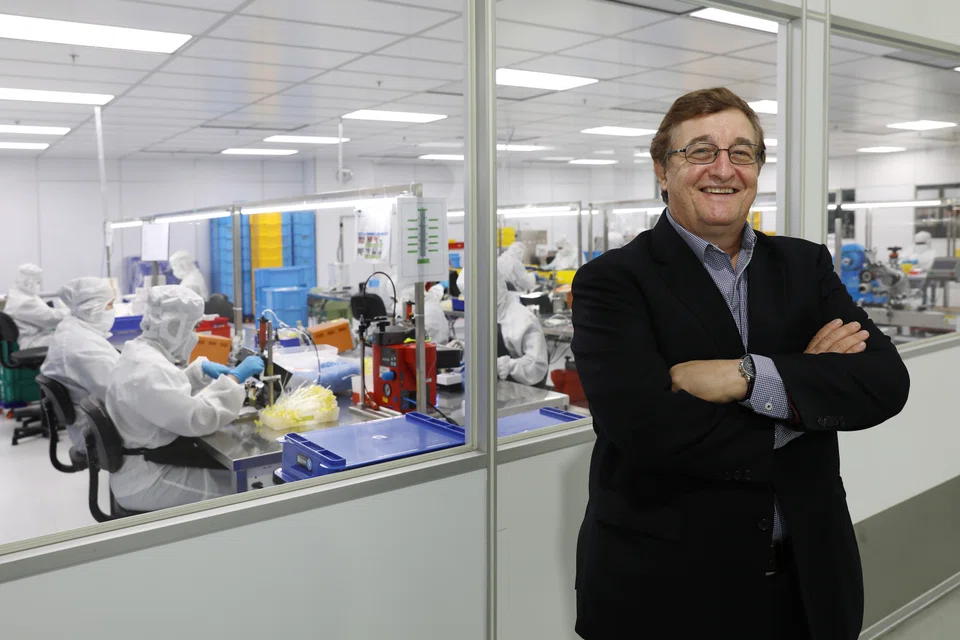
DESPITE nervy times in China, mainboard-listed Vicplas International will stick to its plan to open its third and latest medical technology (medtech) manufacturing outlet in Changzhou next month — ramping up its medical devices production capacity in the country by 60 per cent.
It currently already operates 2 medical devices manufacturing plants there: one in Changzhou and another in Xiamen.
“Quite frankly, we’ve maxed out the capacity in our other (Changzhou) plant. We have a number of projects that are reaching the end of their commercialisation phase,” said deputy group chief executive officer of Vicplas International, Walter Tarca.
With 2 projects heading into mass production, the opening of the latest 7,000 sqm plant will start production from the day doors open in June.
The plant, along with its cleanrooms where medical devices are produced, is now in the validation phase with auditors.
Tarca said he is conscious of potential supply chain issues, but believes them to be manageable.
China is seeing some of its harshest pandemic restrictions yet, and Beijing and Shanghai are tightening curbs in line with the county's strict zero-Covid stance. According to media reports, the Shanghai port had been running at about half its capacity for a month since the city-wide lockdown began in April.
Tarca said the port is now fully active and things are moving faster than before, although there are congestions and longer wait times to contend with.
Some 80 per cent of the group’s products manufactured in China pass through Shanghai, while the rest go through the Nanjing port.
“The biggest disruption I guess for companies like ours and for all companies is the supply chain,” he said. “There’s quite a lot of backlog, ships waiting to be loaded and unloaded.”
Though the costs of logistics have gone up, these are borne by customers and don't affect the group’s profits. Meanwhile, much of the raw materials needed for manufacturing comes from the Asian region, making them logistically easier to procure.
“The majority of our products are being sold to the US and Europe, so they have long distances to travel. Whereas for the inputs, a lot of them come from Japan and Asia — so much closer to home,” he said.
Other than manufacturing plants in China, it also operates a 2,600 sqm plant in Kington, in the United Kingdom; as well as a 7,410 sqm plant at its corporate headquarters in Singapore. It has commercial offices in Singapore, Shanghai, Kington, and Connecticut in the US.
The group is in “advanced stage talks” to build another manufacturing plant near the United States, in a location such as Mexico or Costa Rica. Tarca expects this plant to be up and running within the next 2 years.
“We see a need to have a plot closer to the US, as the US is the primary medical device market in the world,” he said. “Our customers are very excited…that we have made the strategic decision to come closer to them.”
Locating closer to the US would offer greater flexibility to sell into the US and Europe markets. The group doesn’t have such flexibility at the moment and this is one of the areas it is trying to improve on, he added.
Transitioning to medtech
A nearly 40-year-old pipe making company, Vicplas had shifted its focus towards medical devices only in the last 7 years or so. Its business focus is split at about 70 per cent for the medical devices segment and 30 per cent on the pipes and pipe fittings segment, Tarca said.
The medtech contract manufacturing business is parked in wholly owned subsidiary Forefront Medical Technologies, which it acquired in 2008 and of which Tarca is president.
Out of the group’s 1,100 employees, more than 900 are with Forefront Medical Technologies.
In 2015, the group recorded revenue of S$74.1 million. Of this, S$23.3 million came from the medical devices segment. In 2021, revenue was up to S$113.9 million and S$80.2 million was from the medical devices segment. The 2021 figure was the highest-ever revenue figure for the segment.
Over the past 5 financial years (FY2017 to FY2021), the group’s revenue has seen a compound annual growth rate (CAGR) of 15.7 per cent. Steady growth in the medical devices segment has contributed to that.
In its 2021 annual report, Vicplas said the medtech contract manufacturing market is expected to show a CAGR of 11.4 per cent through to 2025. This is attributable to the ageing population, increased demand for improved healthcare in developing markets, and increased willingness by product owners to outsource manufacturing to trusted partners that can fully support product and process innovation.
“The big companies, they don't want to keep investing in factories. It’s not efficient for them. What they want to focus on is sales and marketing, primary research and development; so they're quite happy to outsource the products to trusted contract manufacturers. That's what we want to be,” Tarca said.
One of the attributes that gives the group an edge is being “highly vertically integrated”. When a client comes with a concept, Vicplas is able to design for manufacturability, prototype, create the tools, manufacture and assemble the product.
“One of the things they (customers) like about us is that we're very innovative. We find a way to get things done,” he added.
To grow its revenue streams, Vicplas aims to dive deeper into the extrusion space where it makes medical tubings. It already makes such tubings for a variety of medical areas such as sleep apnoea treatment, ventilators, drug delivery systems, and infusion devices.
“One of the areas we see ourselves moving in is making small things,” Tarca said. “We’re already in that space, but we want to get more involved.”
Covid-19 more bane than boon
Shares of Vicplas had surged to as high as S$0.60 in 2020, possibly as investors flocked to healthcare plays thinking they would benefit from the pandemic.
They have since fallen back to close at S$0.20 on Friday (May 27), down 15.2 per cent year to date. That gives the counter a market capitalisation of close to S$100 million, with a price-to-earnings ratio of 9.7 and a yield of 2.3 per cent.
Tarca said tying the success of the medtech industry to the Covid-19 pandemic is a common misconception.
“I think (Covid-19) has been a negative factor for us,” he said. “We don’t make ventilators, test kits, or rubber gloves.”
Most of the items Vicplus produces serve long-term needs in the medical industry: airway management, surgical devices, orthodontics, endoscopy, drug delivery and diagnostics, among them.
In fact, many of the group’s products support elective surgeries. For instance, it produces infusion devices used for chemotherapy — something that saw a dip in demand during the pandemic as healthcare in general steered its resources towards batting Covid-19.
“Now of course with things opening up and Covid-19 more under control, those orders have come back, and we’re currently in backorder for a lot of the products,” he said. “We’re trying to catch up, which is a good thing.”
TRENDING NOW
Prima to move out of historic Keppel Road flour mill building in 2028

Grab CEO’s wife Chloe Tong on life with Anthony Tan and finding her purpose

OCBC sheds S$8 billion in value as shares close nearly 6% down; analysts cautious on banks

As Asia’s food delivery giants rejig the pie, who will win the market?

