

Further downside expected for the Philadelphia Semiconductor Index
It could continue to pull back towards the 6,400 level, representing a 10.6% downside from the current price

THE Philadelphia Semiconductor Index (SOX), a modified capitalisation-weighted index which tracks the performance of US-listed equities in the semiconductor sector, traded in a range between 7,460 points and 8,500 points in Q1 2026, before breaking below the 7,460 level on Mar 30, 2026.
At the time of writing, the SOX is up 0.8 per cent year-to-date, outperforming the broader tech sector, with the Nasdaq down 10.5 per cent over the same period.
The recent weakness of the SOX is largely due to several factors, including the ongoing Iran conflict, a pivot in rate-cut expectations and Google’s TurboQuant weighing on memory stocks.
Firstly, the escalation of the Iran war has been a key catalyst. With Brent oil prices rising by more than 50 per cent to above US$100 per barrel, this has increased operational costs for energy intensive chip fabrication plants.
The US 10-Year Treasury yield has also risen by more than 90 basis points to above 4.3 per cent since the start of the conflict, weighing on the valuations of semiconductor stocks.
Secondly, the sharp spike in oil prices from the Iran war has rekindled inflation concerns, with market participants repricing interest-rate expectations for this year. The market is currently pricing in no rate cuts this year, down from expectations of 50 basis points of easing prior to the war.
This shift to a “higher for longer” narrative has increased the cost of capital for semiconductor stocks and led to a de-rating in valuation multiples across the sector.
Thirdly, sector sentiment has been impacted by Google’s unveiling of TurboQuant, a new compression method that it claims could reduce the amount of memory required to run large language models (LLMs) by six times.
Investors fear that this could reduce the demand for artificial intelligence memory chips, which have been a critical component in training large LLMs.

This development puts pressure on memory stocks such as Micron, which experienced a drawdown of over 15 per cent.
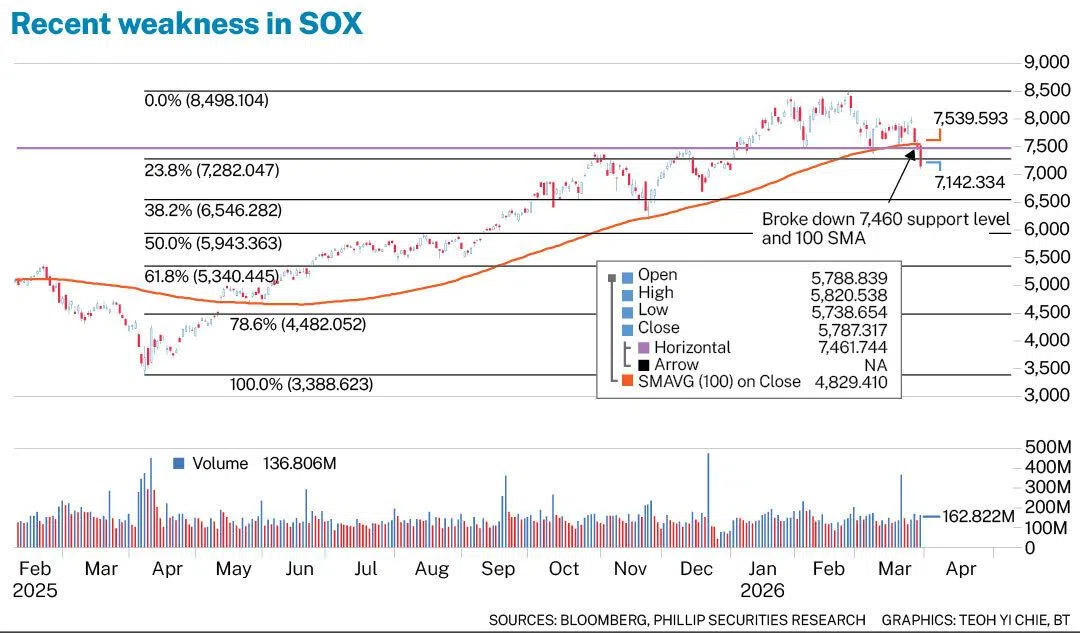
From a technical perspective, investors should exercise caution as the Philadelphia Semiconductor Index is likely to extend its current weakness.
The index price fell below the key 7,460 support level, which has held as a floor since the beginning of the year.
This is coupled with a breakdown below the 100-day simple moving average (SMA), a barometer for medium-term trends, for the first time since February 2025.
The recent breakdown is likely to trigger a deeper pullback towards the 6,400 level, which acted as support between October to December 2025.
The 6,400 level is confluent with a 38.2 per cent Fibonacci retracement level at 6,546, drawn using the swing low of 3,388, formed at the beginning of April 2025 and swing high of 8,498 formed at the end of February 2026.
To conclude, further weakness in the SOX is likely to persist following the recent breakdown of the key 7,460 level.
This is amid risk-off sentiment from the ongoing Iran war, a pivot in rate-cut expectations and Google’s TurboQuant weighing on memory stocks.
The index could continue to pull back towards the 6,400 level, representing a 10.6 per cent downside from the current price at the time of writing.
The writer is senior research analyst at Phillip Securities Research
Decoding Asia newsletter: your guide to navigating Asia in a new global order. Sign up here to get Decoding Asia newsletter. Delivered to your inbox. Free.
Share with us your feedback on BT's products and services
TRENDING NOW

Once staunchly pro-China, Malaysian Chinese businesses are now distancing themselves from Beijing

Looking beyond looming CEO succession, should UOB potentially pursue a transformative merger?

Could stablecoins be the future of money?

Grab CEO’s wife Chloe Tong on life with Anthony Tan and finding her purpose

