

From liquid cooling to regional campuses: How home-grown firm is laying the AI backbone for the region
As artificial intelligence workloads drive demand for higher-capacity data centres, Racks Central is building ahead of the market, using an integrated development model to roll out AI-ready facilities across the region
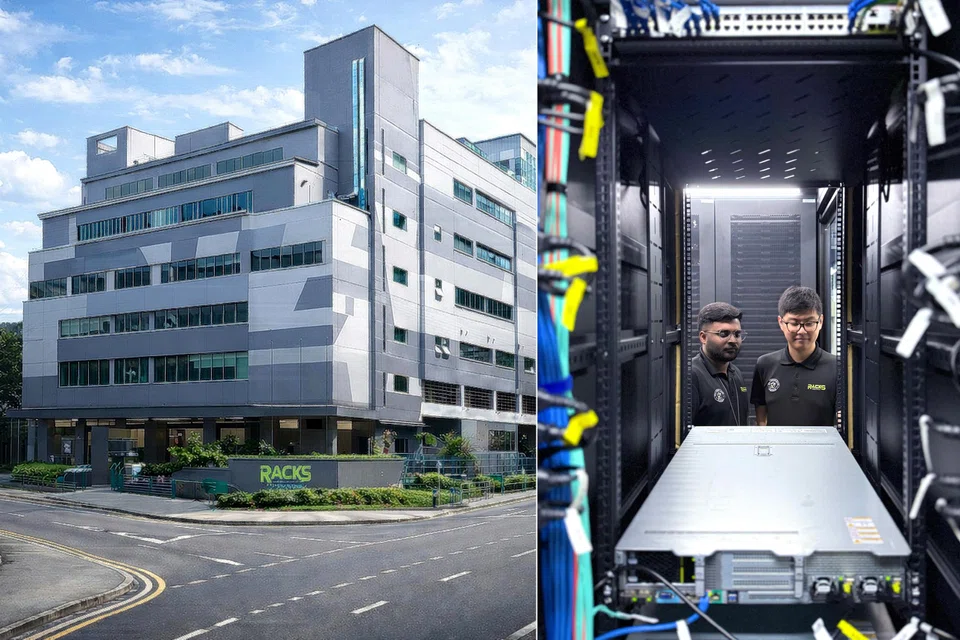
For the past two years, demand for Racks Central’s capacity has consistently outpaced supply. As artificial intelligence (AI) workloads accelerated across South-east Asia, companies began reserving capacity long before new facilities were completed.
The trend reflects both the scale of the opportunity and the need for the home-grown data centre operator to build infrastructure ahead of demand, explains founder and chief executive officer Bobby Wee.
Founded in 2014, Racks Central designs, builds and operates high-performance data centres. What started as a single-floor facility at Tai Seng Drive now spans 43,500 sq ft across six floors, with new AI-ready campuses under development in Johor and Batam.
Its expansion comes as Singapore rethinks how data centres should grow in an AI-driven era, balancing surging demand for computing capacity with limits on land and power, as well as stricter environmental, social and governance disclosure and sustainability standards.
Singapore is home to more than 70 operational data centres and over 1,400 megawatts (MW) of installed capacity. In 2019, the city-state placed a moratorium on new developments while policymakers reviewed the sector’s long-term direction. When approvals resumed in January 2022, new guidelines placed greater emphasis on energy efficiency and the use of greener power sources. In May 2025, the government announced plans to develop around 20ha on Jurong Island into Singapore’s largest low-carbon Data Centre Park, with capacity of up to 700MW. Racks Central has submitted an application to develop a next-generation AI-ready facility within the park, Wee says.
Expanding beyond Singapore’s limits
Even before the announcement of the Data Centre Park, Racks Central had begun planning for a broader regional footprint.
In Johor’s Iskandar Halal Park, construction is underway on an AI-focused data centre campus with potential capacity of up to 500MW. In Batam, a 2ha site within Nongsa Digital Park is expected to add another 160MW.
“Singapore will be the front door, while Johor and Batam will serve as the backyard for computational requirements,” notes Wee.
For multinational companies, Singapore remains the base for headquarters, financing and operational control, while large-scale AI computing is increasingly carried out in nearby locations such as Johor and Batam where land and energy are more readily available.
“Customers aren’t just buying capacity in a single market,” Wee says. “They are accessing a coordinated infrastructure platform that combines Singapore’s connectivity and trust with the scalability of neighbouring locations.”
Racks Central’s regional footprint also gives customers operational flexibility. Enterprises can start small and scale quickly across the Singapore, Johor and Batam campuses, with contract models suited to both enterprise clients and hyperscalers. Its campuses are linked so data can move quickly between sites, while meeting local requirements for data storage and use – all under a single operator.
Tackling a different kind of heat
The shift to AI is also changing the engineering requirements of data centres.
Traditional facilities typically operate at power densities of around seven to eight kilowatts (kW) per rack. AI workloads can push that figure to as high as 160 kW – roughly 20 times higher.
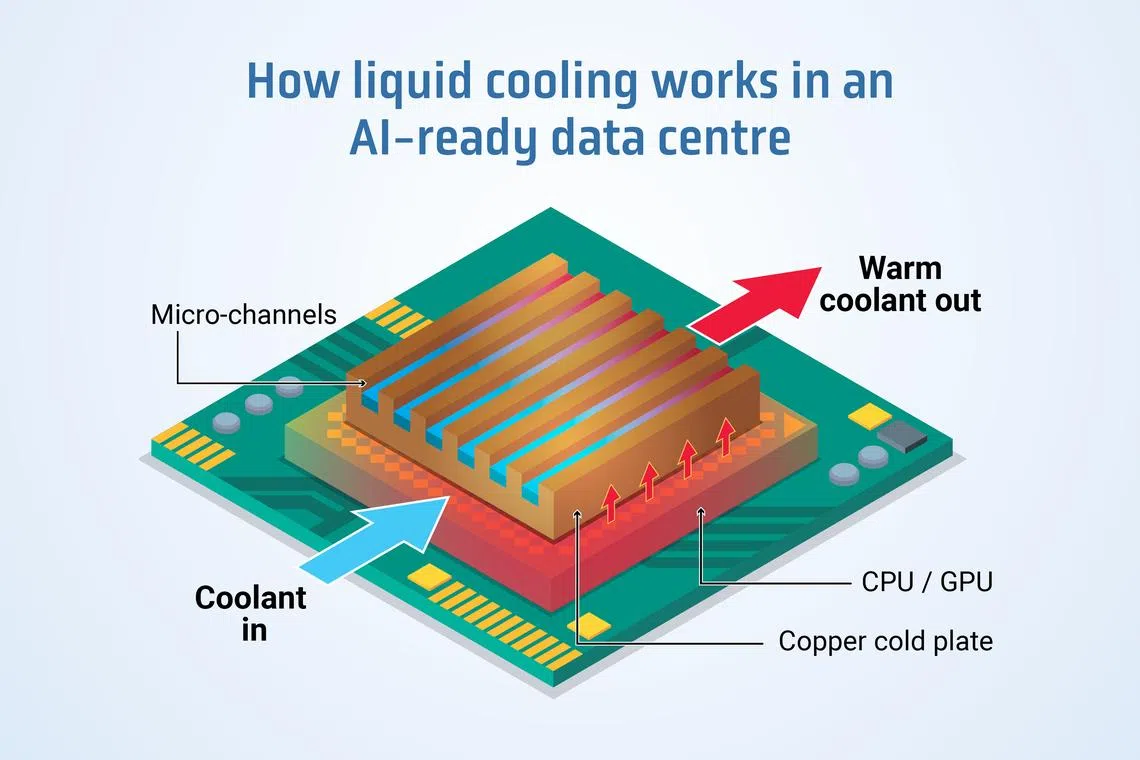
Historically, data centres managed heat by lowering the temperature of the entire room. That approach is no longer sufficient. Modern graphics processing units (GPUs), each roughly the size of a large postage stamp, generate far more heat in a much smaller space than room-level cooling systems were designed to handle.
The industry is now moving towards liquid cooling technologies that remove heat directly at the chip level. Instead of cooling the air around servers, specialised cooling loops circulate liquid around the chip to absorb heat precisely where it is generated. The method is far more efficient – but also significantly more complex and capital-intensive to deploy at scale.
Racks Central has designed its Johor campus with liquid cooling from the outset. When completed in the fourth quarter of this year, the facility is expected to rank among the region’s most advanced environments for ultra-high-density AI workloads.
Moving before the market does
Wee believes the company’s integrated operating model provides a competitive advantage as demand for high-performance AI computing accelerates.
Rather than wait for customer commitments before securing financing and starting construction, Racks Central went ahead with land acquisition, design and construction in parallel. By combining development, ownership and operations within a single organisation, the company can move projects from concept to completion much faster. Projects that used to take two years to deliver can sometimes be completed in about half the time, Wee said.
That speed is becoming increasingly valuable as AI adoption accelerates and the window to secure early infrastructure capacity narrows.
“AI-ready data centres aren’t just an upgrade,” Wee said. “They represent an entirely new playing field. The companies that succeed will be the ones that invest in the right infrastructure now – because when it comes to AI, waiting is not an option.”
Building an AI-ready workforce
Racks Central is investing not only in infrastructure, but also in the specialist talent and end-to-end customer capabilities needed to operate and maximise the next generation of data centres.
- Since 2018, the company has partnered with Singapore’s Institute of Technical Education through the Work-Study Diploma programme, supporting multiple student cohorts through a structured pathway that combines classroom learning with salaried, on-site industry experience.
- In Malaysia, Racks Central has signed a memorandum of understanding with Politeknik Ibrahim Sultan to advance education, industry alignment and community development, with a focus on strengthening technical and vocational capabilities for the digital economy.
The investment in talent directly translates into better service for customers, says chief executive Bobby Wee. Racks Central’s trained engineers and operations teams support a growing suite of managed services – from GPU cluster provisioning and 24/7 infrastructure monitoring to workload migration support – allowing businesses to focus on building and deploying AI applications.
“We’re not just building data centres,” says Wee. “We’re building the people, the platforms and the partnerships that help our customers succeed in an AI-driven world.”

Share with us your feedback on BT's products and services






