

Future offer for Great Eastern, if any, will be made in interest of OCBC: CEO Helen Wong
She notes that the lender’s offer price of S$25.60 is ‘meaningful’, in that it represents a premium to most of the traded metrics of listed life insurance peers

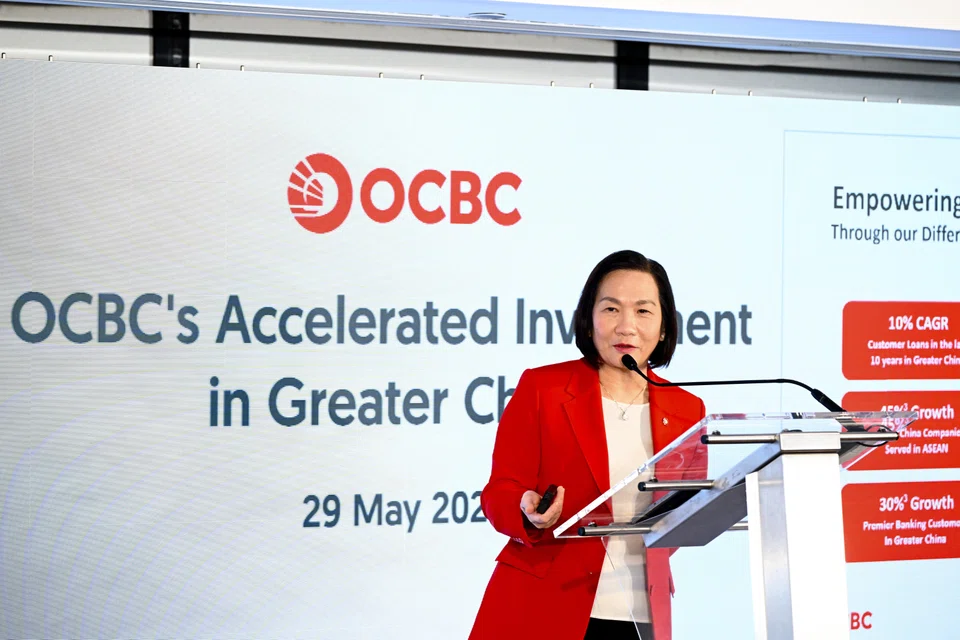
IF OCBC were to make any future offers for the shares in Great Eastern Holdings (GEH) it does not own, it will be in the interest of OCBC and its shareholders, and not GEH’s minority shareholders, said the lender’s group chief executive Helen Wong.
Meanwhile, these minority shareholders have until Oct 23, 2024, to accept OCBC’s offer on the same terms as its May 2024 bid for the insurer.
“We continue to work on our ‘One Group’ strategy to achieve greater synergies with GEH and minimise leakage of the economic value generated,” Wong said at a briefing for the lender’s second-quarter results on Friday (Aug 2).
OCBC had in May made a voluntary unconditional general offer of S$1.4 billion for the remaining 11.56 per cent stake in GEH that it did not already own, with the aim to delist the insurer.
At the close of the offer on Jul 12, however, the lender and its concert parties garnered just 93.52 per cent of GEH’s total shares – below the 98.87 per cent shareholding required to trigger a compulsory acquisition.
It also falls short of the 97.17 per cent level at which GEH may be directed to make an offer to delist.
Trading in GEH’s shares have been suspended since, as the number of shares in public hands has dipped below the 10 per cent free float threshold.
Giving an update on the offer, Wong said that more than 130 shareholders holding more than 600,000 shares have accepted the offer as at the end of July.
She also noted that the lender had considered public market valuation benchmarks for life insurance companies to derive the offer price. She added that it was not uncommon to use a combination of accounting and actuarial multiples, such as the price-to-earnings, price-to-book and price-to-embedded ratios.
The offer price of S$25.60 was “meaningful”, Wong explained, in that it represented a premium to most of the traded metrics of listed life insurance peers mentioned in GEH’s Jun 14 circular on the offer, such as AIA, Prudential and Manulife.
Yet, when the independent financial adviser (IFA) to the deal determined that OCBC’s offer was “not fair but reasonable”, it noted that the offer price was lower than its derived range of values for GEH’s shares, of between S$28.87 and S$36.19.
The IFA highlighted that the implied price-to-embedded value ratio represents a 30 per cent discount to GEH’s embedded value (EV) of S$36.59, and does not ascribe a value to its value of one year’s new business.
But Wong explained that the EV is an imperfect metric to be used solely as a comparison between insurers.
The EV is sensitive to long-term profit forecasts and assumptions, and thus it varies across insurance companies. It is also not particularly standardised, she said. “Because different insurers use different methodologies and assumptions, it results in it being – to a certain extent – a less perfect metric to be used solely for comparison between insurers.”
She added that GEH achieved its leading position in bancassurance from its access to OCBC’s network without paying access fees, which had a positive impact on its EV.
Meanwhile, several other life insurers, or the Asian subsidiaries of global insurers, also no longer report their EVs after implementing the latest insurance accounting standards.
“There’s also a consideration of whether you are buying... a new insurance licence – for us we’re not buying a new licence; we’re increasing our investment,” Wong pointed out.
She said that having a 100 per cent ownership of a delisted GEH can allow it to explore even more synergistic moves.
“Let’s see how these three months go, before we can make further decisions on the options we have and what it means to us in contributions to our capital position.”
Separately, in a bourse filing on Friday, GEH said that it was granted an extension of time to restore its public free float, until the final shareholding of OCBC is known after Oct 23.
TRENDING NOW

JPMorgan, BlackRock among those making bid to manage CPF savings

Andrew Lim to step down as CLI group COO and head of its private funds business from Dec 31
BN-PN’s Melaka election landslide puts spotlight on jobs, investments and political divides

GIC in talks to lease bulk of 88,000 sq ft CapitaSky space to be vacated by Allianz

