

'Future of semi-conductor industry bright' even when chips are down
DPM Heng confident about industry even as electronics shipments drop by double digits for sixth month
Annabeth Leow
Singapore
EUROPEAN chipmaker STMicroelectronics, which makes nearly half of its products here, doubled its capacity for a key semiconductor product with an expanded wafer fab facility in Ang Mo Kio that opened on Tuesday.
Shrugging off a global electronics downturn that has cut factory and export numbers to the bone, chief executive Jean-Marc Chery believes the company's focus on industrial applications will keep revenues steady.
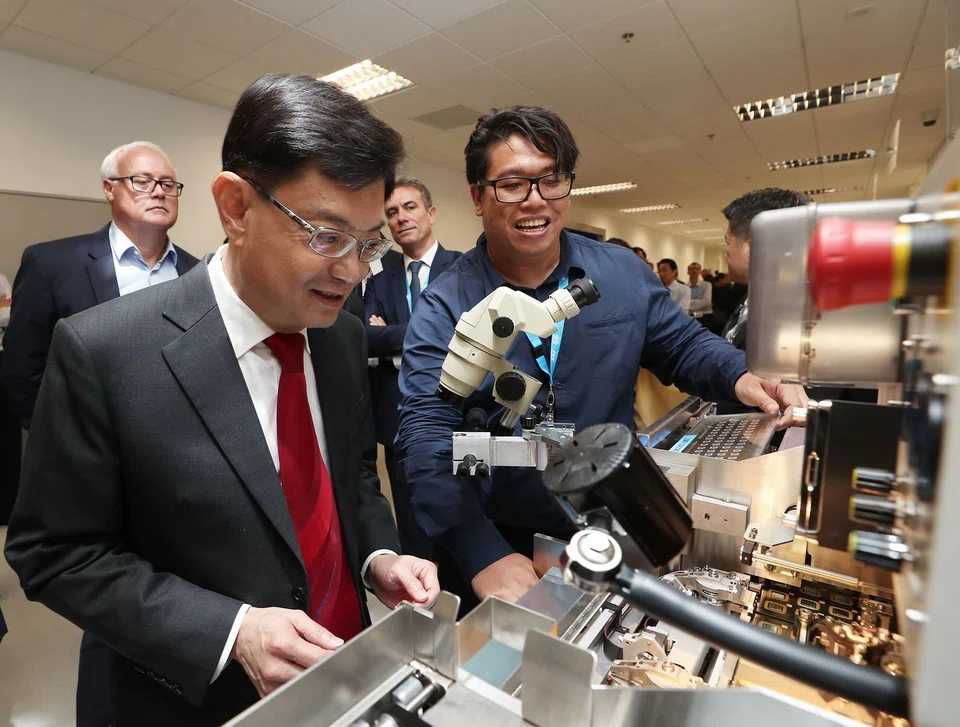
Meanwhile, Deputy Prime Minister Heng Swee Keat again affirmed confidence in the prospects of the worldwide semiconductor industry - even as trade data the same morning showed electronics shipments down by double digits for the sixth month.
He noted that ST has put some US$5 billion into Singapore in the last two decades, with the latest investment "in line with its strategic perspective, because the future of the global semiconductor industry is bright, despite the slowdown today".
Mr Heng, who is also Minister for Finance, was opening his second major fab here in as many months. He had expressed the same sentiment at American firm Micron Technology's new flash memory facility in August.
Globally, the semiconductor industry can count on "fresh demand driven by new applications in the Internet of Things, artificial intelligence and mobility services", he added.
Mao Bor-Yen, STMicroelectronics' general manager for Asia-Pacific manufacturing operations, said at a briefing that "our top focus is automotive", while Mr Chery told The Business Times that ST has banked on serving product trends such as industrial digitalisation and electric vehicles.
Its key portfolio segments are automotive; industrial; personal electronics; and communications equipment, computers and peripheral parts.
Mr Chery said: "Thanks to this positioning on high-growing applications, which are less sensitive to the overall legacy market, ST is demonstrating now, since 2016, that we perform better than the market we serve."
He drew a contrast against semiconductor rivals - both "big flash memory makers" such as Samsung, Hynix and Micron, and "fabless" manufacturers that design and sell, but outsource the actual production.
"Especially in a situation where the market is in a downturn...you need new products and new technology."
The group most recently projected a full-year revenue of between US$9.35 billion and US$9.65 billion, against US$9.66 billion last year.
ST, which has been in Singapore since 1969, snagged the newest wafer fab facility - housed in its ST TechnoPark in Ang Mo Kio - through a US$30 million leaseback deal with Micron.
The expansion will add 15,500 square metres (sq m) of cleanroom space to ST's manufacturing site. With 51,200 sq m of cleanroom in all, it can produce 27,500 eight-inch and 84,000 six-inch wafers a week.
Swiss-based ST's main wafer fabs are in Agrate Brianza and Catania in Italy; Crolles, Rousset and Tours in France; and Singapore. It also has assembly and test sites around the world - including in Toa Payoh.
The Republic now churns out 44 per cent of all of ST's products, with Mr Chery telling BT that the ideal portfolio split hovers around a 40-60 mix between Singapore and Europe.
ST, which has 46,000 staff members worldwide, employs about 4,900 workers in Singapore - including 400 new hires at the expanded fab. The bulk of its manufacturing headcount is filled by operators and technicians.
Singapore's semiconductor industry, which has long been a mainstay of the economy, made up 7 per cent of gross domestic product with some 35,000 jobs as at end-2018.
Other large semiconductor investments made in Singapore over the past year include Systems on Silicon Manufacturing Company (SSMC)'s S$300 million cleanroom, which opened in November, and a US$200 million research facility from Hong Kong-listed AAC Technologies, which is scheduled to go live late next year.
Meanwhile, Mr Heng said investments by global firms such as ST "affirm our approach to the economy - one that is both pro-business and pro-worker", while also calling on more companies here to commit resources to upgrading workers' skills.
"During challenging economic times, the Singapore Government worked closely with companies like ST to retrain and upskill existing workers," he said. "As a result, our workforce could emerge stronger and more capable."
TRENDING NOW
One-third of Singapore-listed firms at risk in severe AI downturn: MAS
‘Not done’: Keppel CEO Loh Chin Hua transformed the group, but says there’s ‘still a lot to do’

He built the Vingroup empire. Now South-east Asia’s richest man is handing some key roles to his sons
‘We don’t want to stay as we are’: CEO Patrick Ng builds a more resilient Huationg

