HOCK LOCK SIEW

Gaming revenue at Genting Singapore bouncing back on domestic market demand

But stock price may not reflect fully resilience of local sources of income

Annabeth Leow
Published Wed, Jan 20, 2021 · 09:50 PM

    SINGAPORE'S gaming sector is far from its pre-pandemic levels - but the bloodshed that analysts had feared last year appears to have been averted.

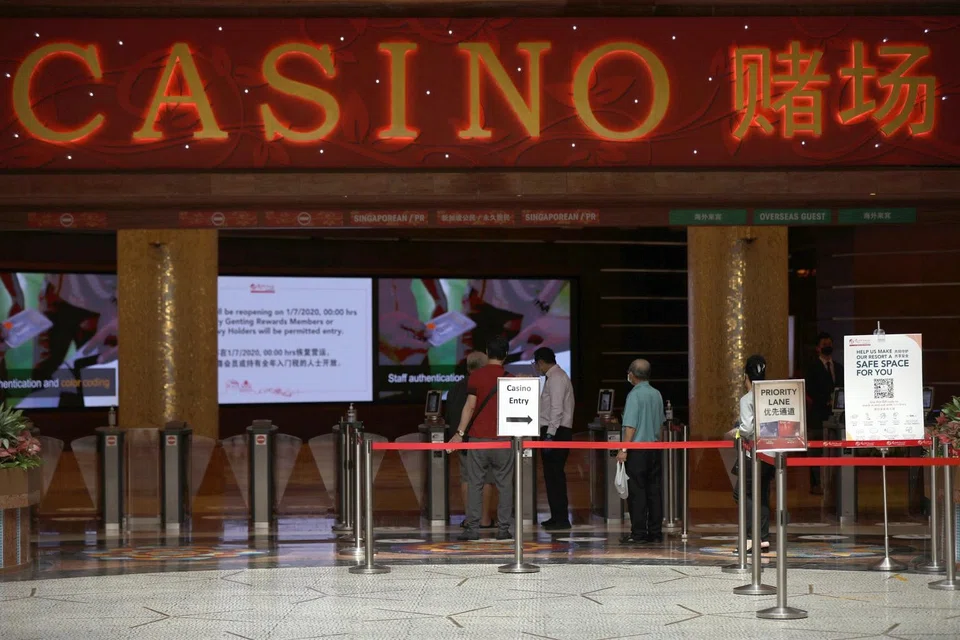
    Local gamers have been supportive in their patronage of tables at the two integrated resorts (IRs): Genting Singapore's Resorts World Singapore (RWS) and Las Vegas Sands Corp's Marina Bay Sands (MBS).

    Yet, the unexpected resilience in casinos is not fully reflected in Genting Singapore's share price.

    Despite strict restrictions on inbound travel into Singapore, Genting Singapore defied the worst-case scenarios about a lack of appetite from domestic punters during a recession.

    The company bounced back from a second-quarter 2020 net loss to a net profit of S$54.4 million in the three months to Sept 30, 2020, its most recent financial disclosure.

    Revenue was down 50 per cent year on year to S$301 million, but gaming revenue showed a slightly smaller fall of 41 per cent - to S$212.9 million.

    Local gamblers - particularly the mass-gaming segment - may be responsible for reviving RWS casino operations to almost three-fifths of pre-virus levels.

    Genting Singapore did not give a breakdown between RWS's mass and premium gaming revenue that period. But rival MBS saw a 70.4 per cent fall in non-rolling chip drop, a proxy for non-VIP gamers - gentler than the 79.7 per cent fall in mainly-VIP rolling chip play in the third quarter of 2020.

    "(A) tilt towards mass market will expand margins due to less commissions and rebates," Maybank Kim Eng (Maybank KE) analyst Samuel Yin wrote last month.

    When resorts gingerly re-opened after last year's "circuit breaker" - which resulted in layoffs at RWS - naysayers suggested that the Singapore gaming scene would pale against its peers. Malaysia had a larger domestic base, while Macau could tap mainland Chinese demand, market watchers said then.

    But Malaysia has since faced a surge in Covid-19 cases, forcing a lockdown that has disrupted domestic tourism to Resorts World Genting (RWG).

    Mr Yin cut his Genting Malaysia target price from RM2.64 to RM2.60 last week, adding: "We fear more downside risk as RWG may have to forego the Chinese New Year peak season and the opening of Genting Skyworlds may be deferred again."

    Meanwhile, Macau has struggled with a clampdown on tourism from mainland China. The situation did not normalise until Sept 23, 2020. Before that, tourism had been limited to residents of neighbouring Zhuhai city from Aug 12, 2020, and from the rest of Guangdong province from Aug 26, 2020.

    Hong Kong-listed Galaxy Entertainment Group saw gaming revenue fall to HK$593 million (S$102 million) for the three months to end-September 2020, from HK$10.6 billion in the year-ago quarter. SJM Holdings, founded by the late Stanley Ho, saw gaming revenue fall to HK$841 million from HK$8.1 billion for the same period in 2019. Both companies have also reported losses for the most recent quarter.

    In spite of their poor financial performance, however, both stocks have done well. SJM lost only 2.3 per cent of its value last year. Galaxy gained 6.1 per cent.

    Genting Singapore, meanwhile, fell 7.61 per cent over 2020. That performance was still better than Las Vegas Sands Corp's 13.7 per cent decline and Crown Resorts' 19.8 per cent tumble, but it suggests the market has yet to price in the strength of the company's numbers.

    The stock still "offers substantial upside" if investors are to assume a full post-pandemic earnings recovery in 2022, said UOB Kay Hian (UOBKH) equity analysts Vincent Khoo and Jack Goh in a report on Jan 12.

    Recovery is already under way, Mr Khoo told The Business Times: "We expect the upcoming Chinese New Year period, while clearly more subdued than in previous years, to deliver slightly better than Q3 2020's level."

    That's even as he noted that a return to pre-pandemic levels must still wait until regional borders reopen on vaccination, from the first half of 2021 onwards.

    UOBKH has raised its target price on Genting Singapore from S$0.98 to S$1.08. The stock closed Wednesday at S$0.87, unchanged for the day. The company's full-year results are slated for release on Feb 9.

    Between the two IRs here, RWS may have rosier prospects than MBS.

    Their Q3 2020 revenues were comparable: MBS reported US$281 million in turnover, while RWS operations - excluding Genting Singapore's investment business - brought in S$272.8 million.

    But the IRs play to different market segments. MBS, which is located in the financial district and includes a luxury retail wing, has arguably been more dependent on income from business travel and high-end leisure visitors.

    In contrast, the non-gaming portion of RWS features not just hotel rooms - which MBS also has - but also the family-friendly Universal Studios Singapore and S.E.A. Aquarium.

    These attractions likely benefited from an influx of domestically confined visitors during the year-end school holidays, especially with stimulus from SingapoRediscovers Vouchers thrown in.

    Genting Singapore's prospects are also attractive when its expected payout is taken into account. Maybank KE's Mr Yin tipped a yield of 2.4 per cent in 2021 and 4.7 per cent in 2022, while UOBKH analysts believe yield could hold steady at 4.7 per cent this year.

    That's respectable in comparison with other global players. Australia's Crown Resorts, for instance, broke with policy and did not declare a final dividend for the year to June 30, 2020.

    "There is also possibility of Genting Singapore doling out a special dividend should it fail to win a Japan casino concession," the UOBKH analysts added in their report.

    As such, market action could soon see Genting Singapore turning the tables on the pandemic downturn.