GIC posts 3.9% 20-year annualised real rate of return, expects lower returns ahead expects lower returns ahead
The sovereign wealth fund continues to see opportunities in private equity, AI and emerging markets

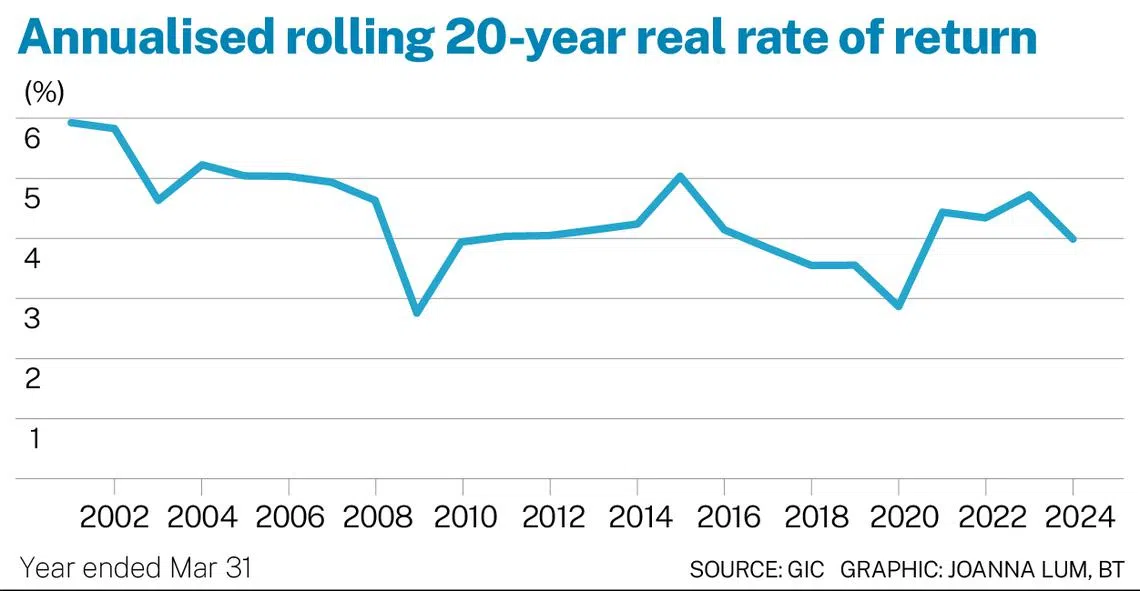
SINGAPORE’S sovereign wealth fund GIC reported an annualised rolling 20-year real rate of return of 3.9 per cent for its latest period ended Mar 31, 2024.
This rate of return – which accounts for inflation and spans the 20-year period from April 2004 to March 2024 – is down 0.7 percentage point from 4.6 per cent the previous year, GIC said on Wednesday (Jul 24).
“The profound uncertainty we face is likely to continue to weigh on returns. Amid this volatility, we must play to our strengths and seize new opportunities,” said Lim Chow Kiat, chief executive of the sovereign wealth fund.
He noted that returns were lower than in previous years as a strong year had dropped out of the rolling window. The period of Apr 1, 2003, to Mar 31, 2004, had strong returns, as equity markets staged a strong recovery after a sharp correction following the dot-com crisis.
GIC has also taken a more cautious stance in recent years, and fewer risks resulted in lower returns, he said.
Significant exposures to fixed income and emerging markets – which had weaker returns in recent years – have also affected returns, he added.
The annualised nominal rate of return, which does not account for inflation, was 5.8 per cent in US dollar terms for the 20-year period.
Nominal return was 4.6 per cent for the 10-year period and 4.4 per cent for the five-year period in US dollar terms.
GIC said these lower figures reflected the market challenges in recent years, which had sharp falls in returns in fixed income and global equities, particularly in emerging markets.
When compared to a reference portfolio – comprising 65 per cent global equities and 35 per cent global bonds – GIC’s portfolio had lower volatility across the 20-year, 10-year, and five-year periods, as it had taken pre-emptive measures to lower its portfolio risks.
But returns were also lower, as the sovereign wealth fund took an underweight stance on developed market equities, which performed strongly during these periods.
GIC noted that the reference portfolio is not a performance benchmark, but represents the risk that its client – the Singapore government – is prepared to take in generating good, long-term returns.
Lower returns ahead
The current investing environment is characterised by “very deep uncertainty”, said Jeffrey Jaensubhakij, group chief investment officer of GIC.
In the near term, there will still be lingering effects from high interest rates, while the next steps of disinflation will likely be “increasingly hard” as wages continue to grow, he said.
He noted the macroeconomic challenges in the region, namely in China, where consumer sentiment and the construction sector remain weak.
In the medium term, geopolitical tensions will remain, he said, adding that inflation is also likely to stay elevated amid strong employment, while governments seem “quite eager” with fiscal expansions.
Meanwhile, the implications of artificial intelligence (AI) are not fully clear yet, and climate change and decarbonisation continue to pose risks.
GIC’s FY2023/24 results at a glance:
- GIC’s annualised rolling 20-year real rate of return is 3.9 per cent for FY2023/24, down from 4.6 per cent in FY2022/23.
- The rolling 20-year real rate of return takes inflation into account, and is GIC’s primary metric for evaluating investment performance.
- GIC expects weaker returns going forward, amid growing geopolitical risks, higher inflation, and slower growth in emerging economies.
Asset and geographic mix
The lower return environment requires a more granular investment approach to generate good, long-term returns, Lim said.
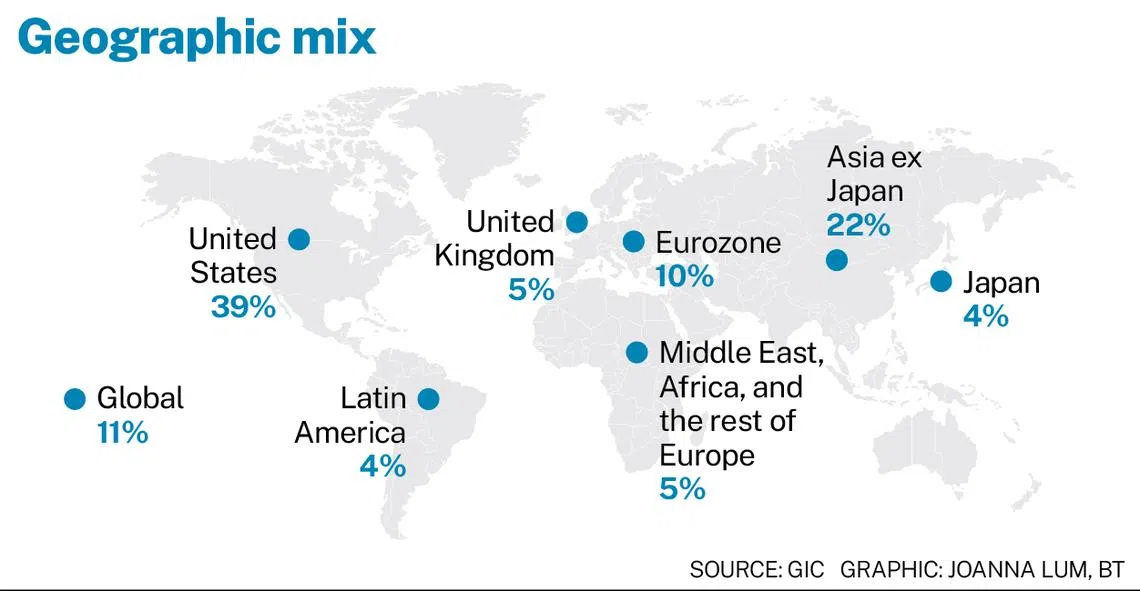
GIC noted that it has, over the years, diversified on a far more granular level to enhance the resilience of its overall portfolio. This includes stepping up its investments in infrastructure and real estate.
Investment teams across all asset classes continue to maintain strict price discipline on the risk-reward prospects of potential investments as well.
In the year ended March 2024, the share of nominal bonds and cash fell, while that of inflation-linked bonds rose. This was to support its portfolio’s resilience to inflation, GIC said.
The share of private equity also rose due to continued deployment of capital and strong returns.
Jaensubhakij noted that GIC’s cautious stance in the last few years has given it dry powder to capture opportunities in spaces including private equity, AI and emerging markets.
For AI, the sovereign wealth fund is looking to invest in opportunities at various stages, from enablers of the technology, to tech companies that monetise AI and those that adopt AI to boost productivity.
GIC also continues to find opportunities in emerging markets, even though the segment as a whole has fallen behind developed markets over the last few years, Jaensubhakij said.
Bright spots include domestic-focused consumer businesses, advanced manufacturing players, as well as healthcare, infrastructure, and digitalisation themes.
Speaking on China, Jaensubhakij noted that GIC’s investments in the country are performing well, although the Chinese market has been lagging behind global markets.
“We have been in the sectors that have done better than the market in general, but you can’t escape what the market does, and the market is not doing particularly well,” he said.
He also noted that not all types of real estate in China are facing oversupply, and there are still areas that remain undersupplied and in demand that GIC can explore. These include residential properties for rent, as well as retail assets.