

GIC posts lower 3.4% 20-year annualised real rate of return, launches new investment framework
Singapore sovereign wealth fund sees need for more flexibility amid geopolitical tensions, AI advances

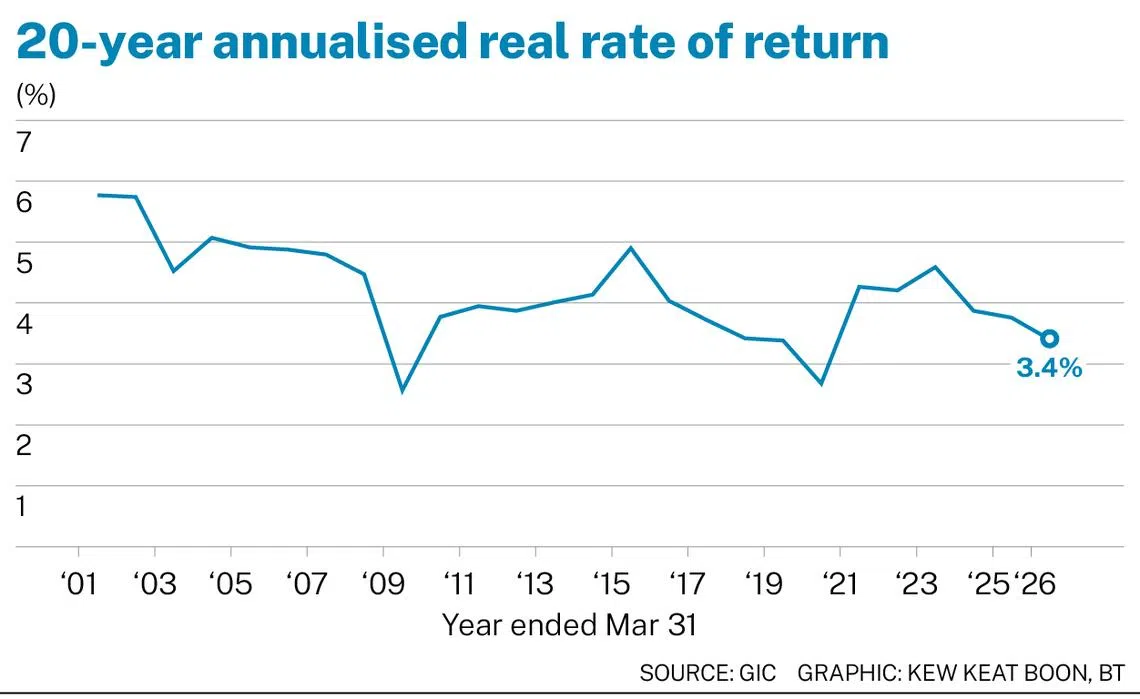
[SINGAPORE] Sovereign wealth fund GIC reported an annualised rolling 20-year real rate of return of 3.4 per cent for its latest period ended Mar 31, 2026.
The return – which accounts for inflation and spans the 20-year period from April 2006 to March 2026 – is down 0.4 percentage point from the 3.8 per cent recorded in the previous year, GIC said on Friday (Jul 24). The latest figure is the lowest since FY2019/2020.
“GIC has prioritised portfolio resilience as part of our mandate (to preserve and advance real value), and our performance continues to be within expectations,” said Lim Chow Kiat, CEO of GIC.
With ongoing changes in the global investment environment, the sovereign wealth fund refreshed its investment framework with effect from this financial year beginning Apr 1, 2026.
GIC expects the revised framework will help it adapt to changes in the global investment landscape, which is being reshaped by a changing world order, rising fiscal risks and advances in artificial intelligence.
The rules-based international order is giving way to a multipolar world, leading to geopolitics being a structural feature instead of just an episodic shock, GIC noted.
Public debt is also at historic highs across major economies, which narrows the margin of safety.
Meanwhile, AI will remain transformative and will increase productivity in the long run. But progress will likely be uneven, with periodic slowdowns in AI-related investment spending, while rapid AI investments also increase disruption risks across industries.
“The outlook is one of elevated uncertainty, which can also produce opportunities,” Lim said. “It’s uncertain because the foundational structure of the world economy, politics and technology has changed and has not settled, so we believe that with the new framework, it allows GIC to position well.”
SEE ALSO




New investment framework
GIC said its new investment framework allows it to invest with more granularity and flexibility.
“The world in our assessment has fundamentally changed, and we believe we have built up capabilities which we should leverage more on,” Lim said.
GIC’s previous framework comprised three components: a reference portfolio that represents the risk appetite; a policy portfolio comprising its core asset allocation; and an active portfolio to deliver excess returns.
These come together to form the GIC portfolio, which delivered real returns of 4.2 per cent per year from its inception on Apr 1, 2013, until Mar 31, 2026.
Over that same period, active strategies contributed 52 basis points of gross alpha per year over and above the policy portfolio.
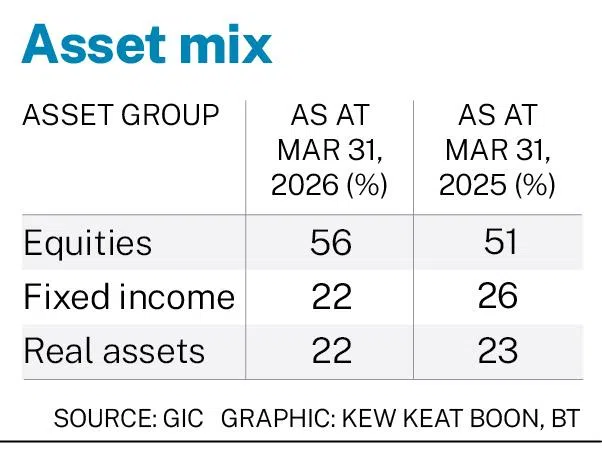
The new framework will comprise a strategic portfolio that classifies assets into three broad asset groups – based on the returns they can deliver – instead of six traditional assets classes.
The GIC portfolio will then be designed to outperform the strategic portfolio, and continue to consist of a broad range of strategies to add value.
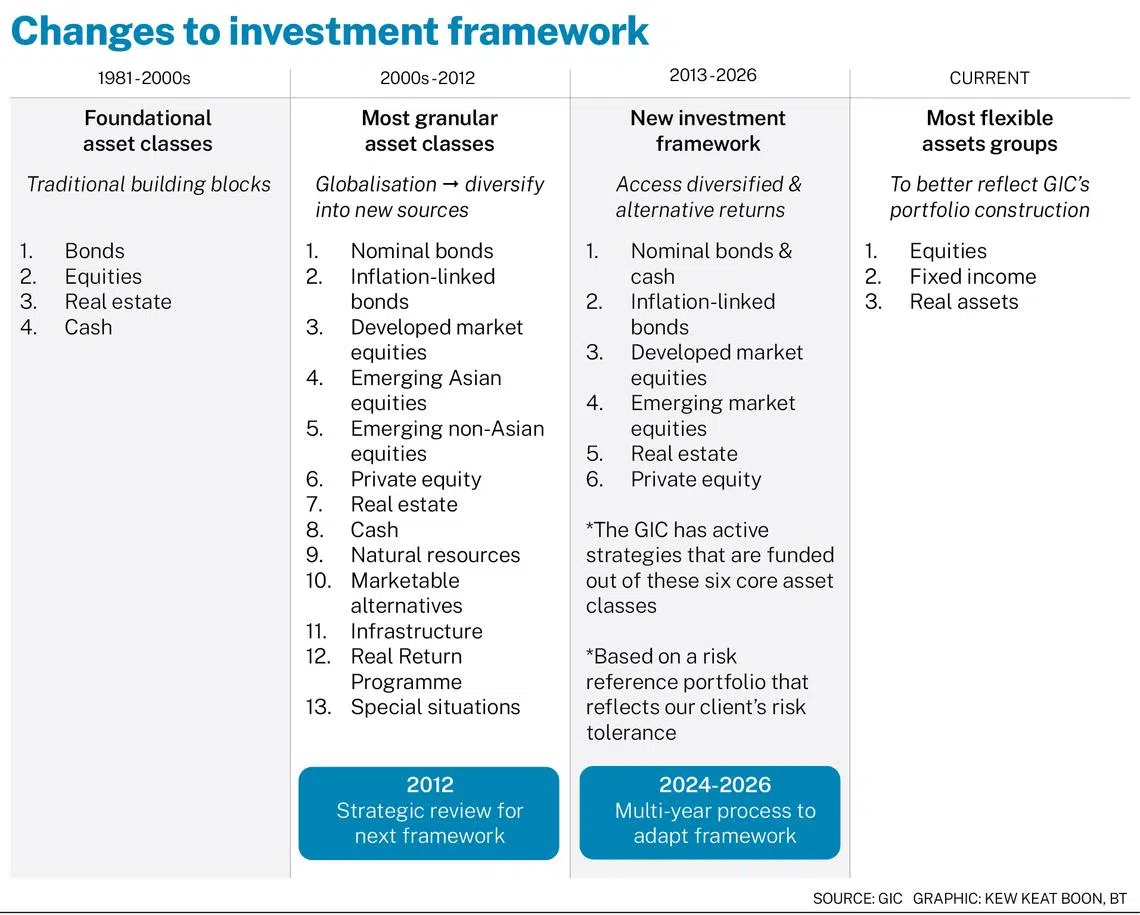
The three broad asset groups are equities, fixed income and real assets – these capture exposure to growth, income and inflation, respectively.
Under “equities”, GIC will no longer be restricted by separate allocation ranges for public and private equity.
Under “fixed income”, it can adjust allocations across fixed income assets amid uncertain rate environments, while the “real assets” group allows diversification across various physical asset classes to boost inflation resilience.
Strategies and AI
GIC expects AI will remain an area with opportunities for long-term value creation.
“AI has reached a point of real-world impact,” said group chief investment officer Bryan Yeo. “It’s no longer a question of whether it can create economic value, but where and how fast.”
Meanwhile, it also expects to deploy additional capital to hedge funds – around US$30 billion over the next three years, Yeo noted.
Among sub-categories, the ones that are in the “sweet spot” are those with a global macro strategy, quantitative hedge funds and multi-strategy hedge funds, he noted.
Yeo said: “These are managers that can dynamically manage their risk, their strategy as well as portfolio positioning in a highly uncertain world going forward.”
GIC will also look to “grow meaningfully” in the cross-asset space, where fund strategies straddle both traditional stock and bond strategies, as well as with specialised sector-focused managers, who have specific skill sets in specific niche areas, he added.
He noted that GIC’s plans to deploy more capital into hedge funds are also “quite a valuable diversified strategy” for its overall portfolio.
“Hedge funds as a strategy for GIC offer a lowly correlated alpha generation compared to our other strategies, for example, in fixed income, equities, real estate infrastructure or private equity.”
GIC will also continue to increase investments in venture capital and infrastructure.
Prakash Kannan, chief economist and head of total portfolio management at GIC, noted that inflation and growth are increasingly diverging due to supply-side shocks.
In this environment, real assets will be able to maintain resiliency compared with most traditional portfolios, which may fail to perform well given that they typically use bonds as diversifiers.
“There is a focus to look at particular assets where the inflation pass through is better captured,” he added.
GIC is also bullish on the theme of climate adaptation, which involves enabling assets, businesses and communities to adapt to higher temperatures.
It estimates that investment opportunities in climate adaptation in both the public and private markets could grow from US$2 trillion in 2025 to US$9 trillion by 2050 – with about US$3 trillion of this driven by further global warming.
“Around 60 per cent of this potential remains untapped, as markets have yet to fully reflect climate risks and opportunities. We expect investment in climate adaptation to grow as businesses act to prevent losses,” GIC noted in its report.
Decoding Asia newsletter: your guide to navigating Asia in a new global order. Sign up here to get Decoding Asia newsletter. Delivered to your inbox. Free.
Copyright SPH Media. All rights reserved.
TRENDING NOW

Once staunchly pro-China, Malaysian Chinese businesses are now distancing themselves from Beijing

Looking beyond looming CEO succession, should UOB potentially pursue a transformative merger?

Could stablecoins be the future of money?

Grab CEO’s wife Chloe Tong on life with Anthony Tan and finding her purpose

