

Global shipping prices stabilising in wake of Suez disruption, but at higher level

Derryn Wong
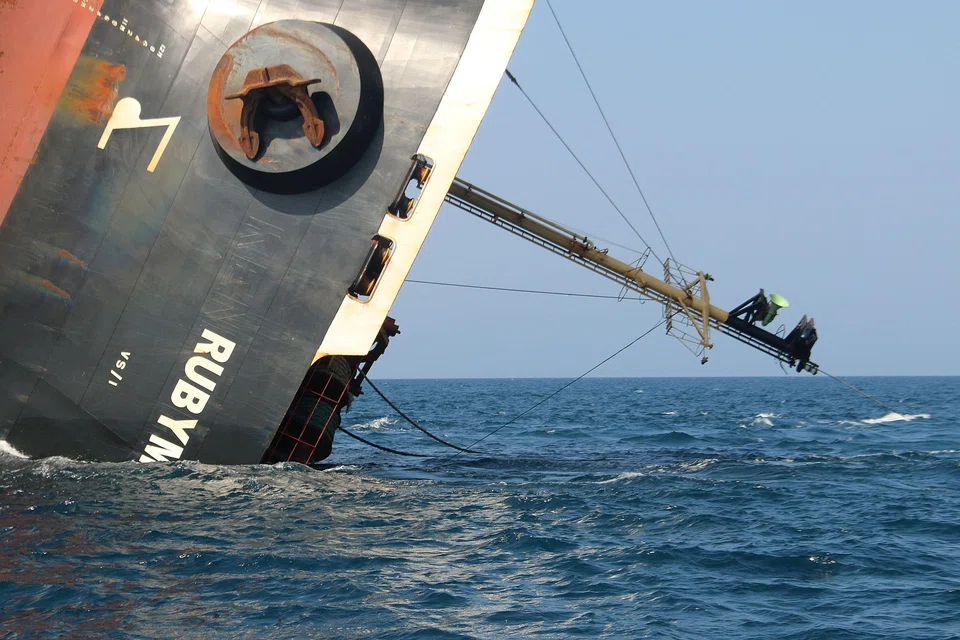
GLOBAL shipping prices are starting to stabilise, after rising for several months due to Red Sea tensions – but they may settle at a higher level than before, said industry observers.
Lian Hoon Lim, managing director at consulting firm AlixPartners, said: “The general consensus is (that stabilisation is happening) because supply and demand of shipping capacity is coming back into balance after the initial shock.”
Container shipping prices rose dramatically in the last quarter of 2023, after Houthi rebels began attacking ships in the Red Sea in protest against Israel’s war in Gaza.
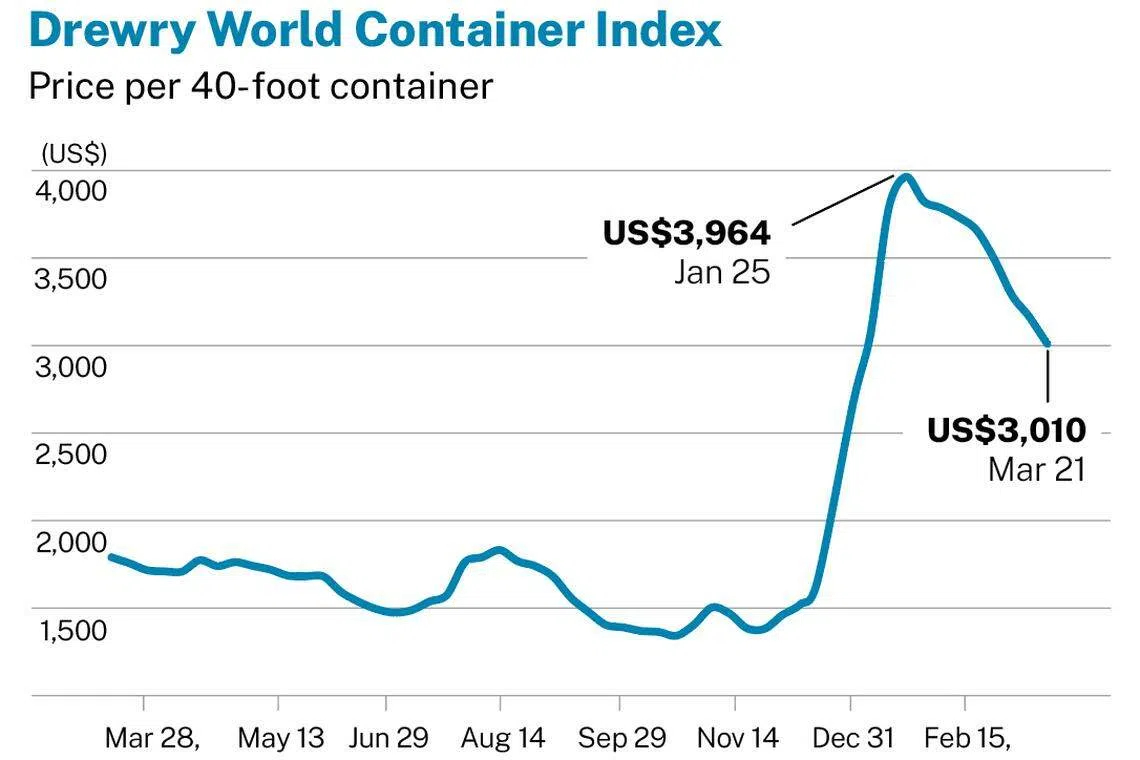
Prices have since eased slightly. The Drewry World Container Index, which tracks container shipping prices across major routes, fell to US$3,010 for the week of Mar 21.
This was down 24 per cent from a recent high of US$3,964 in the week of Jan 25. But it is still 112 per cent more than the full-year average price of US$1,420 in 2019.
The index began rising from US$1,382 in the week of Nov 30, after shipping traffic began avoiding the Suez Canal-Red Sea route following the first attacks in October.
A longer detour
According to the International Monetary Fund, trade through the Suez Canal was down 50 per cent in the first two months of 2024, compared to the year-ago period. Shipping prices rose as most carriers opted for the longer detour around the Cape of Good Hope, of which trade increased by 74 per cent in the same period.
The journey from Rotterdam to Ras Tanura in Saudi Arabia is around 10,000 km by the Suez Canal, but 73 per cent longer via the Cape.
According to Fitch Ratings analysts, the Cape route adds 50 per cent to total transit time for the Asia to Europe route, and increases shipping companies’ operating costs by the same proportion.
As this is a longer route, the full journey needs to be broken up across more ships – thus further increasing the demand for ships.
Adjusting to new routes
Industry observers expect prices to remain stable at current levels as the industry has adapted to the disruptions.
In fact, the longer routes and increased demand for ships helped to absorb an earlier oversupply of shipping capacity. This oversupply was the result of new ship orders made during the pandemic era’s extremely high levels of demand.
Shortly after the Red Sea attacks, container rates spiked as carriers had to adjust their networks very rapidly and deploy more ships into the Asia-Europe lane, noted Lim.
But by now, most shipping contracts will have been re-negotiated to reflect the situation, making prices more stable, he added.
Container xChange analyst Ritika Kapoor expects the usual seasonal decline in container rates. Rates typically fall after the Chinese New Year festive season, decreasing around 30 per cent from February to March and into April. Kapoor thus predicts container rates will fall by 6 to 18 per cent for the same period this year, with bigger declines expected in Asia.
Wong Siew Loong, president for logistics company Kuehne+Nagel Asia-Pacific, said demand has indeed fallen after Chinese New Year – but he does not expect rates to reach the low levels seen in 2023.
New shipping capacity will moderate freight rates, but such supply and demand dynamics are not the only factor, he said. Carriers face higher fuel prices and a longer distance on the Cape route – which will also increase their exposure to the European Union’s carbon border tax.
With the Cape route, emissions for a journey from Asia to North Europe could increase by as much as 260 per cent, according to Sea-Intelligence.
Fitch Ratings analysts said the impact of Red Sea disruptions on freight rates and supply chains has steadied for now, but freight rates could stay higher for longer.
In the medium and longer term, freight rates are being supported by operating cost inflation, higher port charges and the rising costs of environmental regulation compliance, they said.
Planes and trains
The Red Sea disruption has also driven interest in the alternatives of air and rail cargo, though adoption is limited by price and capacity.
Kuehne+Nagel has seen “some uptake” of sea-air services as a result of the Red Sea situation, said Wong.
Alan Lim, director at consultancy Alton Aviation, similarly observed the combined use of air and sea transport to avoid the Red Sea. For instance, Asia-Pacific producers ship cargo to key sea-air hubs such as Bangkok and Dubai, then fly the goods to Europe.
International Air Transport Association figures showed that in January, international cargo-tonne-kilometres – a combined measure of weight and distance travelled – rose 27.5 per cent year on year between Asia and Europe, and 29.5 per cent between Asia and the Middle East.
Sea-air hubs have seen elevated air cargo demand in the first seven weeks of 2024, with Dubai-Europe demand up 71 per cent and Bangkok-Europe up 58 per cent, compared with the year-ago period.
However, Alton’s Lim does not foresee a “full swing” towards air freight. This will be limited to time-sensitive shipments, he said, as air freight is typically around 12 to 16 times more expensive than maritime freight and dangerous goods cannot be transported by air.
Rail freight is faster than sea, but also costs about twice as much per 40-foot container, at around US$6,000 currently. According to a March report from DHL, rail freight takes 22 to 26 days from China to Poland, compared to 28 to 30 days from China to Europe for the Suez Canal sea route.
DHL cited “remarkable demand” for rail freight, leading to rate increases on most of its East-West rail routes.
But AlixPartners’ Lim said that rail can only substitute a fraction of maritime freight capacity. A single freight train can carry a maximum of around 200 containers, compared to more than 18,000 for an average cargo ship.
Given the limited capacity and high rates, rail is typically chosen only for time-sensitive freight, he said.
Kuehne+Nagel’s Wong said the shift to other modes such as air would not moderate sea freight rates. Rather, organisations are temporarily compensating for longer sea transit times by adopting faster but more expensive modes of transportation.






