

Gold beats STI, Hong Kong-listed tech to be top-traded ETF on SGX in 2024
The precious metal continues to shine as investors look to diversify equity and bond portfolios amid geopolitical tensions and market volatility, says analyst

RECORD-HIGH gold prices in 2024 have fuelled investment appetite for physically backed gold exchange-traded funds (ETFs) in Singapore.
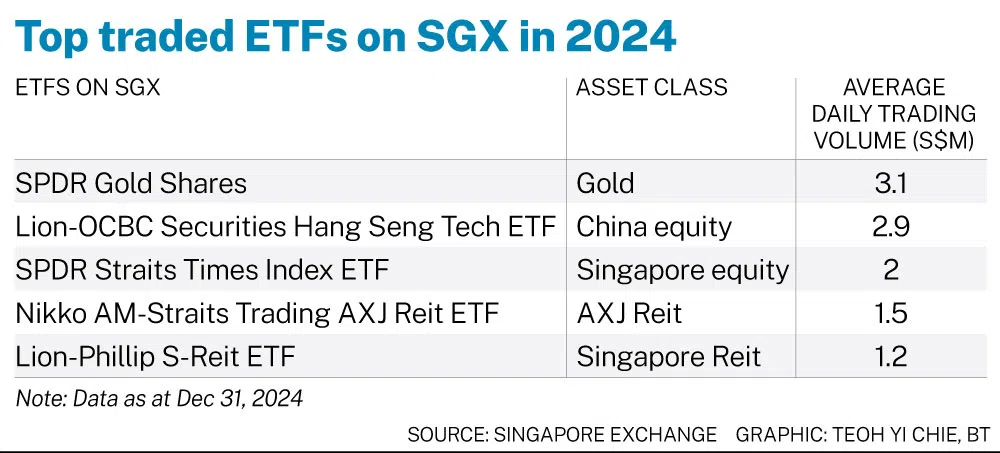
SPDR Gold Shares, the only gold ETF on the Singapore Exchange (SGX), was the top-traded ETF on the local bourse last year in terms of the average daily trading value. It is also the largest bullion-backed ETF globally.
According to SGX data, the counter saw some S$3.1 million changing hands on average each day, overtaking the Lion-OCBC Securities Hang Seng Tech ETF and SPDR Straits Times Index (STI) ETF.
“Gold has continued to provide a store of value amid ongoing global geopolitical tensions and bouts of financial market volatility. This has seen investors look to acquire units in the gold ETF to diversify equity and bond portfolios,” said SGX market strategist Geoff Howie.
He added that ongoing global uncertainties continue to be a key part of the market outlook for 2025.
Robin Tsui, Asia-Pacific gold strategist and SPDR gold sales specialist at State Street Global Advisors, noted that the strong momentum of SPDR Gold Shares on SGX is expected to continue as the fund gains traction among investors from other South-east Asian markets such as Thailand and Malaysia.
He said: “Thailand is a big market for us as well, and they tend to trade our product in Singapore because of the time zone, and just being closer to Singapore.”
Strong flows
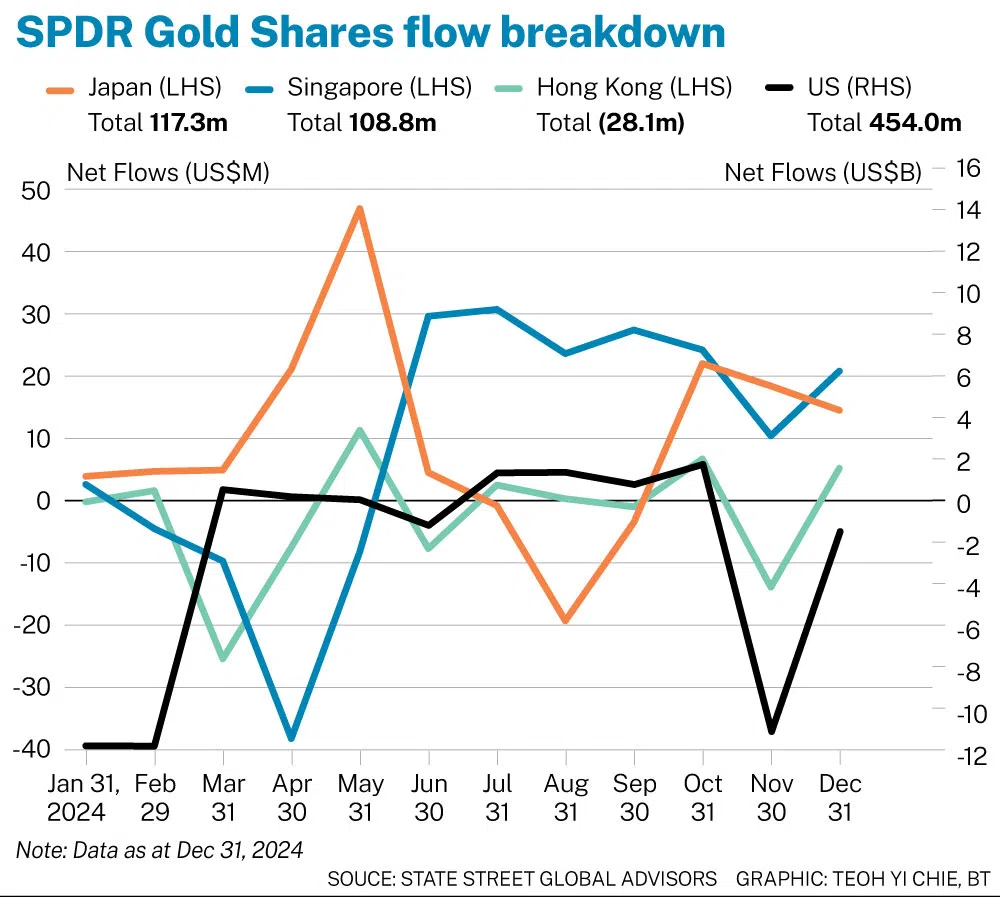
Comparing across the Asian bourses where SPDR Gold Shares is listed, the Singapore market saw the second-largest flows into the ETF at US$108.8 million net inflow last year, after the Tokyo Stock Exchange.
Net flows into SPDR Gold Shares in Japan reached US$117.3 million in 2024. This is expected to stay strong as the yen’s continued depreciation may push Japanese investors to turn to gold, said Tsui.
A revamped tax-exemption programme in Japan could encourage more trading activities, he added.
Early in January 2024, the Japanese Nippon Individual Savings Account programme expanded annual investment limits, and extended the tax-exempt period from up to 20 years to an indefinite term.
Elsewhere in Asia, the Hong Kong Stock Exchange registered the least net flows into SPDR Gold Shares at a negative US$28.1 million.
The consistent monthly outflows in Hong Kong were attributed to its high-rate environment under a US-linked monetary policy, said Tsui.
But as the US Federal Reserve continues to cut rates, and the Hong Kong property and equity markets are hit by tariffs, Tsui expects SPDR Gold Shares to see more positive flows in Hong Kong this year.
Going into 2025, as markets adjust, Tsui expects the gold ETF’s traction in the Singapore and Hong Kong markets to be in line with each other, while he sees Japan as the market that can “move the needle” for the fund.
As a US-domiciled ETF, SPDR Gold Shares’ US listing registered US$454 million inflow in 2024. It was the second-largest inflow among the active gold funds in North America tracked by the World Gold Council, after the US$1.1 billion inflow into SPDR Gold MiniShares Trust.
Since 2023, Asia has been leading inflows into gold ETFs globally amid weak appetite from Western investors. However, 2024 saw revived investor interest from the West as North American funds registered their first positive annual flow since 2020, and European outflows narrowed to about half of 2023’s levels.
The World Gold Council attributed the globally improved gold ETF flows last year to mounting market and geopolitical uncertainty, changing expectations of future rate paths as major central banks embarked on easing cycles, as well as the strong gold price performance.
TRENDING NOW

China recruited exec at Singapore data centre firm to spy on Nvidia CEO Jensen Huang: US intelligence
DBS, OCBC, UOB’s big sell-off: Was it their Q3 numbers or a broader market de-rating?

Could Japan trigger the next global financial crisis?

Philippines’ FDI slowdown exposes uneven investment prospects across S-E Asia

