

How high can gold go after breaking US$4,800? Some analysts say US$7,000
Market watchers caution that heavy speculative bets could trigger price corrections if sentiment falters
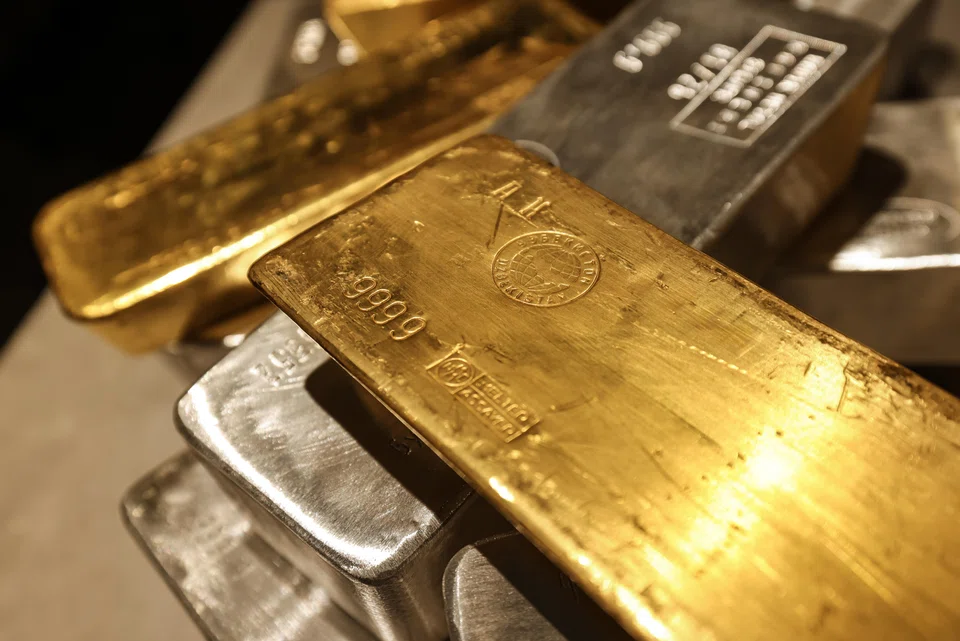
[SINGAPORE] Gold steadied on Thursday (Jan 22), paring early losses after US President Donald Trump dialled back threats to impose tariffs on European nations.
Trump said a “framework of a future deal” over Greenland had been made during talks with Nato secretary-general Mark Rutte, though uncertainty remains over the deal’s specifics.
Gold pierced the US$4,800 mark on Wednesday, hitting a new high of US$4888.21. Consecutive gains were fuelled by concerns over the US’ bid to annex the Danish territory; the precious metal is up about 5 per cent this week.
As at 6.30 pm on Thursday, gold was trading near US$4,825, recovering from losses of as much as 1.2 per cent in early trading. Silver continued its lustrous rally, advancing 0.6 per cent to US$93.57; platinum and palladium also climbed.
Forecasts for gold have become increasingly bullish amid geopolitical escalations in the opening weeks of 2026, such as those in Venezuela and Iran.
Industry observers noted that gold’s record rally from 2025 has continued to piggyback on a slew of structural factors, including investor risk-hedging and continued central bank buying.
Alexandra Symeonidi, senior corporate credit and sustainability analyst at William Blair, said: “I don’t think geopolitical risks are coming down this year, and that’s going to be a major driver for precious metals.”
If tariff and geopolitical risks continue to escalate, investment demand for precious metals is likely to climb in tandem, she told The Business Times. Guy Wolf, global head of market analytics at Marex, said gold is a “critical asset” for the private investing community.
He added that the precious metal serves a dual purpose, as “a means to protect against continued debasement of currencies and as a defensive hedge against economic and geopolitical risks”.
Tailwinds ahead
Among 28 analysts surveyed by the London Bullion Market Association (LBMA), 22 expect gold to surpass US$5,000 this year, while five see it striking the US$6,000 mark.
The remaining analyst, Julia Du, senior commodities strategist at the Industrial and Commercial Bank of China (ICBC), is the most bullish. Du forecasts spot gold to average around US$6,050 an ounce this year, reaching as high as US$7,150 an ounce.
Overall, the upgraded forecasts are driven by expectations of lower US real rates, continued Federal Reserve easing and sustained central bank diversification away from the greenback, LBMA noted.
Spillovers
Among the quartet of precious metals, LBMA revealed in its 2026 Precious Metals Forecast Survey that analysts were more conservative in their price forecast increases for gold.
For now, the analysts expect silver to continue to outperform gold, platinum and palladium in 2026.
LBMA’s survey indicated that silver has an average forecast of US$79.57 an ounce for 2026, up 98 per cent from 2025’s average actual price.
A bull story is also expected for platinum with estimates around US$2,222.14 an ounce or 74.3 per cent higher than last year. Palladium is forecast to consolidate around US$1,740.25 an ounce, logging 51 per cent in average gains.
While the medium-term outlook for more cyclical metals such as silver, platinum and palladium remains constructive, increased volatility is likely, said Heidi Sum, global head of product specialists for liquid real assets at DWS.
Sum holds the view that for now, gold is expected to remain the “least volatile” precious metal. She added that gold could regain relative leadership if markets experience a correction or renewed macro stress in 2026.
This reinforces gold’s role as a “stabilising anchor” within precious‑metal allocations, with silver and mining equities taking on a more opportunistic and growth‑oriented role, said Sum.
While LBMA maintains that geopolitical strains reinforce gold’s role as the “world’s premier safe haven”, it noted that record prices might be starting to weigh on the market.
The association cited softening jewellery demand and price sensitivity among some central banks. Heavy speculative activity leaves the door open for “sharper reversals” in prices if current sentiment sours, LBMA added.
TRENDING NOW

Once staunchly pro-China, Malaysian Chinese businesses are now distancing themselves from Beijing

Looking beyond looming CEO succession, should UOB potentially pursue a transformative merger?

Could stablecoins be the future of money?

Grab CEO’s wife Chloe Tong on life with Anthony Tan and finding her purpose

