

GoTo investors may need a more exciting growth story
Its struggling share price, despite narrower losses, may reflect expectations to ‘go big or go home’

INDONESIA’S GoTo Group is seeing losses narrow since handing control of its e-commerce arm to social media giant TikTok. But its share price is still down 85 per cent since its debut on the domestic bourse two years ago.
Investors could be looking for more exciting earnings drivers from the ride-hailing and food delivery player.
Last week, GoTo reported a 48 billion rupiah (S$4 million) adjusted loss before interest, taxes, depreciation and amortisation for the second quarter ended June.
This is a significant narrowing from its year-ago loss of 885 billion rupiah on a pro-forma basis, which assumes the e-commerce deconsolidation took place on Jan 1, 2023.
Revenue for the quarter was up 39 per cent to 4.3 trillion rupiah. Of this, 3.4 trillion rupiah came from the on-demand segment, which includes ride-hailing service Gojek. The segment itself was profitable, with 90 billion rupiah in adjusted earnings before interest, taxes, depreciation and amortisation (Ebitda). But GoTo went into the red for Q2, with a 168 billion rupiah adjusted Ebitda loss in the fintech segment.
The company aims to increase revenue further and hit adjusted Ebitda breakeven for the full year, said chief executive Patrick Walujo in the Q2 earnings statement.
“As we mark the completion of my first year as chief executive, the company’s fundamentals are the strongest they’ve ever been,” said Walujo, who took up the job in mid-2023. Walujo is co-founder of private equity firm Northstar Group, one of the earliest backers of Gojek.
“Disappointed”
GoTo’s improving financials should be a positive factor, but investors remain lukewarm. The company’s share price has fallen 54.1 per cent over the past year, and 85.2 per cent since its US$1.1 billion initial public offering (IPO) in April 2022.
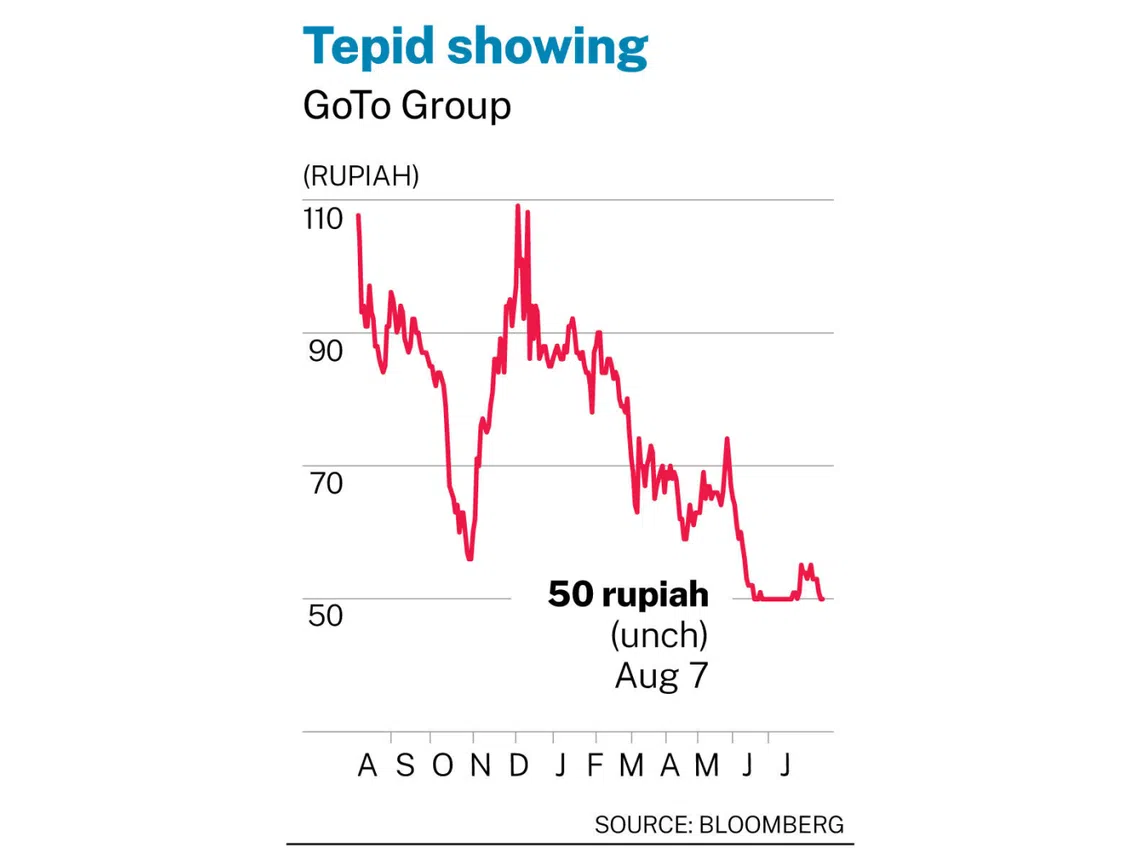
On its IPO debut, GoTo had soared to as high as 416 rupiah. It now trades far lower, closing at just 50 rupiah as of the Wednesday (Aug 7) market close.
“(We) at GoTo and I personally, have been disappointed by our share price performance. We feel that it doesn’t reflect the strong performance of the underlying business,” said Walujo during the company’s earnings call.
The tech rout may be partly to blame. Like its Singapore-based rival Grab, GoTo has to battle tepid investor sentiment in a higher-for-longer interest rate environment.
GoTo’s largest shareholders SoftBank and Alibaba – who both own stakes of over 7 per cent – are also facing their own pressures in the volatile environment.
A more important factor may be perceptions about the company’s growth story. GoTo was originally formed in 2021 from the merger of Gojek and Indonesian e-commerce platform Tokopedia.
But last year, the company combined Tokopedia with domestic rival TikTok Shop Indonesia, with TikTok getting a 75 per cent stake in the joint business.
GoTo still retains some e-commerce exposure from the deal. In Q2, it recorded 171 billion rupiah in e-commerce service fees.
But some observers have noted that the deal came with a trade-off: improving fundamentals while giving up control of a potential growth driver. “GoTo selling three-quarters of its high-cash-burn e-commerce business to TikTok, while significantly relieving pressure on its profit, comes at the cost of losing a substantial amount of potential revenue,” said Bloomberg Intelligence analyst Nathan Naidu in a recent note.
Merger with Grab?
But there is an upside: without the high cash demands of e-commerce, GoTo can direct resources towards more profitable opportunities.
The company’s young fintech arm could present a fresh growth story. In the earnings call, Walujo noted that both the payments and lending businesses have been growing.
GoTo’s loan book grew around 3.5 times compared to last year, reaching 3.5 trillion rupiah. It has also launched a buy-now-pay-later product on TikTok’s ShopTokopedia platform. There is still “massive room to grow”, Walujo noted.
That said, it may take some time for the fintech unit to reach sufficient scale.
Some observers think that a better move would be for GoTo to merge with Grab. Macquarie’s sales team told its clients in February that such a union is “inevitable” and could result in cost savings of up to 50 per cent, according to a Reuters report.
Both companies were reported to have revived merger discussions earlier this year, but GoTo has denied the report. Gojek and Grab had explored a merger in 2020, but that did not go ahead. Grab too faces macroeconomic headwinds; its share price is down 11.7 per cent in the past year.
Whether a Grab-GoTo merger happens remains to be seen. But in the absence of that, GoTo will need to convince investors that even on its own, it is an exciting proxy for Indonesia’s rising digital economy.
Unlike investors in other sectors, those looking at tech perhaps expect more than decent fundamentals. For GoTo, it may be a matter of “go big or go home”.






