

Great Eastern privatisation is ‘natural progression’ in bank’s strategy: OCBC CEO Helen Wong
The lender aims to drive collaboration across its three main business pillars of banking, wealth management and insurance, under its ‘one group’ approach

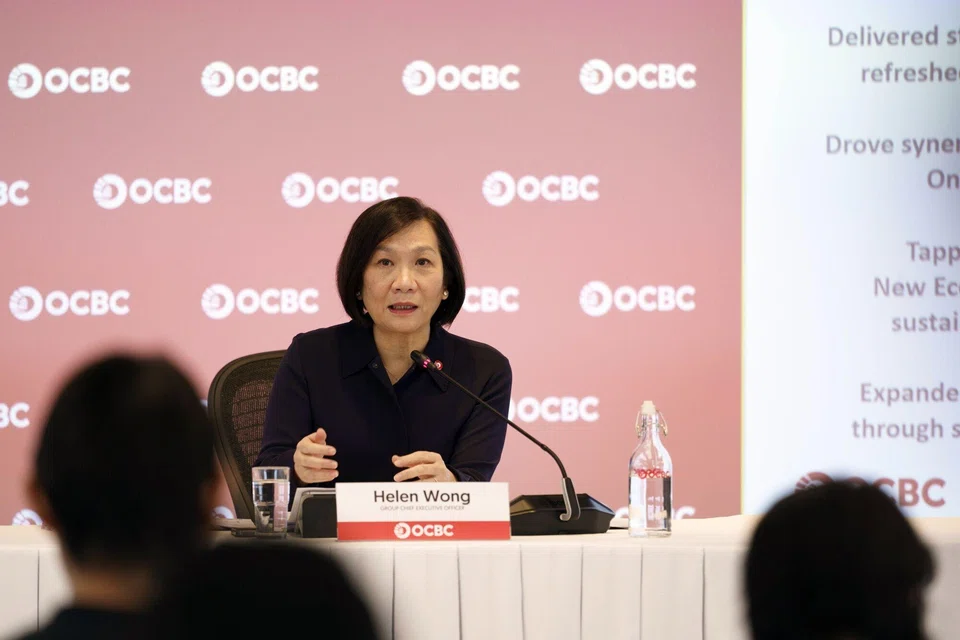
THE full integration of Great Eastern into OCBC will help the lender realise more synergistic value, by providing more opportunities for the bank to work closer with the insurer, said OCBC chief executive Helen Wong.
Wong, speaking at the lender’s fourth-quarter results briefing on Wednesday (Feb 26), said the offer to take Great Eastern private last May was a “natural progression” in its strategy.
OCBC has aimed to drive collaboration across its three main business pillars of banking, wealth management and insurance, under its “one group” strategy.
“We know a balanced portfolio can help us to overcome, in particular, the uncertainty and the volatility in the market over the next decade,” Wong explained.
She noted that in Singapore, 70 per cent of Great Eastern’s customers hold OCBC products, while 30 per cent of OCBC’s customers hold Great Eastern policies, leaving room for more cross-selling of products.
In Malaysia, where the company is seen as a leading insurer, this also leaves more opportunities for its Malaysia banking business, she said.
This is especially so as banks typically do not have access to their insurers’ customers in a regular bancassurance agreement, she added. “The strength of one OCBC group can be amplified if we tightly integrate, for instance, through a bigger ownership of, and if we manage to delist (Great Eastern).”
While Wong said that the lender is “not ready to tell what exactly we are working on”, she noted many more areas to accelerate synergies further, such as in capital resource management, expenses, sharing of expertise and investments.
“The synergy is more than just them using us as a channel – it is whether we can also tap into their client base or their agency base,” she pointed out.
Wong said that the acquisition of Great Eastern will also help with risk diversification and balance of earnings – it is accretive for OCBC’s return on equity; Great Eastern’s profit contributions have also hit as high as 20 per cent in the past decades.
Great Eastern’s new CEO – Greg Hingston, who was appointed in November 2024 – also has an experience of “knowing exactly how to bring an insurance business forward in a banking environment”, she added. “We already have a lot of discussions on how we can realise that synergy, so I’m quite positive about that as well.”
Wong said that she could not elaborate further on plans, given that Great Eastern is a separately-listed entity, with its own independent board and directors.
Last May, OCBC made a S$1.4 billion bid for the remaining 11.56 per cent stake in Great Eastern that it did not already own, with the aim to delist the insurer.
The bank held nearly 94 per cent of the insurer when the takeover offer closed in July, but this was not enough for Great Eastern to delist, or for OCBC to compulsorily acquire the rest of its shares.
The insurer has until May 25 to explore options to comply with free float requirements under the Singapore Exchange’s listing rules.
TRENDING NOW

DBS, OCBC, UOB rout lops billions from STI as inflation, rate concerns spook investors

OCBC sheds S$8 billion in value as shares close nearly 6% down; analysts cautious on banks

IOI Properties and CapitaLand Investment closer to acquiring One Raffles Place in joint bid

Grab CEO’s wife Chloe Tong on life with Anthony Tan and finding her purpose

