GSK opens S$130m facilities in Jurong
New plant and expanded building will step up pharmaceutical firm's output of active ingredients in its HIV medication
Singapore
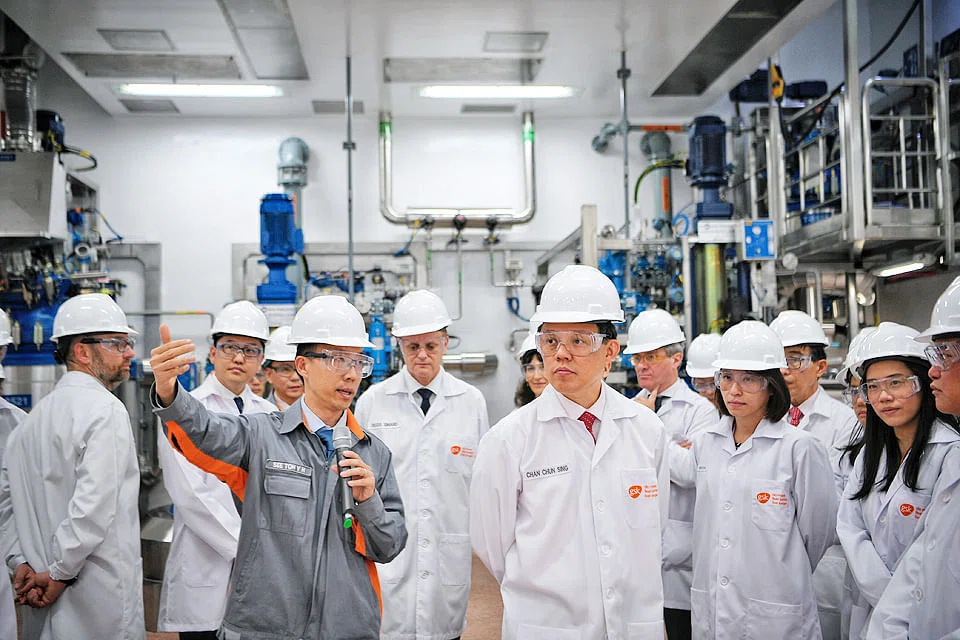
PHARMACEUTICAL giant GlaxoSmithKline (GSK) unveiled a new, fully automated continuous manufacturing facility and an expanded production building at its Jurong site on Friday, worth a total of S$130 million.
The site upgrades will accelerate GSK's global supply chain and, in particular, its production of active pharmaceutical ingredients (APIs) such as Dolutegravir and Lamivudine, key assets in GSK's HIV medication.
The two APIs are used throughout GSK's HIV treatment franchise, which makes up about a third of GSK's pharmaceutical business in the form of drugs such as Dovato, Trivicay and Triumeq.
Daprodustat, an oral treatment for anaemia related to chronic kidney disease, will be the first new chemical entity to be developed in the new facility.
The new facility joins the British drugmaker's existing continuous manufacturing facility, which was built in 2016.
"This technology enables production to take place in one continuous flow with no interruption," said GSK site director Lim Hock Heng. "It gives us better product quality, faster response time and it is also greener to the environment."
Continuous manufacturing involves fewer manual interventions than traditional batch processing, and allows API production to be adapted according to demand.
GSK's expanded building, meanwhile, gained two production modules whose design incorporates digital technology.
The expanded building will be a "testbed for the digitalisation of manufacturing operations and processes", said Regis Simard, pharmaceuticals supply chain president. "Here, we will use data analytics to help reduce cycle time and increase yield."
This level of data-driven flexibility is the future of the pharmaceutical industry, Minister for Trade and Industry Chan Chun Sing said at the event.
"It is what we call precision medicine, enabled by data," he said. "Tailored and custom made for the individual, because we are able to analyse the requirements down to the level of the individual."
Mr Chan was confident that Singapore is well-positioned to participate in this emerging biomedical industry.
"When data flows and data are analysed at scale, that is when we are able to drive precision medicine. Not every country believes in this, but in Singapore, we do."
He added that if Singapore's biomedical ecosystem is to facilitate such data exchange, it must "remain connected with the rest of the world, and work with like- minded partners".
GSK's investment is part of its 10-year Singapore manufacturing roadmap, a collaboration with the Singapore Economic Development Board. This initiative has previously involved GSK contributing S$30 million towards research in green manufacturing and public health policy, as well as an S$80 million investment in its Quality Road plant in 2015.
Operating since 1982, the Jurong site has about 490 employees. GSK was the first global healthcare firm to establish a presence in Singapore in 1959.