

Haidilao couple is Singapore's richest on Forbes list
 Add BT as a preferred source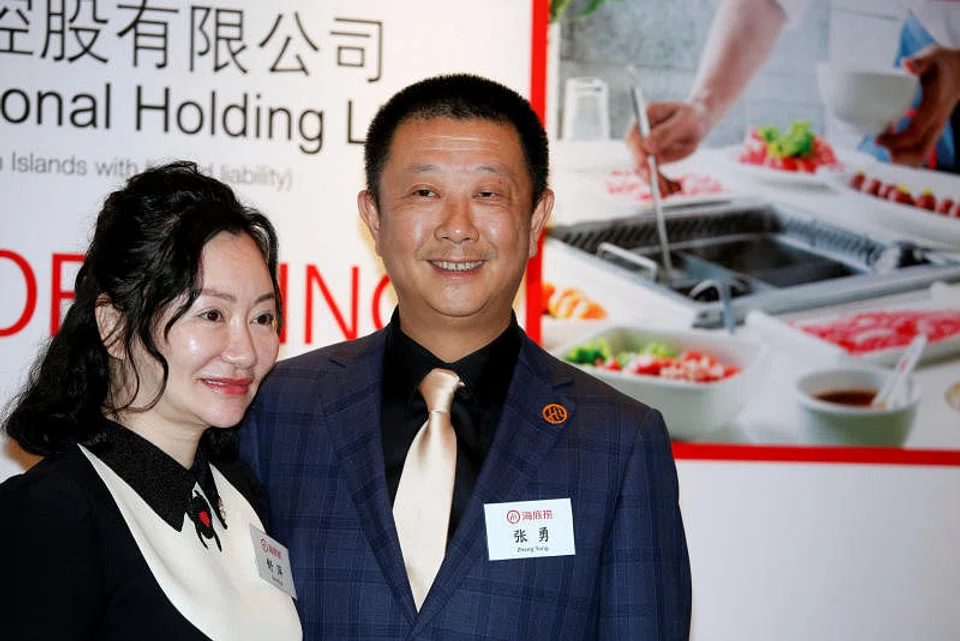
SINGAPORE'S top 10 richest saw their fortunes rise US$37 billion to US$167 billion despite a declining economy and stock market, while the 50 richest clocked 28 per cent gains in their combined wealth, Forbes said on Thursday as it unveiled its 2020 Forbes Singapore Rich List.
It said the city-state had become a "magnet" for tycoons from around the world and provided a home for these wealthy expats, with some taking up citizenship. Three of the top five entrants on this year's list are such individuals, Forbes added.
Haidilao founder Zhang Yong came in tops again this year alongside his wife Shu Ping, a co-founder and director in the company. The couple have a combined net worth of US$19 billion, with the inclusion of Ms Shu accounting for US$5.2 billion. Unlike its billionaire rankings, Forbes' rich list includes family fortunes, including those shared among extended families.
China-born Mr Zhang made his debut on the list last year with a net worth of US$13.8 billion. His entry displaced real estate tycoons Robert and Philip Ng of Far East Organization from the top spot, which they had previously occupied every year for a decade prior. The Ng brothers came in fifth this year, with a combined net worth of US$13.2 billion, up US$1.1 billion.
Second on the list was co-founder and chairman of China-listed Shenzhen Mindray Bio-Medical Electronics, Li Xiting, a naturalised Singapore citizen with a net worth of US$17.8 billion. It is Mr Li's first time on the list. A surge in demand for Shenzhen Mindray's ventilators and other medical devices sent the company's shares soaring amid the pandemic.
Third was paint magnate Goh Cheng Liang, who owns a 39 per cent stake in Japan's Nippon Paint Holdings. Mr Goh saw a multibillion-dollar boost to his net worth to US$14.8 billion, up from US$9.5 billion.
Fourth was Facebook billionaire and Singapore resident Eduardo Saverin, who retains a minority stake in the social media behemoth. His net worth rose US$3.4 billion to US$14 billion on Facebook's share gains.
Sea Limited founder Forrest Li jumped to seventh place this year from No 21 last year, with his US$7.1 billion net worth 4.5 times last year's US$1.57 billion. Shares of the US-listed gaming and e-commerce firm rallied 880 per cent earlier this month to become the world's best-performing large-cap stock.
The other two co-founders of Sea Limited, Gang Ye and David Chen, also saw their net worth spike, with chief operating officer Mr Gang's fortune clocking the biggest percentage gain on this year's list. His wealth jumped to US$4.1 billion, landing him on the 11th spot.
Meanwhile, Mr Chen made his debut on the list at No 25, with a net worth of US$1.37 billion.
The youngest person on this year's list at No 33 is Binny Bansal, 37, the co-founder of Indian e-commerce company Flipkart. Mr Bansal, who has a net worth of US$1.1 billion, relocated to Singapore last year with his family and is now a venture capitalist with investments in more than 40 ventures, Forbes said.
The minimum amount required to make the list increased to US$610 million this year, from US$560 million previously.
Forbes said the big gains enjoyed by some listees this year more than offset the declines suffered by over half the tycoons on the list, including Fragrance Group hotelier Koh Wee Meng and M&L Hospitality's Michael Kum, whose fortunes fell as tourism stalled amid the pandemic.
Four tycoons dropped off the list, including Lim Oon Kuin, whose privately held Hin Leong Trading, one of Singapore's largest oil traders, filed in April for bankruptcy.
Earlier this week, Forbes also released its list of the top 200 listed firms in Asia-Pacific with less than US$1 billion in sales, with six Singapore companies making the list. They are: the Singapore Exchange, AEM Holdings, Eggriculture Foods, Khoon Group, Snack Empire and Union Gas.
Decoding Asia newsletter: your guide to navigating Asia in a new global order. Sign up here to get Decoding Asia newsletter. Delivered to your inbox. Free.
Share with us your feedback on BT's products and services
TRENDING NOW
Yeoh Pei Xien: YTL’s third-gen scion with a pastor’s heart
Singapore banks’ battle for wealth talent goes beyond private bankers
Car dealer charged in S$1.1 million tax evasion case involving Porsches, Ferraris, Rolls-Royces
A ‘shadow bank’ hiding in Singapore’s Little India casts light on financial services gap

