

Hanwell, Serial System see changes in director interests

Singapore
FOR the five trading sessions that spanned June 11 to 17, the Straits Times Index declined 0.8 per cent. By comparison, the Hang Seng Index and KLCI were each down approximately 0.6 per cent over the same period, while the Nikkei was up 0.2 per cent.
Over the five trading sessions, there were a total of 78 changes in director interests and substantial shareholdings filed for more than 40 primary-listed stocks.
Hanwell Holdings
Hanwell Holdings, a group that has recently come under the spotlight on the back of a tussle going on in its boardroom, reported a few changes in shareholder interests over the period.
Hanwell's former executive director Tang Cheuk Chee on June 11 disposed of 68 million shares - some directly owned and some indirectly owned - via an off-market transaction. The total sale price was S$28.6 million, which translates to about S$0.42 per share. The filing was made on the bourse after the market had closed for the day. Hanwell shares ended June 11 at S$0.455.
These shares appear to have been sold to Sin Huat Company, which emerged as a substantial investor of Hanwell on June 11 after acquiring 68 million shares representing 12.3 per cent of voting rights, according to a bourse filing on June 14.
The two shareholders of Sin Huat are Bernard Cheng Koh Chuen and Primus Cheng Chih Kwong. The former is executive director at Prima Group and the latter is Prima Group's chairman and chief executive officer. The core businesses of Prima Group include flour milling, food manufacturing and bakery franchising.
Hanwell manufactures, distributes and markets a range of food and consumer goods. Among its more well known products and brands are Royal Umbrella and Golden Peony rice, Beautex tissues and Fortune Food.
Another filing on June 15 reported that Dr Tang had sold her remaining 39.4 million shares on June 14 for some S$16.5 million. This again works out to S$0.42 per share.
Dr Tang appears to have sold this tranche of shares to Hanwell's non-executive chairman Sam Goi. On June 15, Hanwell announced that Mr Goi's stake in the company had risen to 29.8 per cent, from 22.7 per cent previously, following an off-market transaction.
That makes Mr Goi the single largest shareholder of Hanwell.
Shares of Hanwell reacted positively to the news of the past week's shareholding changes, climbing 11.4 per cent or five Singapore cents to close at 49 cents on June 15 with some 67.2 million shares changing hands.
The shares pared some gains thereafter to close at S$0.44 on June 18, down 3.3 per cent or 1.5 cents for the week.
Prior to these transactions, Dr Tang owned a direct interest of 10.64 per cent or some 58.9 million shares in Hanwell. She also held a deemed interest of 8.76 per cent or 48.5 million shares, which took her total stake in the company to 19.4 per cent.
Formerly an executive director of Hanwell, Dr Tang was not re-elected to the board at the company's annual general meeting on Apr 29. She is the ex-wife of Hanwell's former executive chairman Allan Yap.
Mr Yap, who had been Hanwell's chairman since 2002, stepped down from the company's board on Sept 23 last year.
He had been declared bankrupt by a Hong Kong court in August last year, but Hanwell said it had not been aware of his disqualifying bankruptcy till September.
Mr Goi, who is chairman of popiah skins manufacturer Tee Yih Jia Food Manufacturing, had offered to be executive chairman for a nominal fee of S$1 per annum following the resignation of Mr Yap in September last year. His offer was not accepted by the company's board of directors at the time.
Following Hanwell's April 29 AGM, Dr Tang and Hanwell's chief operating officer Yeo See Liang were ousted from the company's board.
Since then, several changes have taken place at Hanwell's board and management.
In early May, Hanwell appointed two new directors to its board: Tan Kian Chew and Chandra Das. Both are independent directors.
The company also appointed Chu Heng Hwee as chief executive of Hanwell. Mr Chu has extensive experience in the food & beverage industry. He served as CEO of the global bakery division at BreadTalk from 2010 to 2012, as group managing director of BreadTalk from 2016 to 2017, and as group CEO for BreadTalk from 2017 to 2019.
He also served as general manager for the China operations of Japanese chain restaurants run by Maxim's Caterers.
On June 1, Hanwell had announced that Mr Yeo would, as of that date, cease to be Hanwell's COO. This was so as to focus on the company's Malaysia operations, Hanwell said.
In the announcement, Hanwell said that Mr Yeo would no longer be responsible for the company's operations in Singapore.
He would, however, continue to serve as director of certain Hanwell subsidiaries. He remains, for instance, executive director of Socma Trading (M), a Malaysian subsidiary.
In response to queries received from its shareholders ahead of the AGM held on April 29, Hanwell said it was working with e-commerce platforms, including Shopee, Lazada, Redmart, Amazon and Qoo10, in the hopes of offering products in bundles on these avenues.
Serial System
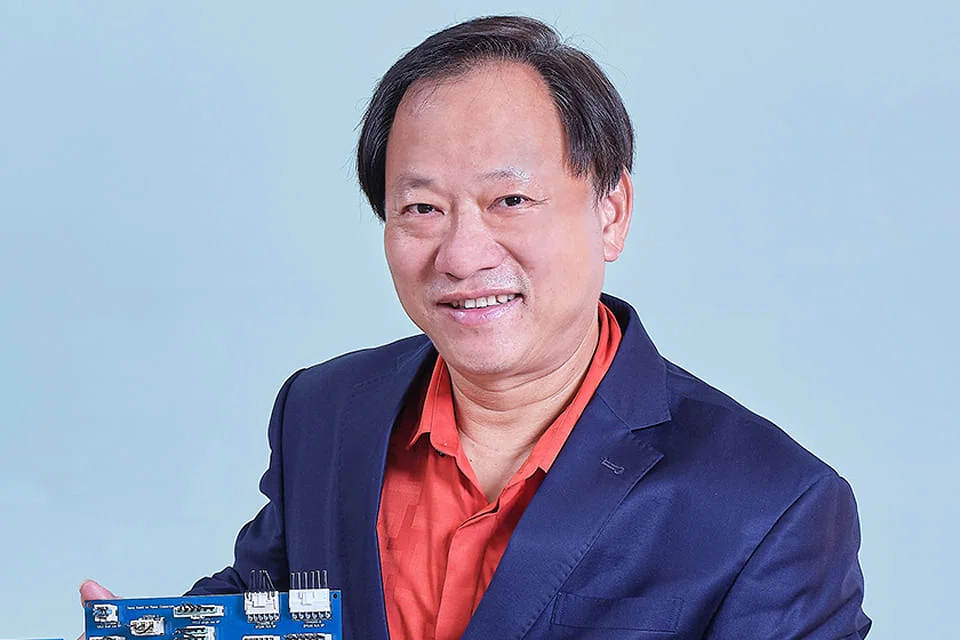
Derek Goh, the founder and chief executive of semiconductor components distributor Serial System, has been raising his stake in the company over the past week - spending a total of nearly S$144,700.
He acquired 461,000 Serial System shares on June 11. According to a bourse filing on June 12, Mr Goh paid S$47,072.71 or roughly 10.2 cents apiece, consistent with the counter's closing price on June 11.
Mr Goh on June 15 bought 153,900 shares for a total of S$22,415.54, or about 14.6 cents a share.
He then made two more transactions on June 16. He bought 400,000 shares for S$59,900, or about 15 cents a share; and another 100,000 shares for S$15,300, or 15.3 cents a share.
With these transactions, Mr Goh's direct interest in Serial System stands at 40.6 per cent. This is up from 40.5 per cent previously. Mr Goh also has a fairly small deemed interest in the company in the form of 171,000 shares held by his daughter.
Serial System, through its wholly-owned subsidiary Serial Microelectronics, lost its distribution agreement with major supplier Texas Instruments (TI) in 2018. The company said then that it was also mulling a potential sale of its TI distribution business.
After some difficulties, Serial System appears to have improved its position recently. It reported net profit of US$2.7 million for the first quarter ended March, reversing from losses of US$6.5 million in the year-ago period. Earnings per share came in at 0.3 US cent from a loss per share of 0.72 US cent last year.
Serial System's revenue rose 44 per cent to US$223.3 million, from US$154.7 million, on the back of the company's strategies to widen its supplier and customer base and improve efficiencies following the outbreak of Covid-19 pandemic.
The company also cited "internal efficiencies" such as its attempt to lower its cost structure in areas such as manpower and related costs, as well as administration expenses. Mr Goh said the company would continue to grow its consumer products division in South-east Asia.
TRENDING NOW

Could stablecoins be the future of money?

Once staunchly pro-China, Malaysian Chinese businesses are now distancing themselves from Beijing
Vietnam’s data-centre investment rush faces reality check on power and site constraints
‘My grandfather’s legacy’: Sherman Kwek lays out three-year plan for CDL to drive returns

