HDB shophouses drawing bigger players with attractive yields and affordability
Transactions for these assets in public housing estates on the rise, thanks to relatively high yields of 4-6%

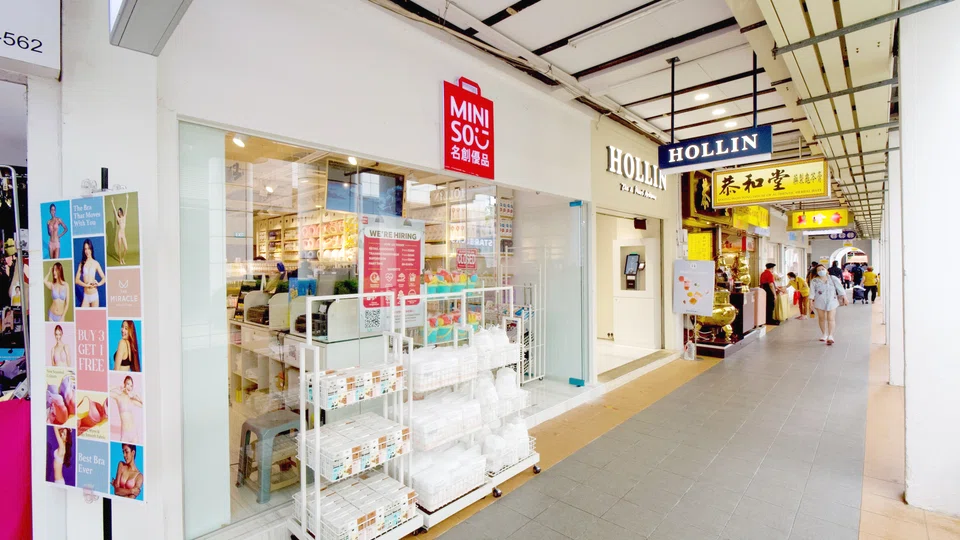
INTEREST in Housing and Development Board (HDB) shophouses is on the rise, with buyers drawn to their relatively high yields, high-traffic locations and limited supply in the market for assets in public housing estates.
Although prices have slumped in recent months amid market uncertainty, volumes and rents remain elevated as the profile of businesses taking up HDB shop space has changed, analysts noted.
Data crunched for The Business Times by local database company Amicus showed that 63 HDB shophouse units changed hands for S$122.5 million as at Sep 26 – already surpassing the 44 transactions worth around S$91 million in 2023.
The average price of an HDB shophouse was S$1.9 million for the nine months tracked this year, 3 per cent lower than the previous year’s S$2 million and 28 per cent lower than the S$2.7 million average in 2022. It was also nearly 20 per cent lower than the S$2.4 million in 2021.
The priciest deal inked this year was for a 3,412 square feet (sq ft) shophouse in Jalan Bukit Merah, which transacted for S$10 million or S$2,931 per square foot (psf) on floor area in March. This was followed by a 1,593 sq ft unit in Ang Mo Kio Avenue 4, which changed hands for S$4.7 million or S$2,938 psf in June.
In comparison, the private commercial market saw 40 shophouses sold for S$354 million in the first half of this year, according to a Knight Frank report. The inclusion of the Q2 sale of The Rail Mall, a strip mall property with 43 shop units and 89 car park lots, pulled the average price down to S$2,225 psf on land for H1 2024.
In the first quarter, however, private shophouse prices were firm and averaged S$5,566 psf on land although volume slipped.
According to Knight Frank, some 53 shophouses changed hands in H2 2023 at S$428.2 million, at an average price of S$5,116 psf on land. This was down from H1 that year when 79 units sold for S$728.9 million at an average S$5,448 psf on land.
Market lull in 2023
Shophouse sales peaked in 2021, when a bumper 254 units worth S$1.9 billion changed hands and high-net-worth investor money flowed into the asset class. The market quietened down in 2023 in the aftermath of the money laundering crackdown in August. Several high-value shophouse deals were eventually traced to members of the Fujian syndicate nabbed in the dragnet.
Like private shophouses, the price growth of HDB shophouses rationalised after “rapid acquisition” in 2021 and 2022, said Evan Chung, head of Knight Frank’s property network.
But interest is returning, and brokers are now seeing HDB shophouse properties catching the attention of bigger players drawn to the yields.
Average yields for such shophouses range between 4 and 6 per cent per annum, depending on the balance tenure and footfall in the area, said Knight Frank capital markets executive director Mary Sai.
In comparison, private freehold conservation shophouses generally fetch a yield of 2 to 3 per cent, while leasehold shophouses may return a slightly higher yield of up to 4 per cent due to shorter tenures, she said.
“The (difference in rental yield) arises from the upfront premium that the investor has to pay for the freehold title, as compared to a leasehold one with a balance lease of perhaps 40 to 50 years,” said Chung.
Affordable assets
Compared with freehold conservation shophouses, HDB shophouse assets are relatively affordable, priced at around S$2.6 million to S$3 million, and serve dual purposes for owners – they can lease out the commercial unit as an income stream while residing on the upper floor of the residential unit, said William Lai, Amicus founder and chief executive.
Median HDB shophouse rents are slightly lower today than they were five years ago. But rents have been trending upwards as major retailers and food and beverage operators started taking over commercial spaces that were previously occupied by small family-run shops and eateries, said Clemence Lee, CBRE capital markets executive director for Singapore.
“These tenants can typically pay higher rentals compared to traditional mom-and-pop shops, and they also attract younger shoppers with higher spending power to the HDB shophouses,” said Lee.
“With rents trending upwards, capital value and prices have also increased.”
The highest rental signed in the year thus far was for a 2,400 sq ft shophouse along Lorong 6 Toa Payoh, which was leased for S$24,000 a month in May, figures from Amicus showed. Another unit in the same area was also leased for S$24,000 a month in June.
Outliers aside, data from HDB showed rents of HDB shops, which include shophouses, remained largely unchanged in the past five years. Meanwhile, median rents for suburban retail space, which include major malls, have risen around 19 per cent since their pandemic lows, pointed out Tricia Song, head of research for South-east Asia at CBRE.
Rents of food and beverage outlets in HDB shophouses, such as coffeeshops and cafes, were S$7.11 psf in H1 2024, lower than the S$7.69 psf in 2019. That of medical facilities slipped to S$7.21 psf in H1 2024, from S$7.86 psf in 2019, while that of essential services, such as provision shops and supermarkets, remained flat at around S$5.25 psf in the same period.
“In general, HDB rental shop rents are below private rentals,” said HDB.