

Healthtech use surges amid pandemic; now to put the brakes on costs
Meaningful use can boost productivity and result in savings, but more advanced tech will require investment which needs to be recouped
 Add BT as a preferred source
Claudia Tan HS
DeeperDive is a beta AI feature. Refer to full articles for the facts.
Singapore
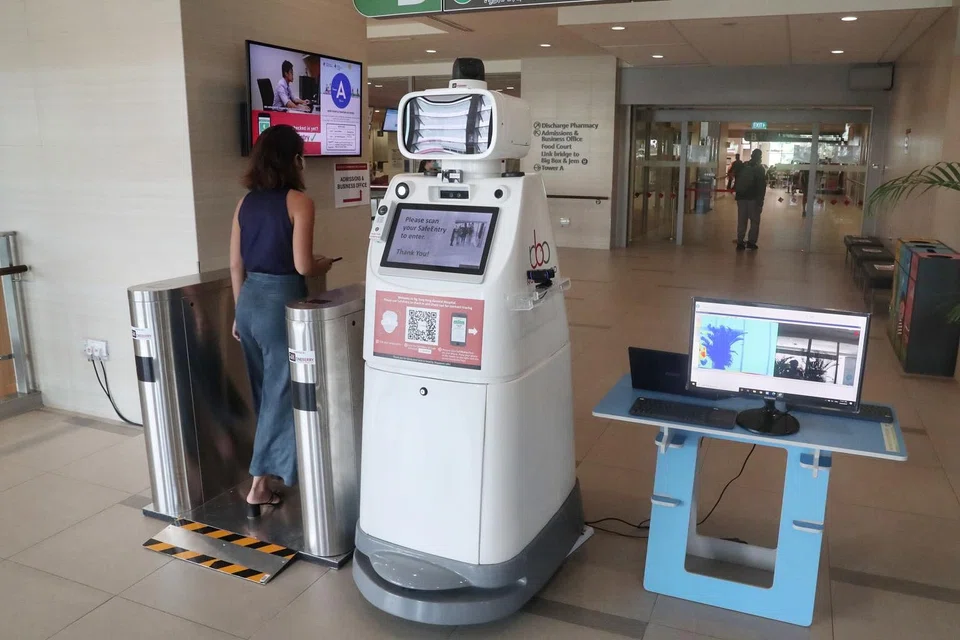
THE Covid-19 pandemic has prompted greater adoption of technology in the healthcare space to cope with a shortage of medical professionals and safe distancing measures. While the acceleration of technology will boost productivity and efficiency for healthcare providers here, the impact on medical costs may be limited.
When the virus swept across the region, a manpower crunch and tougher safety rules threatened the healthcare system's ability to cope with the pandemic.
Elective treatments were put on hold and isolation facilities had to be expanded through the conversion of exhibition centres. Healthcare workers also had to be recalled, retrained and redeployed.
To cope with the shortage of manpower and facilities, some of the once nascent technologies have become essential in the industry.
Ivy Lai, country manager of Philips Singapore said: "Covid-19 has pushed many in the healthcare space to accelerate the rate of health technology adoption and transformation".
Navigate Asia in
a new global order
Get the insights delivered to your inbox.
As the healthcare system grappled with a surge of patients, Ms Lai said that there was a "keen adoption of telehealth solutions and other digital health technologies".
Against this backdrop, Caroline Clarke, market leader at Philips Asean Pacific said that technology will have a "direct impact on lowering medical costs for the end-users if used correctly and effectively".
She cited a pilot heart failure telehealth programme by Changi General Hospital and Philips, which placed some 150 heart failure patients in a telemonitoring group between November 2014 and March 2016. They received telemonitoring support for a year and results were compared against a group that received support only via phone calls.
The programme resulted in a 67 per cent reduction in length of hospital stay for heart failure-related readmissions and a 42 per cent reduction in costs of care, said Philips.
Healthway Medical Group's executive director and deputy chief executive officer, Abram Suhardiman shared similar sentiments.
"The meaningful implementation of tech serves the important purpose of improving productivity and efficiency, and for many aspects of the healthcare sector this will indeed lead to greater cost savings.
"This is especially so when it comes to increasing productivity for administrative processes, both at the clinic and management levels."
Healthway Medical, for instance, enhanced its clinic management system by improving its efficiency and optimising backend processes while integrating it with its teleconsultation app.
Meanwhile, technology adoption doesn't always necessarily require large investments to ensure that cost-savings are not diminished.
Singapore O&G tapped teleconsultation as well as secure file sharing platforms during the pandemic. Chief executive officer Eric Khoo said it is still able to absorb the cost of these technologies adopted given that they were relatively "simple" and "inexpensive" tools.
More advanced technology-enabled systems will "naturally require initial investments" to develop and implement the necessary infrastructure, said Healthway Medical's Mr Suhardiman.
When it comes to telemedicine, for instance, Tay Wee Kuang, analyst at Phillip Securities Research said there is still room for development before it offers substantial cost-savings.
Greater cost-savings could be delivered through more integrative suites of telemedicine or telehealth services, said Mr Tay. In the meantime, development and adoption costs incurred may offset the benefits from the operational efficiencies that they will enjoy, he added.
As such, technology in the healthcare space may yield better cost savings in the long run, said observers.
Healthcare economist Phua Kai Hong said that it is common for the initial cost of technology to be very high but may go down when it is more widely used.
But Amitabh Deka, Aon's head of wellbeing solutions, South Asia and Aon Care, said that widely used technologies may not necessarily guarantee economies of scale.
Improvements in the outcome and quality of medical services may "in fact lead providers to increase the price point", said Dr Deka.
Redundant technology in healthcare may also add to cost.
A technology may be better than the incumbent during its introduction but may continue to be used as a default option even when it becomes redundant, said Dr Deka.
"This often takes time to act upon, introducing inefficiency and needless costs."
Decoding Asia newsletter: your guide to navigating Asia in a new global order. Sign up here to get Decoding Asia newsletter. Delivered to your inbox. Free.
Copyright SPH Media. All rights reserved.
TRENDING NOW

Shelving S$5 billion office redevelopment plan proved ‘wise’ as geopolitical risks mount: OCBC chairman

Eurokars Group introduces rental car franchises Enterprise Rent-A-Car, National Car Rental, and Alamo to Singapore

20 photos that show how dramatically Singapore has changed in two decades

Singapore’s key exports up 15.3% in March from electronics surge, exceeding forecasts

