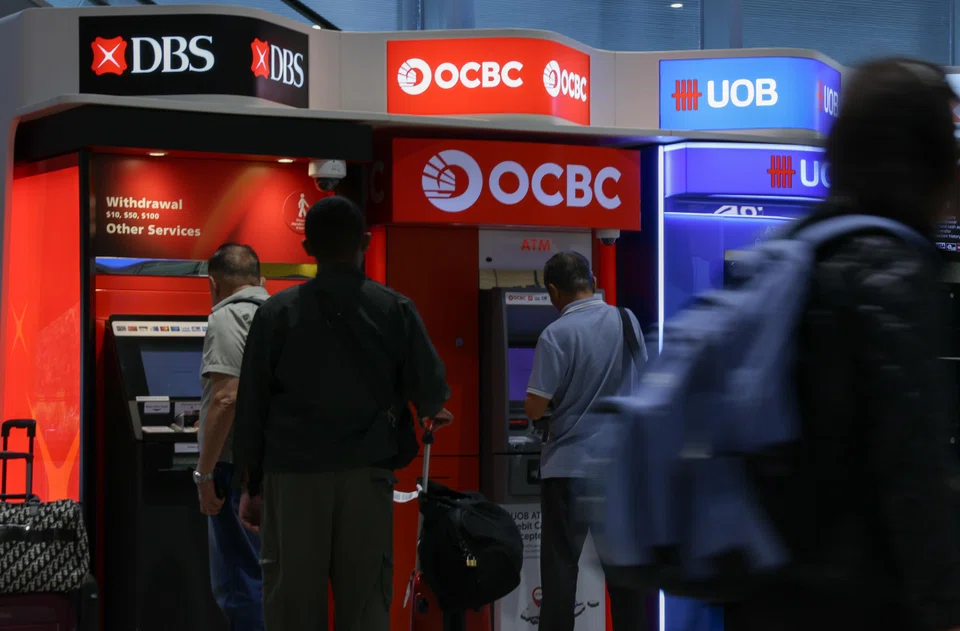
Higher-for-longer US rates could boost Singapore banks’ earnings beyond 2026: analysts
A hawkish Fed could be good news for DBS, OCBC and UOB, even as benefits may not be equal across the sector

[SINGAPORE] A more hawkish US Federal Reserve could provide an earnings boost for Singapore banks by slowing the pace of net interest margin (NIM) compression, analysts say.
Some have also suggested that the sector’s outlook beyond 2026 may improve if interest rates remain elevated.
The prospect of US rates staying higher for longer comes as markets reassess expectations for monetary easing after the Fed signalled a firmer stance on inflation and interest rates under new chair Kevin Warsh.
For Singapore lenders, higher rates generally support profitability by lifting interest income earned on loans and other assets.
“In general, and based on historical performances, banks tend to perform better in higher-rate environments, as this will benefit (their) interest income,” said Carmen Lee, head of equity research at OCBC.
She noted that bank shares rose after the latest Fed meeting on Jun 17, reflecting investor optimism that higher rates could support earnings.
Since that meeting, shares of DBS , OCBC and UOB have risen 1.9 per cent, 1.3 per cent and 1.4 per cent, respectively. In the year to date, DBS is up 17.4 per cent, OCBC has gained 25.7 per cent, and UOB has advanced 15.3 per cent.
While OCBC’s forecasts for 2026 remain largely unchanged because of expectations for relatively stable rates over the coming months, a prolonged period of elevated rates could prompt a review of earnings estimates for 2027, Lee said.
A key reason is that higher rates could help ease the margin pressure that Singapore banks have been experiencing.
Bloomberg Intelligence senior credit analyst Rena Kwok said that a more hawkish Fed would provide a “direct tailwind” to the earnings outlook of Singapore banks, by slowing the NIM compression seen across the sector in the first quarter of 2026.
She added that sustained profitability would “continue to underpin” the lenders’ strong capital positions and support shareholder returns through active capital management.
Why do Singapore rates matter?
The impact on Singapore banks depends partly on how local interest rates respond.
Although Singapore’s monetary policy is centred on managing the exchange rate rather than domestic interest rates, analysts noted that Singapore dollar borrowing costs generally move in the same direction as US rates.
Chen Jiesheng, an interest rate strategist at UOB, said that the Singapore Overnight Rate Average (Sora) typically tracks the US Secured Overnight Financing Rate (SOFR), albeit with occasional lags.
“A hawkish Fed exerts upward pressure on Singapore rates, though the pass-through is often dampened by S$NEER appreciation,” he said, referring to the Singapore dollar nominal effective exchange rate.
Chen expects the gap between Sora and SOFR to narrow gradually, and forecasts compounded three-month Sora at 1.42 per cent by Q4 2026.
As at Wednesday (Jun 24), the compounded three-month Sora stood at 1.07 per cent, down from 1.18 per cent at the start of the year.
Still, the transmission is not always straightforward.
Morningstar equity analyst Kathy Chan noted that Singapore experienced significant safe-haven inflows in 2025, which helped suppress domestic funding costs even as US rates remained elevated.
Those dynamics could persist amid ongoing geopolitical uncertainty, potentially limiting how much Sora rises even if the Fed adopts a more hawkish stance, she said.
Chan also warned that any benefit to interest margins could be partly offset by weaker loan growth if businesses become more cautious amid a challenging macroeconomic environment.
Which bank stands to benefit most?
Among the three local lenders, analysts pointed to DBS as having the strongest asset-quality profile if rates remain higher for longer.
Kwok of Bloomberg Intelligence said that DBS is best positioned to withstand stress on borrowers’ repayment ability because it has fewer defaults among riskier customer segments, and maintains stronger provisioning buffers than peers.
Those reserves would provide a cushion against potential credit losses should elevated borrowing costs begin to weigh on weaker borrowers, she added.
At the same time, DBS may not necessarily be the biggest beneficiary of higher US rates.
The bank disclosed in April that it had positioned for lower rates, with management saying that delayed Fed easing had weighed on earnings.
This example underscores how a higher-for-longer rate environment does not automatically translate into stronger earnings for banks. Depending on factors such as hedging strategies, rising rates can sometimes become a headwind to net interest income.
In April, DBS CEO Tan Su Shan shared that for every basis point (bps) of increase in US dollar rates, the lender’s net interest income falls by about S$4 million.
A month later, OCBC’s management said that the bank’s annualised net interest income sensitivity to a 1 bps decline in rates across its major currencies was about S$5 million, with the Singapore dollar being the “key driver”.
Management at UOB, meanwhile, said the lender was “a lot more sensitive” to movements in Sora than to US interest rates.
Morningstar’s Chan noted that DBS also has a net floating-liability position on its US dollar balance sheet, meaning higher US rates could create some pressure on margins for that portion of the business.
That could partially offset the broader benefits from a higher-rate environment, making the impact on DBS more nuanced than a simple uplift from rising rates, she said.
TRENDING NOW
‘Not trying to solve world hunger’: GoTo takes pragmatic approach to AI
He built the Vingroup empire. Now South-east Asia’s richest man is handing some key roles to his sons
Malaysian developer Eco World tops bids for Sin Ming area housing plot with S$1,612 psf ppr bid
Singapore’s new data centres must use renewables. Can they overcome the hurdles?