

Homes, offices, the great outdoors - NetLink wants to hook up wherever
It has no plans to invest overseas for now as it wants to focus on what it is supposed to do.

Annabeth Leow
Singapore
TOUTED as a defensive play in line-ups such as OCBC Investment Research's Singapore model portfolio, NetLink NBN Trust is seen as poised to weather the ongoing pandemic.
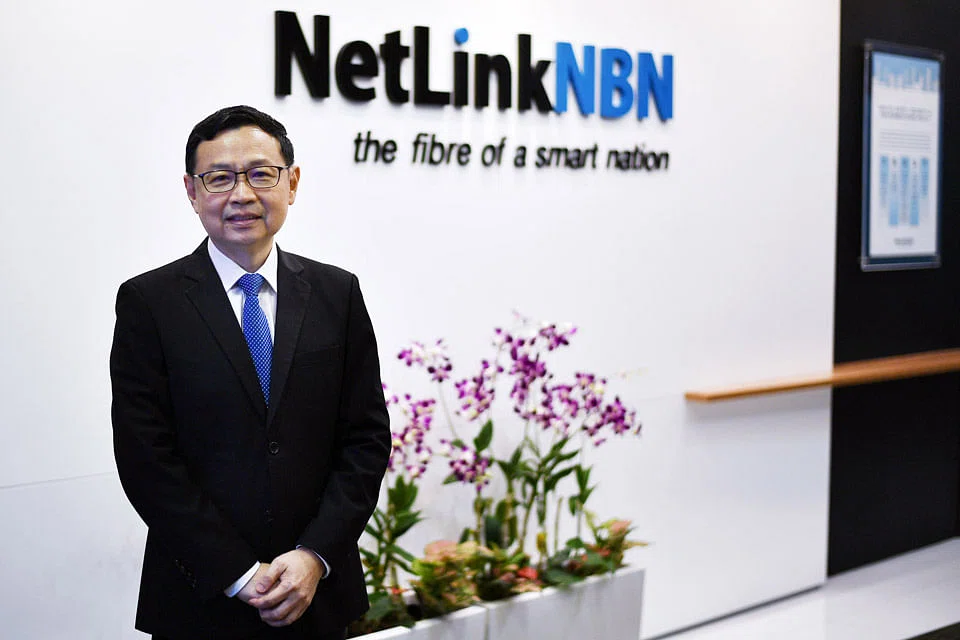
The sticking point, according to Tong Yew Heng, chief executive of the manager, is how the fibre broadband business trust can grow. So his plans involve not just its core residential market, but also small businesses and imminent 5G developments.
Speaking to The Business Times in mid-March, Mr Tong reiterated that NetLink's "business model is resilient" since its hook-ups yield steady revenue, with users unlikely to jump ship.
"We are not as concerned as other businesses on whether the volume will actually drop," he said. "The question for us has always been what is the growth going to be like."
NetLink provides fibre connections to homes; non-residential users; and non-building address points (NBAPs) such as roofs, void decks, bus stops and traffic lights. As at end-2019, it served more than 1.42 million home users, 47,408 non-residential connections and 1,624 NBAPs.
Residential connections form the bulk of its business - contributing close to two-thirds of the S$91.6 million in revenue reported for the three months to Dec 31, 2019.
NetLink enjoys a de facto monopoly in this segment, although it does not serve homes directly. It is paid for its fibre services by requesting licensees (RLs) - telecom players such as Singtel and StarHub. NetLink also competes with the telcos in other segments.
Besides new commercial and residential buildings and new estates, such as the Punggol Digital District or Tengah, NetLink is eyeing redevelopment in mature estates such as Toa Payoh.
Non-broadband users are another untapped market, Mr Tong said. These include some 90,000 households, such as seniors and lower-income families. More of them could take up broadband with help from the Infocomm Media Development Authority (IMDA)'s enhanced Home Access 3.0 scheme, which takes effect in April. It will give eligible households a broadband speed upgrade at no extra cost and includes an option of a broadband and smartphone bundle not available previously.
On the non-residential front, an estimated 200,000 small and medium-sized enterprises (SMEs) are not on fibre and may be using alternatives such as mobile broadband.
Potential market segment
"We are looking into this area and doing more studies to understand their broadband requirements," said Mr Tong, naming chain stores as a potential market segment. "We are talking to the RLs to better understand how we could help them sell more of these broadband connections."
NetLink's wholesale fibre prices are regulated by the IMDA. For example, the monthly recurring charge in the non-residential segment is S$55 for each connection. Nevertheless, tariff rebates can be offered under "customised agreements" with the regulator's approval.
"If (RLs) have a proposal, they can always bring it to us, if they want a bulk discount and if they are targeting a certain location... Some of them can be quite creative. They have their own ideas about how they want to structure their offer to a certain group, whether it's a large corporate or an SME, and we do listen," he said.
The other, sexy avenue for growth is 5G wireless technology. Regulators are presently weighing proposals for two nationwide networks. Meanwhile, NetLink has already been tapped for pilots such as TPG Telecom's 5G trial network at Science Parks 1 and 2.
Mr Tong cautioned that 5G technology is not about to move the needle for NetLink yet. "The roll-out needs a fair amount of time and the pace of the roll-out is also not determined by us - it's determined by the telcos that will be awarded the 5G licences. But, in any case, it will be positive for us."
As NetLink seeks growth, it will need to invest. The trust's manager is expecting capital expenditure to be higher this financial year than the S$71.1 million spent for the 12 months to March 31, 2019.
NetLink is investing in flexibility and diversity, Mr Tong told BT. "The next phase will be fibre-to-anywhere in the country and that will not be easy; but that's an opportunity for us."
For example, some customers want their fibre to run from different locations. Also, upcoming NBAP connections for Smart Nation projects and 5G access require a denser network to be in place - rather than direct routes and minimal manholes.
"We will also design the fibre route such that it could also serve potential outdoor requirements," Mr Tong added. This means that fibre should run along the road, so that it can easily be hooked up to street infrastructure like lamp posts when the time comes.
Positive outlook
NetLink's connections from the NBAP segment shrank by 5.2 per cent quarter on quarter at one point last year, as the Smart Nation Sensor Platform initiative moved into a new phase of trials: from NetLink's above-ground boxes to Singapore Technologies Engineering's "smart lamp posts". But Mr Tong dismissed this change in numbers as merely "fluctuation" and remains positive about the outlook for outdoor projects.
"It doesn't matter if you switch on and then later switch off. The more trials there are, the more interest in trying to deploy to outdoor locations. Eventually, over the long run, it should lead to more requirement."
NetLink had about S$636 million in gross debt on its books as at end-December. DBS analysts Sachin Mittal and Lim Rui Wen say that gives it "ample debt headroom to fund future growth".
The resilience of NetLink's business model may be tested amid the present Covid-19 crisis, but Mr Tong told BT that all its telco customers "have been prompt in their payment for fibre connections".
Recurring revenue is not likely to take a hit from the outbreak, even though "there might be a slower pick-up in business activities and all that" if the uncertainty wears on.
"We have to wait and see, because we are about one month into this... But that will only affect the number of new additions," Mr Tong said.
Meanwhile, as NetLink's customers-cum-competitors face cut-throat competition in the consumer mobile market, it appears that the broadband market has calmed down. "In fact, if any part of their business is facing more risk, this part, the fixed broadband business, would become more important to them... Over the last two years, we have seen the prices for residential end-users settle down at a fairly stable level," he said.
Even inconveniences such as service disruptions from cable cuts are not expected to pose a serious financial issue, according to Mr Tong.
According to IMDA statistics provided to BT, since 2015 there have been about seven Internet service disruptions each year affecting at least 500 users for more than an hour. Two-thirds were caused by contractors working on MRT lines, drains, and other activities.
The latest outage at NetLink, in late February, saw service to about 1,000 households in Ang Mo Kio knocked out for more than six hours after a third party's contractor cut cables during sewer diversion.
But Mr Tong said the trust can recover disruption-related costs from such third-party contractors. The regulator has also rolled out tougher requirements for earthworks contractors last year.
NetLink's focus on Singapore makes it one of the few purely domestic plays listed on the Singapore Exchange - not a bad position given the border shutdowns going around across the world - and Mr Tong says the intention is to stay a domestic player.
"We are committed to helping Singapore achieve its vision of a Smart Nation, so there's still a lot of work to be done," he said. With islandwide fibre-to-the-home coverage secured, Mr Tong said the next Smart Nation step is fibre-to-anywhere: "Therefore we have no plans to invest overseas right now. We want to do what we are supposed to do, well, and I think that requires focus."
TRENDING NOW

South-east Asia has lost Nvidia’s best salesman

Higher rates, weaker spending: Is the Philippines entering stagflation?

Who is Leo KoGuan, the Singapore-based billionaire backing Nvidia’s Jensen Huang?

Demand, tech capabilities position Apac and AI as Skyscanner’s next growth frontiers: CEO Bryan Batista

