Hot stock: SIA dives 9.4% after Q3 results disappoint, erasing 3-week gain

Vivienne Tay
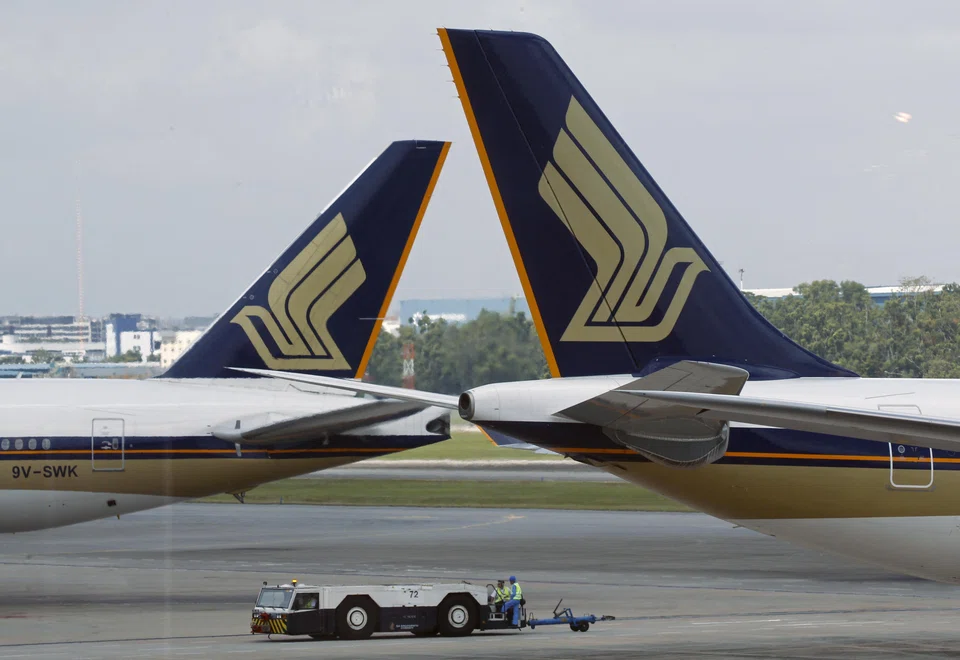
SHARES of Singapore Airlines (SIA) tumbled as much as 9.4 per cent during early trading on Wednesday (Feb 21) after hitting a six-month high on Tuesday.
Investors took profit amid disappointment from the national carrier’s financial results for the three months ended Dec 31, 2023. Analysts were disheartened by Q3’s net profit performance, which came in 15 per cent below consensus.
Three weeks of gains for SIA’s stock evaporated seconds after the market opened, as the counter hit a low of S$6.68. This was down S$0.69 from its closing price of S$7.37 – a six-month high for the flagship carrier – on Tuesday, before the results announcement.
By 10.22 am, SIA was trading 9 per cent or S$0.66 lower at S$6.71. It was the fourth most traded counter by volume at the time, with 17.9 million shares changing hands.
On Tuesday, SIA posted net profit of S$659 million for the third quarter ended Dec 31, 2023, rising 4.9 per cent from S$628 million in the corresponding year-ago period.
This came amid robust passenger demand, led by a rebound in North Asian markets as China, Hong Kong, Japan and Taiwan reopened, the group said in its business update.
Operating profit, however, was 19.3 per cent higher at S$609 million from S$755 million in the previous corresponding period, as total expenditure rose, with non-fuel expenditure and net fuel cost rising.
Following the results on Tuesday, CGS-CIMB downgraded SIA to “hold” from “add” but raised its target price to S$7.30 from S$6.91.
The downgrade follows SIA’s strong share price increase over the past three months and the airline’s guidance on passenger yields continuing to normalise as competitors gradually restore their flight capacities.
In contrast, OCBC Investment Research raised its fair value estimate on SIA to S$8 from S$7.29 after raising its price-to-book estimates. It has a “hold” recommendation on the counter.
“In our view, SIA continues to hold long-term value in investors’ portfolios, although there could be some share price volatility in the near term ahead of SIA’s full-year results release,” OCBC said in a report on Wednesday.
DBS Group Research, meanwhile, did not expect the sequential declines in SIA’s Ebitda (earnings before interest, taxes, depreciation and amortisation) and operating margin during the seasonally stronger quarter.
The results also came as a “negative surprise” for Citi, particularly the quarter-on-quarter increase in fuel costs per available seat kilometres (ASK) ahead of rising jet fuel costs. ASK is a measure of an airline’s carrying capacity to generate revenue, with the available seats multiplied by the distance flown.
SIA’s quarter-on-quarter cargo yield growth of 3 per cent was also soft compared to peers such as EVA Airways and China Airlines, which grew 32 per cent and 20 per cent, respectively on the quarter, Citi noted.
Year on year, cargo yields were down 37.4 per cent, although loads rose 3.9 per cent due to strong year-end demand from e-commerce. Cargo yields for the quarter also remained 32.1 per cent above pre-pandemic levels.
CGS-CIMB noted that cargo yields for the period were 51 per cent lower than SIA’s peak in Q3 2022.
After accounting for lower cargo yields and higher jet fuel prices, the research team cut its FY2024 core earnings forecast for the airline by 9 per cent.
It believes Bloomberg’s consensus expectations on SIA’s financial performance may have also “run ahead of reality”.
In the release of its results, SIA said air travel demand would remain healthy in the next two quarters on robust forward sales and capacity increases in most markets ahead of the school holiday period. This suggested that passenger load factors would continue to see high levels in the near term.
“However, we think that these positives have been well reflected in its share price, and the street may have run ahead of what SIA can reasonably deliver,” said CGS-CIMB analyst Raymond Yap.
DBS believes the market was in search of a stronger set of results, particularly in light of the stock’s robust performance year-to-date. It currently has a “hold” recommendation with a target price of S$7.
Citi, meanwhile, has a “buy” call on SIA and a target of S$7.72 and believes the decline in share price could be short term. While the research team is encouraged by the strong demand guidance for the next quarter and overall passenger yield strength in the quarter ended Dec 31, 2023, it is seeking further information from SIA’s management over the softer-than-peer cargo yields.
TRENDING NOW
Grab CEO’s wife Chloe Tong on life with Anthony Tan and finding her purpose
Jacqueline Loh to step down as MAS deputy MD in senior leadership reshuffle
Why 1 in 2 young Singaporeans who said ‘no kids’ now say ‘yes please’: new study
Private home prices accelerate with 1.4% rise while HDB resale values dip further in Q3: flash data