

From smarter e-waste recycling to circular packaging: How local partnerships with MNCs are driving growth in S’pore
Collaborations with home-grown innovators are enabling global companies such as SK tes, Diageo and Sanofi to tackle emissions, strengthen productivity and drive expansion in the region
AS CLIMATE targets meet cost pressures, supply chain complexity and rising stakeholder scrutiny, sustainability is no longer just a corporate add-on but a business imperative.
In Singapore, a growing number of multinational corporations (MNCs) are turning to local enterprises not only to reduce emissions and waste, but also to improve efficiency, strengthen resilience and build new capabilities for growth across Asia.
See how SK tes, Diageo and Sanofi have found partners among Singapore’s innovators, to help them co-develop and deploy sustainable solutions.
SK tes and Aubotic Technology: Automating e-waste recycling for efficiency and safety
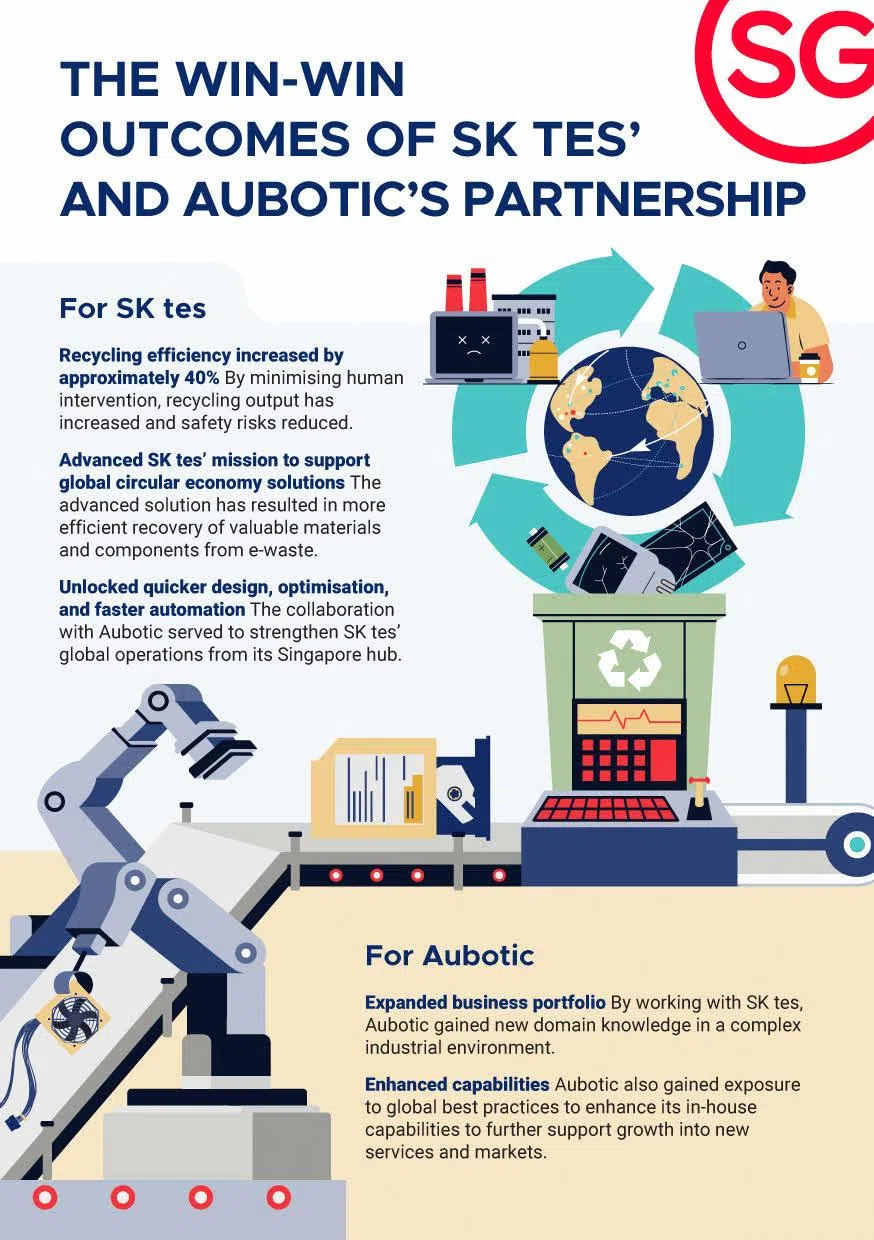
Electronic waste, or e-waste, is typically collected and sorted by hand into categories. The devices are then examined. Parts that can be reused are then extracted. What remains is safely destroyed. For many companies, this process can be tedious and complicated.
SK tes, a global leader in sustainable technology solutions headquartered in Singapore, needed to address the environmental impact of e-waste and the inefficiencies of the recycling process.
The company turned to automation to improve productivity, increase the accuracy and efficiency of recovering valuable materials and components, and enhance worker safety.
In 2025, SK tes initiated a partnership with Aubotic Technology – a Singaporean automation and robotic engineering solutions provider – to research and build next-generation robotic technologies aimed at improving consistency and reducing reliance on manual labour in the recycling process.
This included automating the initial stage of portable battery recycling by detecting batteries that were still in their packaging.
See how robotics improved e-waste recycling for SK tes.
Diageo and ecoSPIRITS: Cutting Scope 3 emissions through circular packaging
When Diageo, a leading alcoholic beverages company, found that roughly 90 per cent of its carbon footprint came from Scope 3 emissions, it sought to trial different solutions.
Scope 3 emissions are the indirect greenhouse gas emissions generated across a company’s value chain, outside its direct control. They include everything from the manufacturing of purchased materials and business travel, to the use and disposal of the company’s products by its customers.
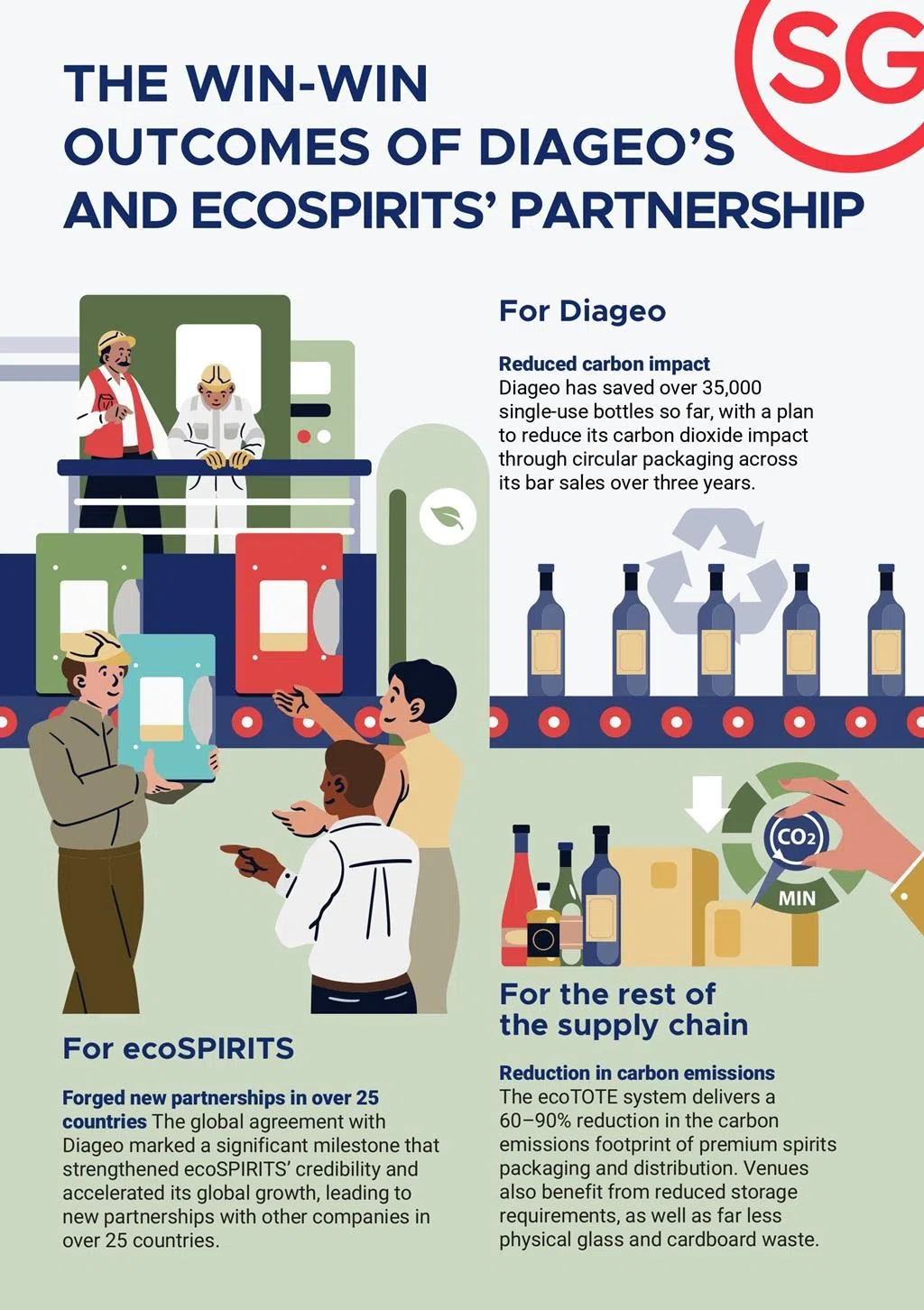
For Diageo, packaging accounted for about one-third of those emissions.
In 2021, it began trialling a partnership with ecoSPIRITS, a Singapore-based technology company that offers reusable glass packaging through a patented closed-loop distribution system.
To distribute its products in this new packaging, Diageo launched a South-east Asia pilot in 2022, and signed a Global Licensing Agreement in 2023 to expand the solution to more markets.
The project began through Diageo’s Sustainable Solutions programme – an open-innovation programme where the company invests in new technologies and partnerships with start-ups.
ecoSPIRITS’ system replaces single-use glass bottles with reusable containers known as ecoTOTEs. By cutting the need for disposable glass packaging, it offers a lower-carbon, lower-waste distribution model that supports a more circular supply chain.
Spirits are transported in bulk, processed into ecoTOTEs for venue delivery, then collected, sanitised, refilled and reused once empty. ecoSPIRITS now has more than 100,000 ecoTOTEs in circulation worldwide.
Under the partnership, Diageo brands Smirnoff vodka, Gordon’s gin and Captain Morgan rum will be made available in ecoTOTE format in participating markets.
As part of Diageo’s Spirit of Progress environmental, social and governance (ESG) plan, the company has committed to increasing the percentage of recycled content in packaging to 50 per cent by 2030. It has also hit its 2025 goal of 35 per cent recycled content in PET bottles.1
See how Diageo is cutting carbon impact with ecoTOTEs.
Sanofi and Magorium: Turning medical plastic waste into lower-carbon infrastructure
Sanofi’s new $800 million state-of-the-art manufacturing facility in Singapore, Modulus, serves as a blueprint for sustainable biopharmaceutical production.
This modular concept facility not only represents a significant investment in Singapore’s vibrant biopharmaceutical industry, but also embodies a strategic commitment to environmental sustainability.
By integrating eco-friendly features into its core design and construction, Sanofi is pioneering new standards for a more sustainable future in the biopharma industry.
The next-generation facility has been designed with the lowest possible carbon footprint with optimised waste management and renewable energy, demonstrating how large-scale industrial projects can successfully embed green initiatives from the outset.
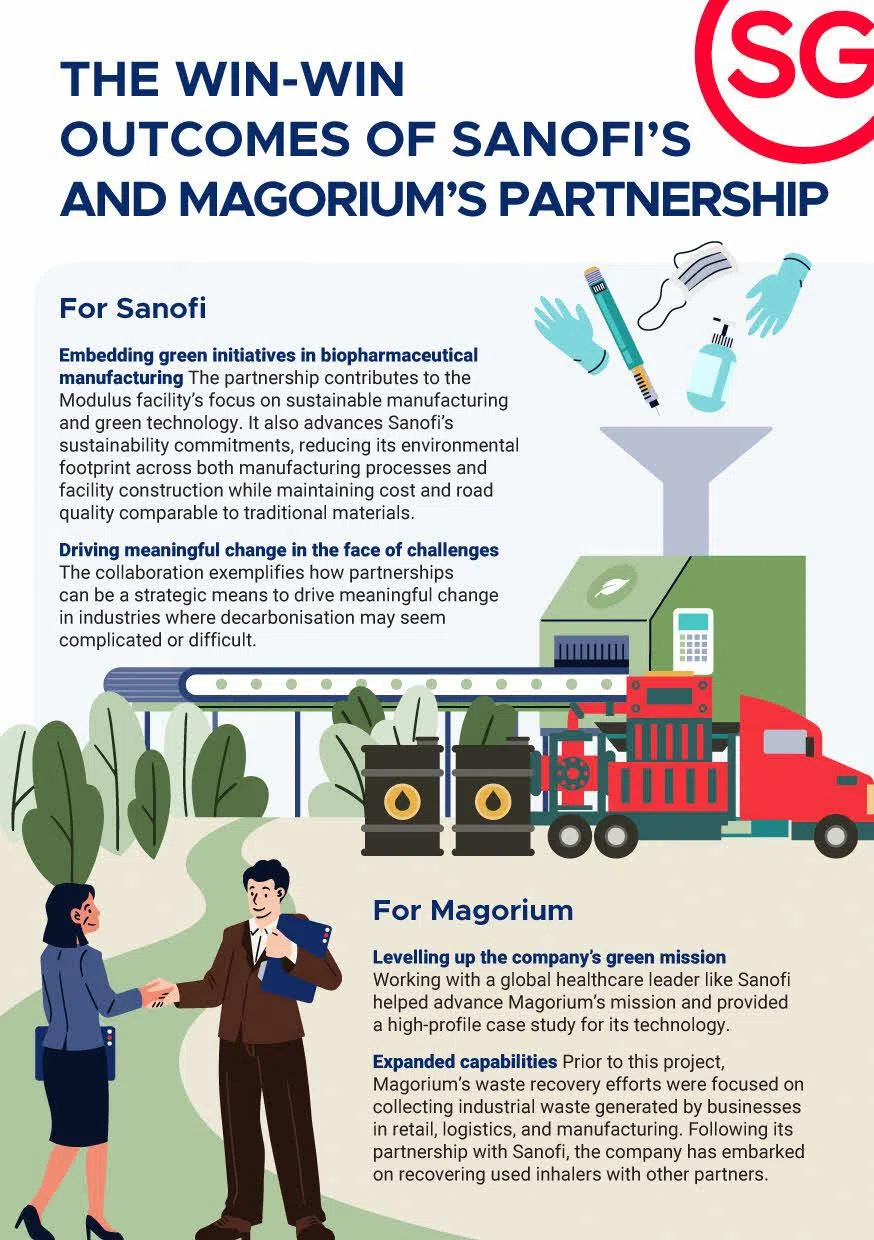
A notable feature of the 58,000 sq m Modulus facility is the innovative use of recycled plastics, including discarded insulin pens, for paving its roads. The material is being used across about 1.5km worth of roads – about the length of 15 soccer fields.
This was made possible through a strategic partnership with local deep-tech enterprise Magorium, whose proprietary technology transforms unsorted plastic waste into NEWBitumen, a more sustainable substitute for crude-derived bitumen.
The two companies also partnered with the National University Hospital in Singapore to collect medical waste, such as via Sanofi’s insulin pens recycling initiative.
By transforming discarded medical waste into a usable construction material, the collaboration points to a more circular and scalable approach to corporate waste management.
Approximately 800,000 Sanofi insulin pens are used annually, generating about 16,800 kg of plastic waste – roughly the weight of 16 small cars. Through the insulin pens recycling project, Sanofi aims to collect and recycle more than 70 per cent of the pens it distributes.
The effort has not been without challenges. Collection depends heavily on consumer participation, and the volume of recoverable waste can be difficult to predict.
The team learned that engaging customers at multiple touchpoints and working closely with pharmacists to monitor volume helped them overcome the respective challenges.
The technology has already been utilised elsewhere in Singapore, and Magorium is now exploring new pilot projects in the ASEAN region.
See how Sanofi and Magorium are advancing greener manufacturing.
Find out more about the Partnerships for Capability Transformation (PACT) scheme. For queries, reach out to the Economic Development Board.
Footnote:
1 “An Update on Diageo’s Sustainability Goals to Build Climate Resilience.” Diageo, 14 Aug. 2025, https://www.diageo.com/en/news-and-media/stories/2025/an-update-on-diageo-sustainability-goals-to-build-climate-resilience.

Share with us your feedback on BT's products and services
TRENDING NOW

Once staunchly pro-China, Malaysian Chinese businesses are now distancing themselves from Beijing

Stocks to watch: HPL, Aims Apac Reit, Zico, Advanced Systems Automation, ComfortDelGro
‘How many will survive?’: Bubble fears arise as China’s humanoid robotics face reality check
Smaller board lots can’t fix a market run by three banks

