iFast says it’s not a key beneficiary of crisis-driven inflows, flags risk from Middle East tensions
The fintech platform also unveils its planned CAGR at its AGM on Friday, but shareholders question the projections
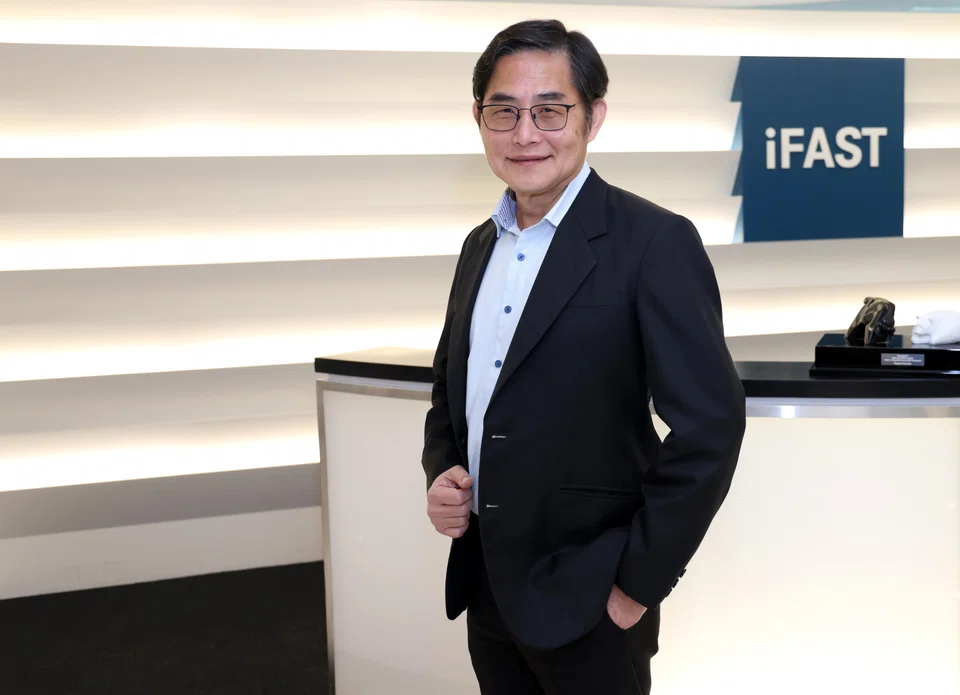
[SINGAPORE] Fintech platform iFast has said it has not had a meaningful uplift in inflows, despite the Middle East conflict having driven capital into major financial hubs such as Singapore, Hong Kong and London, where it operates.
Lim Chung Chun, chairman and group CEO of iFast Corporation, said at the group’s annual general meeting (AGM) on Friday (Apr 24): “We are so far not the key beneficiary.”
He noted that much of the inflows were instead from high-net-worth investors, but added that iFast’s exposure to this client base was limited.
Speaking to more than 500 shareholders at the Sands Expo and Convention Centre, he warned that further escalation in Middle East tensions could hit iFast in the short term, particularly its unit trust and stock business.
At the start of the AGM, Jean Paul Wong, executive director of iFast, took the shareholders through the company’s Q1 2026 results, which were released the day before.
The company’s net profit jumped 47.3 per cent to S$28 million for the three months ended Mar 31, 2026, up from S$19 million in the year-ago period.
More details were disclosed about iFast’s three-year plan (for 2026 to 2028) to grow its assets under administration (AUA) to S$100 billion by 2030. This is expected to take its compound annual growth rate (CAGR) to 25.6 per cent or higher over the next five years.
Under the plan, the key markets of Singapore and Hong Kong are to grow at a CAGR of 22.5 per cent and 26.2 per cent, respectively.
Meanwhile, iFast Global Bank could grow at a CAGR of 56.9 per cent under the group’s push to scale its digital banking capabilities.



Shareholders raised concerns on the bank’s rate of growth, comparing it with other platforms such as Revolut; they also asked whether the projected CAGR of 56.9 per cent was too ambitious.
In response, Lim said that the base of iFast’s AUA for 2025, at S$1.6 billion, was a low one, but that moving towards the target of S$15 billion was achievable.
The group is also counting on artificial intelligence to drive efficiency.
The company expects the overall group headcount to peak in mid-2026, and be at a lower level at the end of 2028, which would pave the way for improved profit margins from 2027.
On how AI would benefit the group, Lim said the payoffs would come mainly in areas such as customer service and technology.
Business updates
On strategic moves, iFast said that its planned acquisition of a 30 per cent stake in Financial Alliance Corporation in January had an earnings yield of about 6 per cent, comparing it to the debt raised in early March this year at a 2.75 per cent coupon rate.
Separately, iFast is pushing ahead with its “Truly Global” Business model. Under this exercise, iFast’s direct-to-consumer retail investment platform, FSMOne, will be rebranded as FSM Global in Singapore and Hong Kong.
There will also be a new partnership with Ant International to expand cross-border payment capabilities.
The group expects double-digit growth in its Hong Kong business in 2026, with additional upside from its Orso pension administration business, which starts contributing in the second half of 2026.
Ten resolutions were passed at Friday’s AGM, including the approval of a final dividend of S$0.025 a share for FY2025, and the granting of options to Lim.
Shares of iFast closed S$0.49 or 5.2 per cent lower at S$9 on Friday.
Decoding Asia newsletter: your guide to navigating Asia in a new global order. Sign up here to get Decoding Asia newsletter. Delivered to your inbox. Free.
Copyright SPH Media. All rights reserved.