

InnoTek’s attempts to diversify undervalued by the market

Yong Jun Yuan
PRECISION metal components manufacturer InnoTek has fallen on hard times. Its share price, buoyed last year by expectations that the company would be able to grow its sales to Chinese electric vehicle manufacturers, has more than halved over the past year.
InnoTek has a substantial cash pile, making its stock look undervalued. But investors keen to avoid a value trap will be looking for a turnaround plan – which the company has, in the form of its efforts to diversify.
The mainboard-listed company issued a profit guidance on Jul 14, indicating that it would likely report a net loss when it releases its financial results in mid-August. It attributed this to increased labour and manufacturing costs, as well as higher raw materials costs resulting from ongoing disruptions in the global supply chain.
Prolonged movement restrictions in China, as part of the country's “dynamic zero” Covid-19 policy, have also affected InnoTek’s major customers, hampering revenue growth.
In its Jul 14 statement, InnoTek's management promised to disclose "forward strategies" at the time it releases its H1 results. Among the issues that such strategies would need to address is a decline in revenue that pre-dates the pandemic.
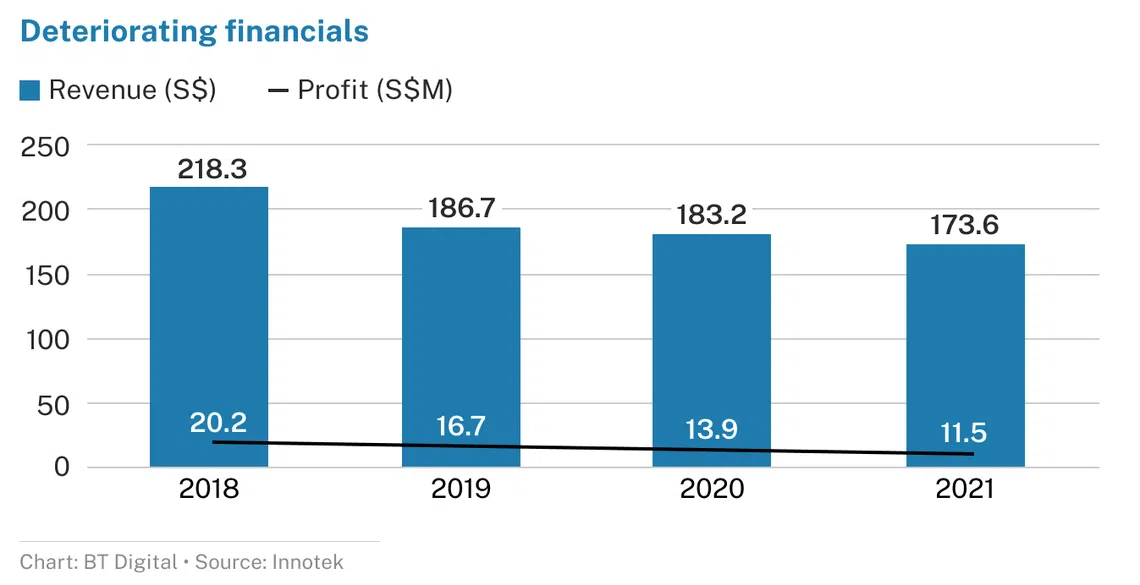
In FY2019, InnoTek’s revenue fell 14.5 per cent year on year to S$186.7 million. In particular, precision machining segment revenue from external customers declined 39.4 per cent to S$44.4 million.
At the time, InnoTek said that the precision machining segment saw lower orders for TV bezels under 55 inches. Commercial display products and heatsinks reached their end-of-life in the production cycle.
The downward trend continued into FY20 and FY21. Last year, the company’s revenue declined by 5.2 per cent to S$173.6 million. Gross profit margins declined 5.2 percentage points to 19.4 per cent. Precision machining segment revenue from external customers declined by a further 28.6 per cent to S$39.6 million.
To improve margins, the company has said it will exit the production of lower-margin TV back panels and focus on larger-sized TV bezels of over 65 inches.
Furthermore, its new facility in Vietnam has secured orders for bezel production for high-end larger TVs – although it was facing challenges due to the spread of Covid-19. InnoTek expects demand for such high-end larger TVs to remain “buoyant”.
As part of a diversification plan, InnoTek has been looking to grow its precision components and tooling segment. In FY21, this segment grew 4.9 per cent to S$134 million.
InnoTek’s chief executive Lou Yiliang also said in the company’s 2021 annual report that the company is adding more automobile parts to its repertoire, such as car door panels and airbag housings.
InnoTek has secured a steel stamping project with a “leading” electric vehicle battery producer, Lou said, and the company would try to continue capturing market share with its “deep domain knowledge” and its relationships with customers.
In addition, the company said that it has explored partnerships to work on medical devices, gaming machines, 5G infrastructure and the semiconductor industry, which will see strong demand in the long-term.
While the company adapts, Lim & Tan Securities analysts are recommending that investors “keep the faith”.
In a report last month, the brokerage noted that InnoTek had S$70.4 million in cash and short-term deposits as well as S$20.3 million in equity and debt securities as at Dec 31, 2021.
This represents 70.9 per cent of the company’s market capitalisation of S$99.3 million. At its current share price of S$0.44 on Monday (Aug 8), InnoTek is trading at half its book value at end-FY21.
“Given the US Fed’s determination to bring inflationary pressures under control, we believe H1 2022 is likely to mark the peak for raw material costs for InnoTek while its strong net cash position of S$90 million would allow them to comfortably navigate the rapidly rising interest rate environment,” the analysts said, adding that they were confident in the company’s ability to outperform its more leveraged competitors in China.
Furthermore, the analysts noted that the company’s strong financial position could still allow it to pay dividends for FY2022.
In FY2021, a dividend of 2 Singapore cents per share was declared, representing a payout ratio of 39.7 per cent. Based on the stock's close at S$0.44 on Monday (Aug 8), that gives the counter a historical dividend yield of 4.5 per cent.






