

Instant-coffee maker Food Empire’s potential dual listing may not mean instant success

INVESTORS might be expected to shun a consumer products company that derives the bulk of its revenue from countries embroiled in a war.
But the stock price of instant-coffee maker Food Empire , whose key markets include Russia and Ukraine, has surprisingly been on a tear over the past year.
The mainboard-listed company is now stirring up more excitement with its latest announcement in mid-October that it is exploring a dual primary listing in Hong Kong.
A successful dual listing could mean better valuations for the stock. But there are some warning signs that it could be already overvalued.
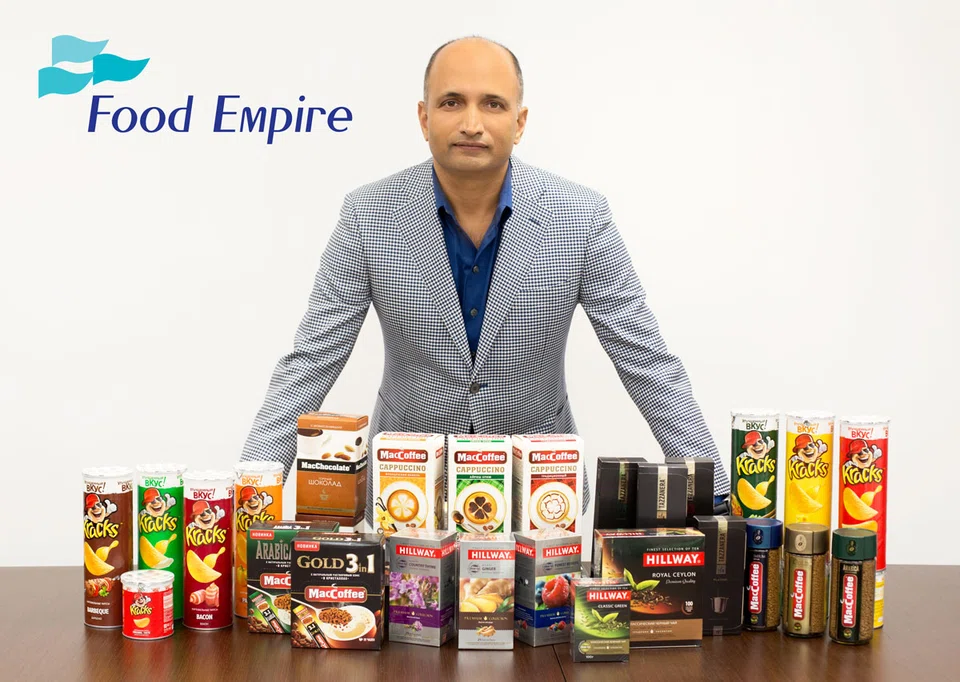
With eight manufacturing facilities around the world, Food Empire’s array of food and beverage (F&B) products is sold in more than 60 countries.
It is perhaps best known for its three-in-one MacCoffee brand, which the group’s founder and executive chairman Tan Wang Cheow once described to The Business Times (BT) as a household name in Russia.
On the face of it, Food Empire has the makings of a local stock poised to make an international name for itself. And investors here have perhaps bought into the company’s growth story.
According to Bloomberg data, the counter has more than doubled its value over the past 12 months. With dividends reinvested, Food Empire has generated a total return of 117.1 per cent over the past year.
In the year to date, the stock has delivered a total return of 72.6 per cent. In comparison, total return for the benchmark Straits Times Index stood at negative 1.6 per cent over the same period.
Brewing troubles
In February last year, Food Empire’s auditor EY raised concerns about the financial, economic and social impact of the war on the company.
This came as the escalation of the Russia-Ukraine war threatened to stifle the group’s growth. EY added that there was a possibility of impairments on Food Empire’s assets if the conflict persists.
On its part, Food Empire also flagged uncertainties surrounding the conflict in its results updates and announcements.
Yet, despite the prolonged war, the Singapore-listed counter has not wavered.
In its most recent financial results, for the first half ended June, Food Empire reported an 11.8 per cent rise in revenue to US$198.2 million. The increase came on the back of a combination of higher volumes and pricings across most of its key markets.
Revenue from Russia, which accounted for over a third of Food Empire’s total revenue in H1, was up 23.6 per cent to US$70.6 million.
Revenue from its second-largest geographical segment – Ukraine, Kazakhstan and the Commonwealth of Independent States, which accounted for about a quarter of total revenue – rose 20 per cent to US$49.5 million.
However, the stronger topline figures were offset by the depreciation of the Russian rouble and Ukrainian hryvnia against the US dollar, as well as lower revenue from Europe.
This put a strain on the group’s H1 earnings, which fell 1.5 per cent to US$26.7 million.
Still, on the return-on-equity (ROE) front, Food Empire has performed significantly better than its Singapore-listed peers.
According to Bloomberg data compiled by BT, Food Empire’s ROE stood at 22.4 per cent – putting it at the head of the pack.
Only two other counters had ROE figures crossing the 20 per cent mark: palm oil players First Resources and Kencana Agri. ROE for confectionary company Delfi came close at 19.7 per cent.
In comparison, ROE for F&B conglomerate Fraser and Neave stood at 4.3 per cent, and that of Gardenia bread-maker QAF was at 3.4 per cent.
But other financial metrics suggest that Food Empire, which closed at S$1.05 on Oct 27, could already be overvalued.
For example, its price-to-book ratio stood at 1.5 times. This is above its local peers’ one-year average of 1.1 times and five-year average of 0.7 times, according to Bloomberg data.
Meanwhile, it is trading at a price-to-earnings ratio of 6.8 times. This puts it close to the middle of the pack among its peers.
Perking up in South-east Asia
However, RHB analyst Alfie Yeo believes Food Empire’s valuation is still “undemanding”.
Yeo flagged some potential risks for the company, including a disruption of operations due to the Russia-Ukraine conflict as well as currency swings.
Still, he remained bullish on the group’s operations in Vietnam, where it has established itself as the third largest three-in-one instant-coffee player.
RHB has a “buy” call on Food Empire with a target price of S$1.39.
“Vietnam is currently a significant contributor to Food Empire’s South-east Asian revenue,” Yeo said in a recent report. “Food Empire’s strategy to strengthen its market share with new product variants and further market penetration of its mainstay coffee product Cafe Pho should bode well and support future growth going forward.”
Revenue from South-east Asia – Food Empire’s third largest geographical segment – rose a modest 1 per cent to US$45.9 million in H1. This was mainly due to lower revenue from the Vietnam market partially offsetting higher contribution from the group’s non-dairy creamer and snacks manufacturing facilities in Malaysia.
The group also has a substantial presence in South Asia, where revenue jumped 15.3 per cent to US$21.7 million in H1.
Food Empire’s potential dual primary listing on the Hong Kong exchange could be interesting to watch.
In its Oct 16 announcement, the company said it believed the move would give it “a more diverse investor and shareholder base and additional sources of fund raising” as well as “enhance the company’s corporate profile and visibility in the international markets”.
But without significant operations in East Asia, it might be difficult for Food Empire to stir up interest in the Hong Kong market.
TRENDING NOW

From legacy to launch: Francis Yeoh and Yeoh Pei Xien on family unity and YTL’s next‑gen ventures

Things to know about DBS’ incoming chairman Anthony Lim
Wealthy Indonesians snap up government bonds as yields near 8%: OCBC

From local AI partnerships to global opportunities: How MNCs help Singapore firms scale

