

Interest rate cuts, end of remote work could make office S-Reits the dark horse of 2025
Lower interest rates can spur hiring, boosting demand for office space

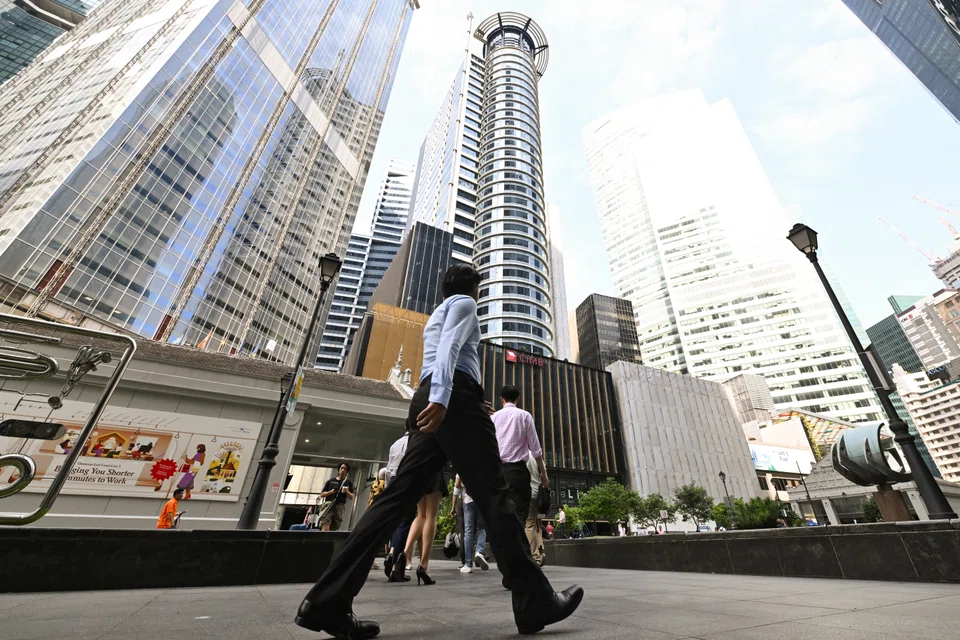
SINGAPORE-LISTED office real estate investment trusts (S-Reits) have the potential to be the “dark horses” on the local bourse next year as they are more sensitive to interest rate cuts compared to other sub-sectors, analysts say.
Positive business sentiment, easing debt and a continuing trend towards work-from-office could buoy office S-Reits, whose valuations have lagged their counterparts on the bourse.
Office S-Reits are trading at about 50 per cent discount to their book values on average, compared to the overall S-Reit sector which is trading at about 20 per cent discount.
Impact of rate cuts
Already, there are signs that interest rate cuts can have an outsized impact on office Reits.
Following the first interest rate cut by the US Federal Reserve in more than four years on Sep 18, the three US office S-Reits – Keppel Pacific Oak US Reit (Kore) , Manulife US Reit and Prime US Reit – led the gainers among the constituents in the iEdge S-Reit Index for Q3.
Derek Tan, the head of regional property research at DBS Bank, told The Business Times that commercial S-Reits, which include office Reits, have the potential to be dark horses next year as concerns over their relatively higher leverage ratios ease with rate cuts.
“Their sensitivity to interest rates is higher compared to other sub-sectors. If we are on a sustained downtrend, the ability to surprise is certainly higher,” said Tan.
In the case of US office S-Reits, specifically, analysts said that the jump in their share prices following rate cuts was due to their lower share price compared to other office S-Reits.
The price declines in S-Reits with office assets in Singapore have been smaller compared to US office S-Reits.
Therefore, when the recovery comes, the share price upside is not as sharp, said Carmen Lee, head of OCBC Investment Research.
Improving business sentiment
Lower interest rates can also spur hiring, boosting demand for office space.
“As rates are lowered, we expect more companies to invest in growing and expanding their business – hiring more employees and taking up more office space to house these employees,” said Xavier Lee, an equity research analyst with Morningstar.
However, Morningstar’s Lee said that a meaningful impact on office demand would require further rate cuts to spur economic activity and boost business sentiment.
Given the limited supply of office space in the central business district, office rents are expected to “accelerate” in 2025 on the back of improved office leasing demand, he said.
Office Reits that stand to benefit from the growth are Keppel Reit , CapitaLand Integrated Commercial Trust and Suntec Reit , he added.
Back to office
Several analysts also felt that Amazon’s move to recall its workers to office will have a knock-on effect on other companies, improving demand for office space.
On Sep 16, the tech giant announced that its employees will have to work from the office five days a week, up from three currently, from next year onwards. Other big companies, such as consultancy McKinsey, are also rethinking their remote working policies.
OCBC’s Lee said that it is “highly likely” that companies may request for workers to work from the office more frequently. This should help with office occupancy, she said.
For US office S-Reits, in particular, the policy change by Amazon marks an “incremental positive” as office occupancy rates in the US could improve, DBS Group Research said in a note on Sep 17.
The research house expects the risk for US office Reits – which have seen their occupancy rates dip to 80 per cent recently – to lower with more staff returning to office.
It named Kore and Prime, which are leading the recovery among US office S-Reits, as its preferred Reits for investors who are looking to participate early in the recovery of the office sector.
However, Morningstar analyst Suryansh Sharma was less optimistic. He was of the view that beyond Amazon, more companies will have to mandate a return to office before there is a material impact on office Reit fundamentals.
Recession risk
Overall, analysts said that office S-Reits remain undervalued compared to other sub-sectors and warned investors to watch out for headwinds.
Darren Chan, a senior research analyst at Phillip Securities Research, expects rental reversions for the sector to remain positive going forward. However, it is likely to fall from around 10 per cent currently to the low, or mid-single digits as demand for office space will not be high enough to absorb the new supply of office space.
Chan added that the brokerage prefers other sub-sectors such as retail as it believes hurdles remain for office S-Reits.
A common challenge that office S-Reits face is an economic downturn, which analysts said could affect business sentiment. Slower leasing momentum and lower occupancy or tenant defaults could also throw off office S-Reits, they warned.
Lee of OCBC said that bigger Reits with diversified holdings across several geographical locations remain preferred to reduce over-exposure to one asset or country.






