Is ESR-Reit on a road to redemption?
After its attempted merger with Sabana Reit failed, ESR-Reit is pursuing a slew of DPU-accretive initiatives

A STRING of growth initiatives unveiled by ESR-Reit last week, including an equity fund raising, was met by a sell-off in the market.
But these latest moves could set ESR-Reit on a road to redemption of sorts, after spending months last year embroiled in a controversial attempt to acquire Sabana Shari'ah Compliant Industrial Real Estate Investment Trust (Sabana Reit) at a steep discount to its book value.
The deal ultimately failed to garner sufficient support from unitholders of Sabana Reit at an extraordinary general meeting (EGM) in December. Since then, units in Sabana Reit have rallied more than 18 per cent, while units in ESR-Reit are nearly 5 per cent lower.
Now, ESR-Reit appears to have refocused on managing its own portfolio. It is pursuing asset enhancement initiatives (AEIs), offloading non-core assets and acquiring properties with the potential to deliver more value.
ESR-Reit has also begun tapping its sponsor group - Hong Kong-listed ESR Cayman - for assets located outside Singapore. This opens a new avenue of growth for the Reit, and could position it over time as a more useful asset securitisation vehicle for the sponsor group.
Active management
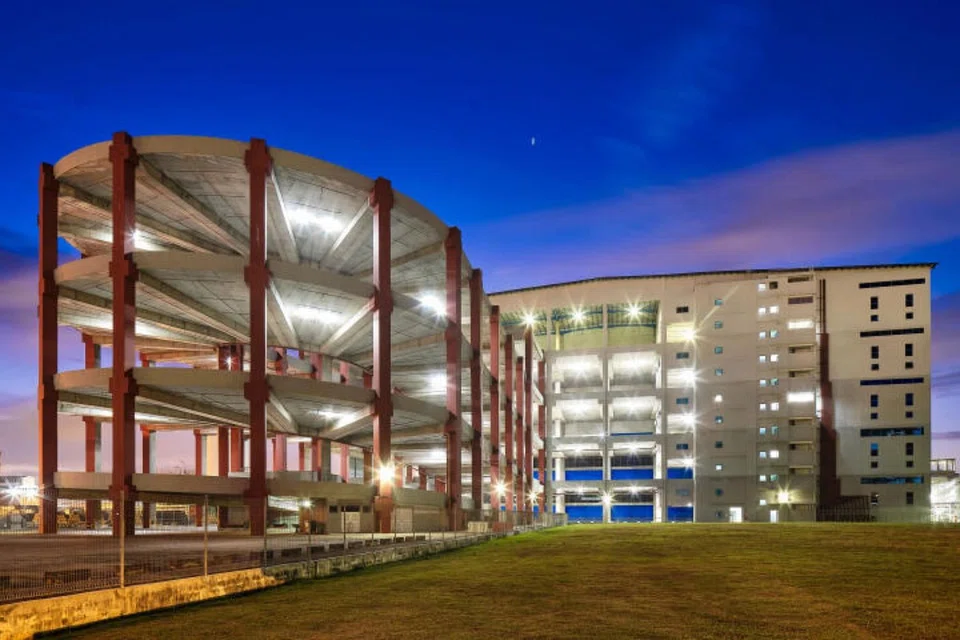
On May 6, after calling for a halt in trading of its shares, ESR-Reit said it will acquire a five-storey ramp-up logistics facility with mezzanine offices on each floor, located at 46A Tanjong Penjuru. The property has a gross floor area of 523,689 sq ft, and is fully committed with six tenants.
ESR-Reit will pay S$112 million for the property, plus an upfront land premium of S$7.6 million to JTC. The property was appraised by Jones Lang LaSalle Property Consultants to be worth S$119.6 million as at April 30, inclusive of the upfront land premium payable.
The acquisition of the property is expected to be marginally accretive to ESR-Reit's distribution per unit (DPU) from the outset.
But ESR-Reit said it intends to invest in air-conditioning at the property to attract higher rental paying tenants over time, including e-commerce players and companies handling high-valued goods, such as electronics and pharmaceutical products.
"These tenants would typically require a controlled environment to store, pack and distribute temperature-sensitive products," ESR-Reit said, in an announcement. It estimates it will be able to charge such tenants as much as S$1.60 per sq ft per month, versus the current average gross rents of S$1.30 per sq ft per month.
Just one week before announcing the purchase of the property, ESR-Reit said it would divest 11 Serangoon North Avenue 5 and 3C Toh Guan Road East for some S$53.0 million.
The sale consideration is 5 per cent more than the combined valuation of the two properties as at Dec 31 of S$50.5 million, and 7.1 per cent more than their total acquisition price.
ESR-Reit said the divestment is part of its strategy to monetise non-core assets and channel the proceeds towards value creation opportunities.
Meanwhile, ESR-Reit is conducting AEIs at two of its properties to enhance their revenue potential. On May 6, the Reit said it is spending S$25.9 million to increase the gross floor area (GFA) at 16 Tai Seng Street by 29,000 sq ft or some 13.8 per cent. The AEI also includes refurbishing the facade, drop-off point, lifts and lift lobbies, and the external linkway to a nearby MRT station.
ESR-Reit has also modified its AEI for its property at 7000 Ang Mo Kio Ave 5, to cater to more tenants in the advanced manufacturing and electronics sectors instead of tenants in the infocomm and data centre sectors. The AEI is expected to cost S$53.3 million and add some 265,000 sq ft of GFA to suit multi-tenancies of high-tech tenants.
Australian assets
The most intriguing of ESR-Reit's announced initiatives last week is perhaps its purchase of a 10 per cent stake in the ESR Australia Logistics Partnership, a fund that holds 33 income-producing properties, two land parcels for future development, and two properties that are currently under development - all of them in Australia.
This is ESR-Reit's first foray overseas, and it will be investing alongside GIC, which holds 80 per cent of the fund. ESR-Reit's sponsor group is the manager of the fund and owns the remaining 10 per cent.
The deal is also a reassuring sign that ESR-Reit is shaping up as an asset securitisation platform for its sponsor, despite bungling the merger with Sabana Reit last year. In particular, ESR-Reit's 10 per cent stake in the fund could give it an information advantage, and position it to effectively bid for any assets the fund sells in the future.
ESR-Reit will pay A$60.5 million (about S$62.4 million) for its 10 per cent stake in the fund, which had a net asset value of A$605 million as at March 31. ESR-Reit is also subject to a capital commitment of A$7.05 million, which the fund may call at any time.
Based on pro forma estimates, the investment in the fund could boost ESR-Reit's DPU by 2.9 per cent.
Cool market reaction
In conjunction with the acquisitions and AEIs, an equity fund raising of S$150 million was also announced last week - S$100 million through a placement of new units, and S$50 million through a preferential offering.
On May 7, ESR-Reit said the placement price was fixed at S$0.372, which was the bottom of the indicated range, and a discount of 8.9 per cent to ESR-Reit's volume weighted price on May 5.
More than 268.8 million new units in ESR-Reit will be issued as part of the placement. Details of the preferential offering are yet to be announced.
ESR-Reit's market price promptly sank when the trading halt was lifted on Friday. It closed at S$0.39, down nearly 4.9 per cent.
Despite the cool reception in the market, some analysts are positive about the outlook for ESR-Reit.
CGS CIMB said in a research note last week that the transactions ESR-Reit announced could result in an "all-in" DPU accretion of 1 per cent, and reduce its gearing from 42.1 per cent to 41.4 per cent.
The Reit's gearing could fall further to 40.4 per cent once it completes the sale of 11 Serangoon North Avenue 5 and 3C Toh Guan Road East.
CGS CIMB is forecasting a 6.4 per cent rise in net property income to S$174.7 million in FY2020, and a further 7.1 per cent rise to S$183.9 million in FY2022. It expects DPU to come in at S$0.029 for FY2021, and S$0.032 for FY2022.
On those forecasts, units in ESR-Reit are currently trading at an FY2021 yield of 7.4 per cent and a FY2022 yield of 8.2 per cent.
With ESR-Reit now focused on enhancing its asset portfolio, and working with its sponsor to gain a foothold beyond Singapore, many investors might well be tempted by these relatively high yields.
CGS CIMB has a target price of S$0.494 for ESR-Reit.