

ISDN looks to the East as supply chain shifts create new opportunities
The company recently ventured into India, where its first automation project is already in progress

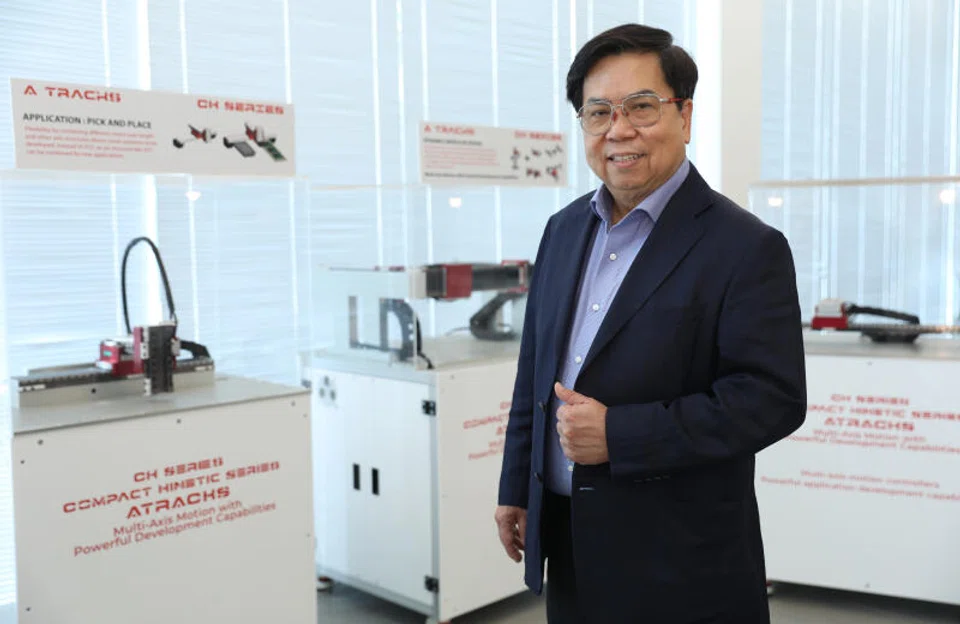
[SINGAPORE] Geopolitical tensions and evolving trade policies are forcing manufacturers to rethink where and how they operate – and industrial automation group ISDN Holdings is positioning itself to be part of that recalibration.
President and managing director Teo Cher Koon highlighted that the world has entered what he calls a “reciprocal tariff era”, where trade barriers are reshaping supply chains across Asia.
Companies are no longer just chasing low-cost production locations or transhipments through intermediaries, said Teo.
“They are more focused on industry 4.0, digitalisation and higher-value production – areas where ISDN sees new opportunities,” he said, highlighting the shift towards smarter, high-tech manufacturing.
The mainboard-listed group, which has spent nearly four decades building its presence in China and South-east Asia, is now expanding its footprint in the region.
India marks ISDN’s newest growth frontier, with a recently established office in the country. The move reflects the company’s strategy to capture demand for smarter, higher-value manufacturing as companies diversify their operations across Asia amid tariff concerns.
The first project is already under way: a white goods factory seeking automation solutions for production inspection, assembly and quality control.
Asked about the growth timeline and potential contribution to ISDN’s top and bottom lines, Teo said: “India is a new market for us, so we have to learn and progress carefully. At the moment, it’s just the beginning, so it’s not very significant. But in the years to come, probably in the long term, I believe India will catch up.”
He added: “What people are saying is the future belongs to the East – China and India. These two added together, we’re talking about almost 2.8 billion people. Population creates demand.”
Regional playbook
While India represents the company’s newest frontier, China remains the group’s largest market in the industrial automation segment – accounting for roughly 60 to 75 per cent of turnover.
Growth in China is steady but modest, around 4.5 per cent in the first half of 2025, with ISDN focusing on niche, high-end industrial automation solutions. On a constant currency basis, growth was 9.7 per cent. “In China, we are serving the niche, top-end market, so it’s less competitive,” said Teo.
By contrast, South-east Asia is emerging as a faster-growing engine, expanding about 12.5 per cent in H1 2025.
Teo expects takings from both regions to grow in tandem over time, though South-east Asia will likely expand at a quicker pace, given its low base and rising opportunities amid geopolitical tensions and tariffs.
In H1 2025, ISDN’s net profit declined 66 per cent on year to S$1.3 million, primarily due to unrealised foreign exchange losses in its energy business.
The company incurred S$5 million of unrealised, non-cash forex revaluation losses in H1 2025, compared to a gain of S$300,000 in the year-earlier period, as the US dollar weakened during the period.
ISDN’s renewable energy business generates recurring income from long-term contracts of up to 25 years. However, a consequence of this business model is the need to revalue the long-term receivables and payables each period, resulting in non-cash, unrealised gains and losses as foreign exchange rates fluctuate.
Excluding impact from unrealised forex losses, ISDN’s net profit would have risen by 35.1 per cent to S$4.5 million.
Part of ISDN’s growth strategy to capture South-east Asia’s growing industrial automation market is leveraging partnerships with Chinese technology companies, particularly in robotics and automation.
Teo explained that many Chinese partners supply highly advanced robots, but often lack the expertise to adapt these machines to local South-east Asian manufacturers.
“We are seeing a lot of Chinese business partners coming to South-east Asia…so we try to capture and capitalise on their know-how and technology in the artificial intelligence field,” he said, adding that ISDN bridges the gap between cutting-edge robotics and operational needs of local factories.
In a recent smart warehouse project, ISDN deployed 20 autonomous mobile robots (AMRs) and 12 vertical AMRs from Chinese partners. While the robots handle the physical movement of goods, ISDN integrated them with warehouse management systems, Internet of Things and the customer’s enterprise resource planning software to ensure smooth operations. .
Renewable energy as a growth engine
ISDN business in smart warehouses and data centres, which is expected to see increasing demand in the coming years, complements another growth vertical: renewable energy.
In August, the company acquired 51 per cent stake in PT Funda to strengthen its hydropower capabilities in Indonesia. PT Funda is an Indonesia hydropower firm that provides end-to-end hydropower services, including engineering, procurement, and construction.
The acquisition is part of ISDN’s long-term plan of providing one-stop renewable energy solutions in Indonesia and capture a larger pie in this growing sector.
“The investment in PT Funda improves our capability in terms of hydropower, renewable energy construction and development,” said Teo. “We think this is going to offer us a very promising future because of the energy requirement to power AI factories and data centres.”
He added that renewable energy and industrial automation are two different types of business.
“Renewable energy is high capex but provides long, steady, recurring income. Industrial automation, on the other hand, offers quicker payback but depends heavily on engineering expertise and is cyclical.”
ISDN currently operates three hydropower plants in North Sumatra, with a combined capacity of 24.6 megawatts, generating about US$9 million in earnings before interest, tax, depreciation and amortisation (Ebitda) per year.
“Next year, we will add two more power plants, bringing total capacity to 44.6 megawatts. With the additional 20 megawatts, we expect to add another US$9 million of Ebitda – about US$18 million in total from the second half of next year.”
He hopes that the company’s renewable energy business would have already spun off by 2030.
“When it grows to a certain size, it’s easier to show the value to the market as a separate entity,” said Teo, adding that the spinoff could take the form of a public listing or a trade sale when the time is right.
Natural hedge
By pursuing both high-value industrial automation and renewable energy, ISDN is building what Teo calls “a natural hedge” against market fluctuations – both across business segments and geographies.
Industrial automation is project-based and cyclical, while renewable energy provides stable, recurring cash flow. Likewise, ISDN’s geographic spread between China and South-east Asia balances scale with growth potential.
Despite global uncertainties and cyclical challenges in the semiconductor back-end segment, Teo remains optimistic about ISDN’s financial trajectory.
The exponential growth of AI factories and computing power is driving a 10 to 12 per cent compound annual growth rate in data centres over the next five years, he noted. McKinsey & Company projects total capital expenditure to reach US$7 trillion by 2030, with a substantial portion channelled into data centres.
To capture this opportunity, ISDN has launched a centralised platform for real-time monitoring and predictive/prescriptive analytics. The company has already secured orders from the world’s second-largest colocation service provider, said Teo.
“I am quite positive. Though the semiconductor back-end business has not really come back fast enough, we are seeing some movement. We’re also seeing other electronic industries start to move, which are good signs for us.”
TRENDING NOW

Two Singapore-listed palm oil firms named in Greenpeace report on Indonesian plantation fires

Singapore Airlines flight returns to San Francisco after ‘unruly’ passenger incident

Singapore looking into which companies responsible for haze-causing fires: PM Wong
Deluge IPO 3.86 times subscribed ahead of SGX debut

