

With its teleconsultation platform intact, revoking MaNaDr’s licence could have little impact
Telemedicine revenue accounts for about US$12.8 million or 90.4% of its parent company’s total sales

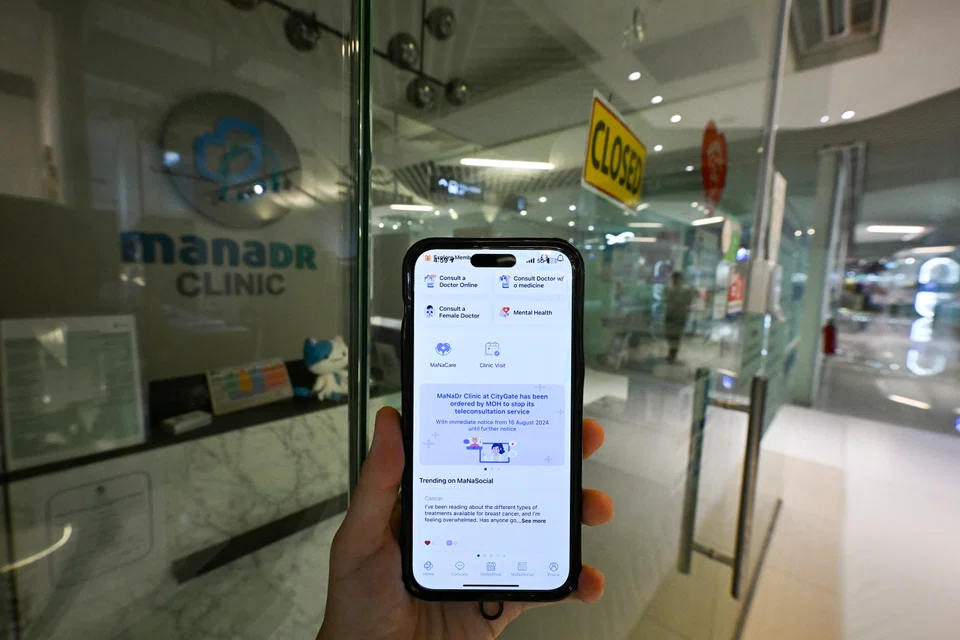
JUST days before Christmas, MaNaDr Clinic unwrapped a lump of coal in its stocking – confirmation that the healthcare provider’s licence to offer medical services in Singapore had been revoked.
The news was not entirely unexpected. The writing had been on the wall since Oct 24, when the Ministry of Health (MOH) first announced its intention to strip MaNaDr of its licence.
The intervening period up to last Friday (Dec 20) allowed the company to present its case to the ministry, outlining why it had fallen short, while MOH deliberated its fate.
But no representation could salvage what the ministry bluntly described as “an entrenched culture of disregard” for ethical and clinical standards.
Among the issues flagged by MOH: over 100,000 teleconsultations involving video calls lasting one minute or less in a sampled month, the shortest call logged at just one second; and an unusually high number of medical certificates issued post-consultation.
The revocation order barred MaNaDr from operating at its permanent clinic at 371 Beach Road, temporary sites such as patients’ homes, or remotely through teleconsultations.
But the order notably left untouched MaNaDr’s – and by extension, its parent company Mobile-health Network Solutions’ – primary revenue driver: the telemedicine platform.
A quick visit to the MaNaDr app or website shows that little has changed. Users can still book a doctor and attend a teleconsultation, almost as if the regulatory action had not occurred.
In essence, the Nasdaq-listed telehealth provider’s core business model remains largely intact, as the revocation order seemingly applies only to its in-house operations and clinic.
As Mobile-health Network Solutions states in its October annual report: “We have more than 1,000 (staff) members, most of whom are telemedicine locums in our medical team.”
In contrast, as at Jun 30, the company’s in-house medical team consisted of just four employees, out of a total of 73 staff members.
This means that close to all of the locums using MaNaDr’s platform for teleconsultations are external doctors and clinics. And for them, operations appear to be business as usual.
But given that these operations account for the majority of revenue at MaNaDr’s parent company, it raises the question of whether the regulatory action was punitive enough.
For a platform criticised for prioritising quantity over quality, might a stricter response have been warranted?
Business as usual
Similar to a ride-hailing platform, MaNaDr primarily functions as a marketplace, connecting third-party contractors – in this case, doctors – with patients, while taking a cut from their earnings.
Although MaNaDr’s exact rate is undisclosed, similar telemedicine platforms in Singapore typically charge around 20 per cent, The Business Times understands.
For the full year ended Jun 30, 2024, Mobile-health Network Solutions reported revenue of US$14 million, a 77.4 per cent increase from US$7.9 million in the previous year.
Notably, sales from third-party sources totalled US$13.5 million, making up 97 per cent of overall revenue.
Similarly, telemedicine revenue accounted for about US$12.8 million, or 90.4 per cent of total sales, driven by 1.5 million telemedicine transactions during the year – a 70.4 per cent increase from 908,000 transactions in the previous period.
This translates to an average of over 128,000 calls per month.
The company’s net loss ballooned to US$15.6 million from US$3.2 million previously, largely due to a one-time US$9.1 million share-based compensation expense, following its initial public offering (IPO) on Apr 10 on the Nasdaq stock exchange.
Based on the numbers, the exact impact to Mobile-health Network Solutions’ operations from the stripped licence remains unclear.
For one thing, third-party revenue – sales generated from teleconsultations by locum doctors, from which the platform takes a cut – obviously accounts for the bulk of the company’s earnings. This revenue stream remains unaffected by the licence revocation.
But in its latest annual report, Mobile-health Network Solutions assessed the impact of the suspension, estimating a 50 to 55 per cent drop in teleconsultation cases up to the date when its consolidated financial statements were issued.
This, however, contrasts with an earlier assessment in August – following the initial suspension of MaNaDr’s own telehealth service – where the company deemed the impact “immaterial” and unlikely to “materially adversely affect” its finances.
The company’s assessments, therefore, seem to oscillate between “all good” and “oh no” – offering little clarity or practical insight.
Trading woes
Regardless of the impact on its financial statements, Mobile-health Network Solutions’ share price has taken a hit from the scandal, as one doctor pointed out to BT.
On Aug 15, just before MOH announced on Aug 16 that MaNaDr was under investigation, the stock closed at US$0.92.
By Oct 24 – the day MOH revealed its intention to revoke MaNaDr’s licence – the share price had dropped to US$0.434.
The decline has only worsened. On Thursday, the stock closed at US$0.26, down 6.3 per cent – a stark contrast to its IPO debut price of US$4, and an even greater fall from its peak close of US$27.27 on Apr 19.
As it stands, the stock is at risk of being delisted from the Nasdaq, as its share price has consistently fallen below the US$1 per share minimum requirement.
While the stock’s decline may seem like fitting punishment, it also leaves MaNaDr with an opportunity. The true test will be whether the company uses this moment to address its lapses – or simply carries on, business as usual.






