

Japan Foods’ halal outlets dish out success
CEO Kenichi Takahashi wants to double the new Muslim-friendly segment’s revenue share to 40%

Annabeth Leow
DESPITE domestic and international restrictions during the Covid-19 pandemic, Singapore restaurant operator Japan Foods Holding turned a profit and stayed debt-free – and even expanded its store count — with the help of a lucrative foray into the halal dining segment.
Does the management’s approach sound like a traditional way to run a business?
“Yeah, I don’t think so. Not traditional,” said its colourful chief executive and chairman, Kenichi Takahashi, who founded Japan Foods in 1997 to open an Ajisen Ramen franchise in Singapore.
Under his leadership, Japan Foods has expanded its business in not just the pandemic but also downturns such as the Asian financial crisis, the severe acute respiratory syndrome epidemic, and the global financial crisis in 2009, when Japan Foods made its debut on the Catalist board.
When asked about corporate succession plans, engineer-turned-restaurateur Takahashi, who spoke in a mix of English and Japanese, joked that he cannot afford to retire as yet.
But he told The Business Times that the eventual handover should be a cinch: “Our company already has successful branding in Singapore. Also, Japanese F&B restaurants know our company.”
Halal market
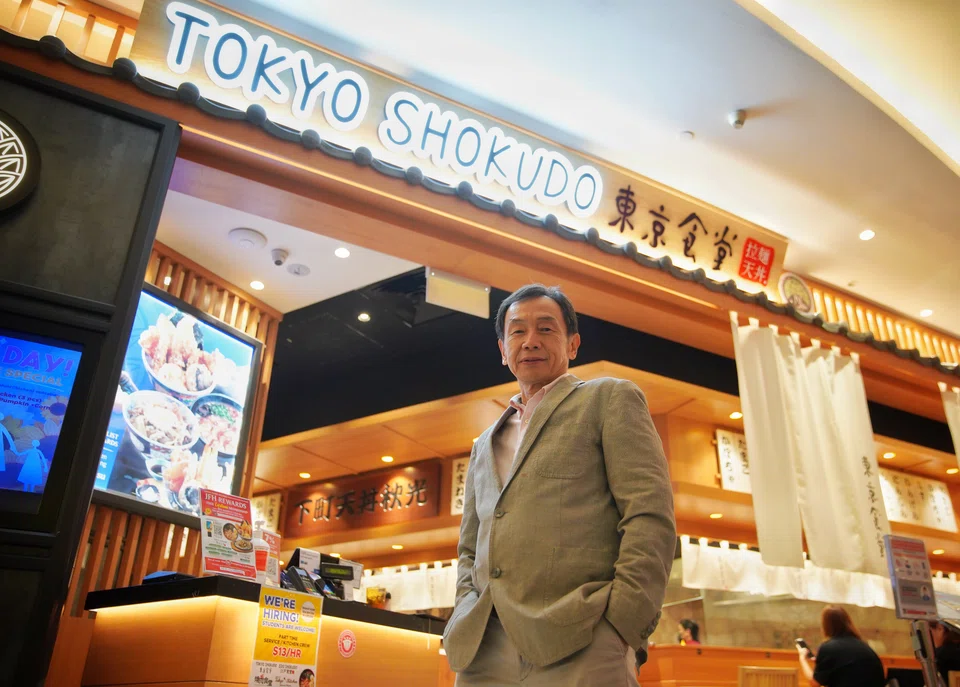
Japan Foods broke into the halal market with its Tokyo Shokudo ramen brand, which opened in Tampines Mall in November 2020. As of end-June, it had 11 halal-certified restaurants spread across 3 culinary specialities: ramen, teppanyaki and yakiniku.
The group also has a no-pork, no-lard Japanese-style Western brand, Tokyo Kitchen, that is awaiting halal certification, and Takahashi added that “now we are planning 1 more new halal concept”.
Halal brands in Singapore made up 20.5 per cent of revenue in FY2022 ended March. Takahashi aims to double that to 40 per cent in the next few years.
He is also eyeing halal expansion into neighbouring Malaysia and Indonesia — and “even in future the Middle East, if I have a chance and I can get a good partner”.
The halal market could even be a lifeline for pie-themed Pizzakaya, a joint venture (JV) brand with Thai-owned casual dining group Minor Food Singapore.
Opened in end-2020, the Pizzakaya chain was loss-making in FY2022. But Takahashi said Pizzakaya is a new concept that “still has time” to turn around – by becoming a halal-certified chain, for instance, once the dough recipe is adequately tweaked.
Given his outlook on demand for halal cuisine, one may wonder why Japan Foods took more than 2 decades to enter the segment.
When asked, Takahashi told BT that the team has had to build up its experience and brand footprint – including its research and development (R&D) expertise — since Islamic requirements limit the availability of acceptable ingredients such as shoyu (soya sauce).
“How to make a good taste, same as non-halal brands, is our most challenging point,” he said.
Cost discipline
Japan Foods posted a net profit of S$3.2 million for FY2022, down 10.8 per cent year on year on waning pandemic-related support such as government wage subsidies. Revenue for the period, however, was up 7.1 per cent to S$54.6 million thanks to growth in the halal segment.
The company improved on these results further with a net profit of S$1.4 million for the first quarter ended Jun 30, 2022, reversing a net loss of S$1.2 million in the year-ago period.
Revenue for the 3 months nearly doubled year on year to S$18.8 million, from S$9.8 million previously, which was attributed to both relaxed Covid-19 dining restrictions and “the positive response to the group’s expanded halal segment”.
“Our shops have not-so-big space and very high turnover, and are making sales. The material cost is lower and rental fees are also not so heavy compared with Chinese restaurants and others, so the damage was lower than other companies,” Takahashi said, adding that he also took the opportunity to pick up retail spaces from F&B operators that went belly up.
Takahashi also attributed cost savings to an 18,000 sq ft central kitchen in Kampong Ampat in Tai Seng, where machines produce noodles, gyoza, and soup.
Japan Foods employs about 50 workers at the central kitchen, which Takahashi said is fewer than would be needed otherwise.
With 59 restaurants and 19 different brands, Japan Foods also benefits from some scale and an ability to mix and match dishes across outlets. For example, the group’s chains dish up tempura don (tendon) from Akimitsu at Tokyo Shokudo, and desserts from Fruit Paradise at Kagurazaka Saryo.
The central kitchen cannot serve Japan Foods’ halal outlets, which prepare dishes on site, but BT understands management is looking into setting up a halal-certified facility too.
All the same, the latest business update nodded at the inflationary pressures facing the entire F&B industry.
“The group expects the next 12 months to be challenging,” Japan Foods said in its business outlook, while citing factors such as “higher cost of operations”.
To further manage manpower costs, Japan Foods may streamline staffing in its restaurant operations, and lean more heavily on the central kitchen, said Takahashi.
He noted that rental fees are also putting the squeeze on the group. Current lease liabilities hit S$17.4 million as at Mar 31, 2022, up from S$15.6 million before, while rental concessions from landlords decreased. The price of raw materials, such as chicken, and transportation, has also increased.
“If we cannot absorb, we will up the selling price,” he said, but added that “we can still absorb more”.
Eastward ho!
Japan Foods is also set to ramp up overseas expansion, after it had to put on ice a partnership inked with Thai-owned Minor Food Singapore in 2018.
Japan Foods and Minor agreed to develop, franchise, and manage each other’s Thai and Japanese restaurant brands in Japan, Thailand, and China, in a 50-50 JV. (In an exclusion under the deal, ramen restaurants in China are off limits without Japan Foods’ say-so.)
Takahashi said the JV secured the lease to a store in Tokyo’s trendy Shibuya district before the pandemic, and has held on to it despite not being able to open.
Japan Foods now plans to open the first Thai-concept eatery in Tokyo in August, and will focus on the Japan market before expansion continues in the other 2 countries. The JV company is in talks for a second location in Tokyo, and both outlets will offer Thai cuisine under an undisclosed brand.
The new outlets will add to Japan Foods’ overseas presence through its associates, which operate 12 restaurants in Hong Kong, 9 in mainland China, and 1 in Indonesia.
Cash is king
Even as other Singapore-listed F&B peers have made headlines in recent months for their debt troubles and financial woes, Japan Foods stands out for the absence of long-term debt on the balance sheet – thanks to Takahashi’s conservative dislike of being in hock.
The lack of debt and the company’s strong cash flow has made the stock a steady dividend payer.
Japan Foods paid a dividend of 1.85 Singapore cents a share in FY2022, representing 99.8 per cent of earnings. The payout was 120.1 per cent of earnings in FY2021 and 214 per cent in FY2020.
That’s as Japan Foods announced in 2021 its commitment to paying out at least 100 per cent of annual net profit to shareholders, up from a minimum of 50 per cent before.
“We want to try to give a constant return to the shareholder; and with the cash flow we have, we believe we can do that for the foreseeable future,” said Kenneth Liew, the company’s chief financial officer. “F&B is a cash business. We have already accumulated quite a bit of cash reserves before the pandemic, and we did not invest heavily in capital investments.”
Noting that the stores and central kitchen are all rented to save on capex, he added: “You’ll see that the operating cash flow that we’ve generated is a lot more than profit.”
Japan Foods recorded S$25.4 million in net cash from operating activities in FY2022, up from S$19.5 million in the year-ago period. Cash and bank balances stood at S$23.2 million as at end-March.
RHB analyst Shekhar Jaiswal wrote in a report on Jul 4: “Once we get past the near-term economic weakness, this large cash balance will provide it with sufficient firepower to aggressively expand the number of outlets in Singapore or regionally, if needed.”
Shares of Japan Foods closed Friday (Jul 22) at S$0.44, up 10 per cent for the year. The counter has a market capitalisation of S$76.8 million, and trades at 23.8 times’ earnings and a yield of 4.2 per cent.
TRENDING NOW

Philippine power giant First Gen rebuffs foreign offers, plans up to US$2.6 billion in expansion

Once staunchly pro-China, Malaysian Chinese businesses are now distancing themselves from Beijing

Nearly half of Singapore workers put in at least six unpaid hours a week: survey

Vietnam’s data-centre investment rush faces reality check on power and site constraints

