Japan’s stock market revival could hold lessons for Singapore despite fundamental differences

The Straits Times Index has gained a modest 4.8% in the year to date

Navene Elangovan
Published Thu, Jun 20, 2024 · 05:00 AM
    • Market observers say the Singapore Exchange could consider issuing guidance for listed companies to trade above book value, like the Tokyo Stock Exchange.
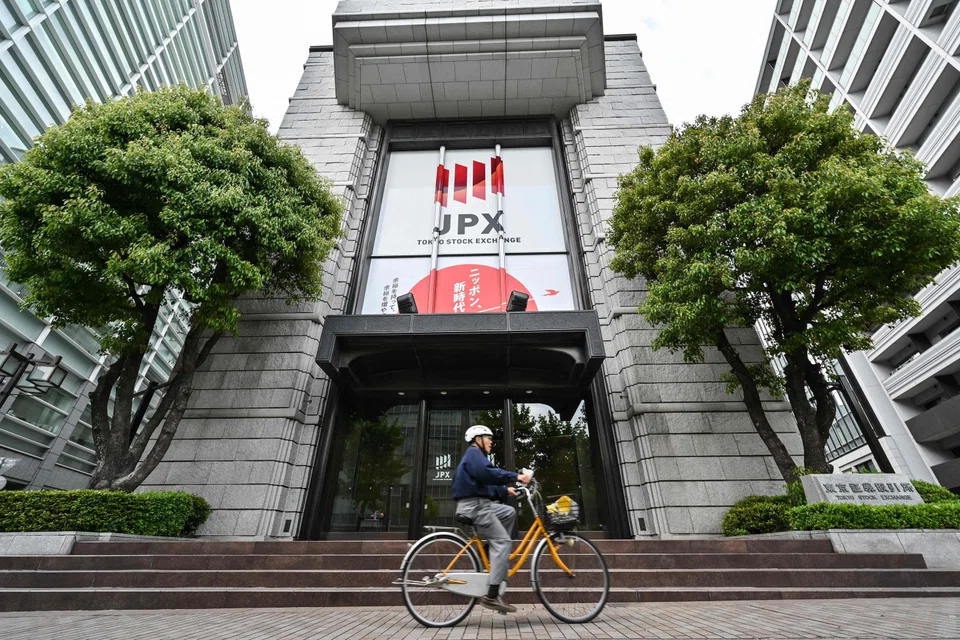
    • Market observers say the Singapore Exchange could consider issuing guidance for listed companies to trade above book value, like the Tokyo Stock Exchange. PHOTO: AFP

    SINGAPORE’S stock market has been languishing in recent years amid low liquidity and a dearth of new listings.

    This is in stark contrast to Japan’s public market, for example, where fiscal reforms have sparked a resurgence of interest from investors.

    Japan’s benchmark Nikkei 225 index notably hit a 34-year high earlier this year and has climbed 16.1 per cent in the year to date.

    Meanwhile, Singapore’s benchmark Straits Times Index has gained a more modest 4.8 per cent over the same period.

    To be sure, there are fundamental differences between the public markets in Singapore and Japan. But market observers say there are still some lessons that the city-state can take away from Japan, which has successfully emerged from a period of economic stagnation in the 1990s.

    These include imposing a requirement for listed companies to trade above their book values, investing pension funds in the local market, and improving the rights of investors.

    Reforms reignite Japan’s revival

    Market observers attributed the revival of Japan’s public market to a series of short and long-term reforms, as well as macroeconomic factors.

    Associate Professor Takuma Kumashiro of Kobe University Graduate School of Law, who specialises in corporate governance regulations, said that various reforms in the 2010s helped to set the stage for the latest revival.

    These reforms include the mandatory appointment of non-employee directors for listed companies and the establishment of guidelines for mergers and acquisitions by the authorities.

    They helped to increase the proportion of non-employee directors on the boards of Japanese-listed companies and improve shareholder engagement, said Assoc Prof Kumashiro.

    More recent reforms have also revived the market. These include the Tokyo Stock Exchange’s guidance last year for listed companies to disclose plans to trade above their book value, as well as the sustained investment of pension funds in local equities.

    Japan’s negative interest rates and investors’ increasing focus on Asia while avoiding the geopolitical and regulatory risks linked to China also contributed to Japan’s market rally, said corporate governance academic Professor Mak Yuen Teen from the National University of Singapore.

    Lessons for Singapore

    Among the market reforms that Singapore can emulate is the guidance for listed companies to ensure that their valuations are above a price-to-book ratio of one, said Jesper Koll.

    The expert director at investment advisory company Monex Group said that the guidance holds listed companies accountable to capital efficiency. It also encourages investment managers to hold the chief executive officers of listed companies accountable.

    On whether imposing such a guidance on a small market like the Singapore Exchange (SGX) would lead to fewer listings, Koll said that doing so would help to encourage more quality companies to list.

    “If Singapore had three really great companies, that would be better than having 300 mediocre companies,” said Koll, who is also an ambassador for FinCity.Tokyo, an organisation that aims to raise Tokyo’s profile as a global top-class financial city.

    Meanwhile, Assistant Professor Alan Koh from Nanyang Technological University’s business school suggested that Singapore also invest its pension funds in the local equities market.

    “This may signal confidence of the state in Singapore’s listed firms and thereby attract foreign institutional investors,” said Asst Prof Koh, an expert in Japanese corporate law and governance.

    Currently, pension funds from Singapore’s Central Provident Fund are invested outside of the Republic.

    Prof Mak said that Singapore can learn from Japan in the areas of investor rights and protection, such as the ability of shareholders to hold directors and management accountable through independent investigations into their actions and class action.

    At a broader level, Asst Prof Koh said that Singapore could try to make its market more relatable to foreign institutional investors, akin to efforts by the Abe administration in the 2000s.

    He said that Japan’s corporate governance model, where directorships of boards could be held by long-time employees of companies, is difficult for foreigners to understand as they are more familiar with the Anglo-American model where directors are expected to monitor and scrutinise management.

    Asst Prof Koh said that, likewise, Singapore’s market might be difficult for outsiders to understand given the role of state-linked institutions as well as its unique historical background, such as the corporate scandals by Chinese companies or S-chips in the 2010s.

    “As a smaller market with its own idiosyncrasies, the burden is on Singapore to make itself – including both successful and failed experiences – understandable to the rest of the world,” he said.

    Limits to adopting Japan’s ways

    Market watchers, however, are cognisant of the limitations that Singapore faces in adopting Japan’s initiatives.

    Asst Prof Koh said that Singapore may not achieve comparable results to Japan if it were to adopt the latter’s reforms, given fundamental differences between both markets. For one, Japan has a much larger equity market than Singapore. The Singapore market also has a “miniscule presence” of institutional investors compared to Japan.

    Given that Singapore has relatively more foreign listings compared to Japan, Prof Mak said that it would be difficult for the authorities to regulate and hold foreign listings accountable for poor management.

    Moreover, Japanese culture prioritises honour, which means that companies will hold themselves accountable when committing to guidelines to improve their stock price. “If we try this in Singapore, we may get empty promises from companies and there is no accountability for such empty promises,” said Prof Mak.

    On its part, Singapore’s stock exchange regulator, SGX RegCo, has put in place its own initiatives to improve the market.

    For example, SGX RegCo introduced a nine-year limit on the tenure of independent directors to promote board independence and encourage board renewal.

    It also launched a consultation on the convening of shareholder meetings to give shareholders and investors a stronger say in the performance of companies.