Why this Johor data centre treats water as a priority – even before it’s fully built
Bridge Data Centres is converting effluent for cooling at its Johor campus – part of a wider strategy to secure the water and power needed for AI growth
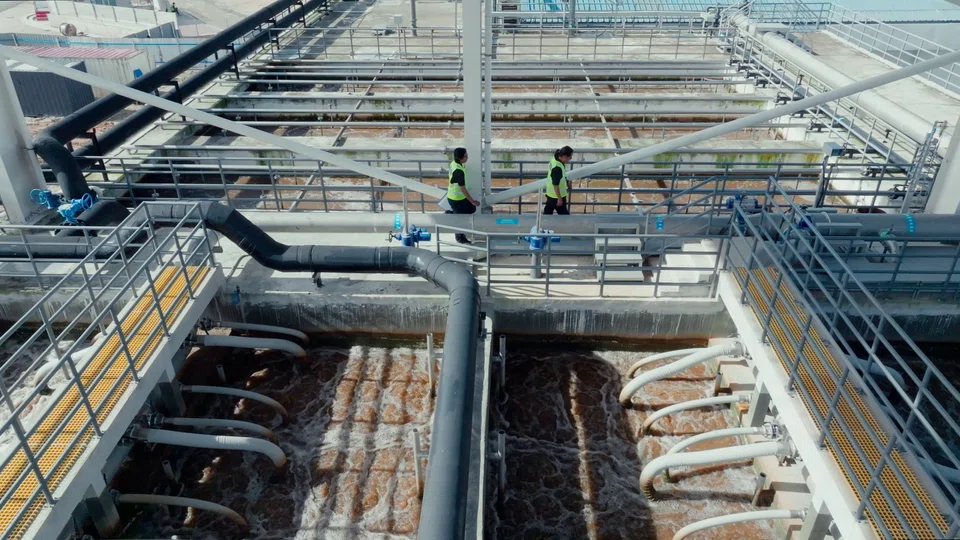
Long before its servers ever spin up, a data centre campus in Ulu Tiram, Johor, already has its water sorted.
Since August 2025, a water treatment plant on site has been taking treated effluent and cleaning it further into water fit for cooling, even as construction on the data centre itself continues around it.
The plant, the first built inside a data centre site in Malaysia, belongs to Bridge Data Centres (BDC). The system uses membrane bioreactor and reverse osmosis technologies, which was co-developed by BDC and local Malaysian technology companies.
It is a small example of a bigger shift. As AI pushes computing demand to a new scale, developers are being forced to rethink the resources needed to power and cool their facilities.
The project was designed in full compliance with guidelines issued by Malaysia’s National Water Services Commission. BDC worked closely with regulatory agencies, Johor Special Water, Indah Water Konsortium and Permodalan Darul Ta’zim throughout the planning and execution phases.
For BDC, that sequencing – solving for water before the demand exists – is the point.
“Our water treatment plant project reflects our ‘glocal’ strategy at work,” says BDC chief executive officer Eric Fan. “Working with the right team in Malaysia turned our commitment to sustainability into practical infrastructure. This is how we intend to continue building our capabilities in digital infrastructure and lowering our impact on the local environment in Malaysia and beyond.”
How BDC is treating effluent for data centres
At its MY07 campus in Ulu Tiram, Johor, Bridge Data Centres converts treated effluent into a standard clean enough to cool its data centre equipment.
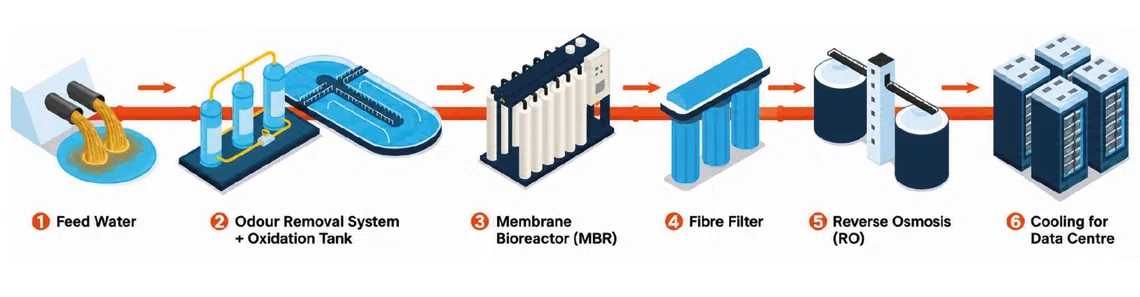
The effluent goes through six stages before it reaches a data hall: feed water, odour removal and oxidation, a membrane bioreactor, fibre filtration, reverse osmosis, then into the cooling loop.
Depending on intake conditions, the plant can push water recovery above 90 per cent.
Managing the AI surge
At scale, the link between water and cooling sharpens: More computing power means more heat, and removing that heat can itself demand significant water.
As AI systems pack more computing power into individual racks, they also generate more heat – increasing the demands placed on cooling infrastructure. BDC has deployed liquid cooling at scale, including cold-plate cooling for high-density AI workloads, to manage those temperatures without driving up the resources needed to run its facilities.
“The central challenge is delivering sufficient power, cooling and supporting infrastructure at the speed and scale that AI workloads require,” Fan says.
The same forward-planning logic extends to power for the Singapore-headquartered data centre developer and operator. The International Energy Agency estimates data centres accounted for about 1.5 per cent of global electricity consumption in 2024 – a figure it expects to more than double by 2030 as AI drives demand.
Bain Capital-backed BDC has committed to using 100 per cent renewable energy across its portfolio by 2040. In Malaysia, it became the first data centre operator to sign a power agreement with Tenaga Nasional Berhad under the Corporate Renewable Energy Supply Scheme. The agreement allows BDC to draw solar power through Malaysia’s national grid, which is currently powering roughly half of the energy used by BDC’s data centre assets there.
Renewable power through the grid, however, does not remove the need for backup generation. Data centres require uninterrupted power, so BDC is looking at how to decarbonise that too.
BDC completed its inaugural hydrotreated vegetable oil (HVO)-powered backup fuel pilot in Asia-Pacific at one of the company’s data centre campuses. The pilot demonstrated that HVO can be used as a cleaner alternative to conventional diesel for critical data centre backup power systems. Produced from waste-based feedstock, HVO requires no equipment changes and can cut greenhouse-gas emissions by up to 90 per cent, according to BDC.
While HVO offers a way to lower emissions using existing equipment, BDC is also exploring longer-term alternatives.
“No single technology can meet every requirement across every market and operating scenario,” Fan says. “BDC therefore applies a diversified approach that reflects local energy systems, technology readiness and the need for resilience.”
The challenge becomes more complex as operators expand across markets with different grids, water systems and regulatory environments. BDC operates and develops hyperscale campuses across Malaysia, Thailand and India, making those local constraints part of its expansion calculus.
“The industry will therefore need stronger collaboration among operators, hyperscale customers, utilities, technology providers and public agencies,” Fan adds.

Share with us your feedback on BT's products and services