Keppel CEO Loh Chin Hua bets on AI, energy transition to drive S$200 billion ambition
The asset manager expects to cross S$100 billion in funds under management this year

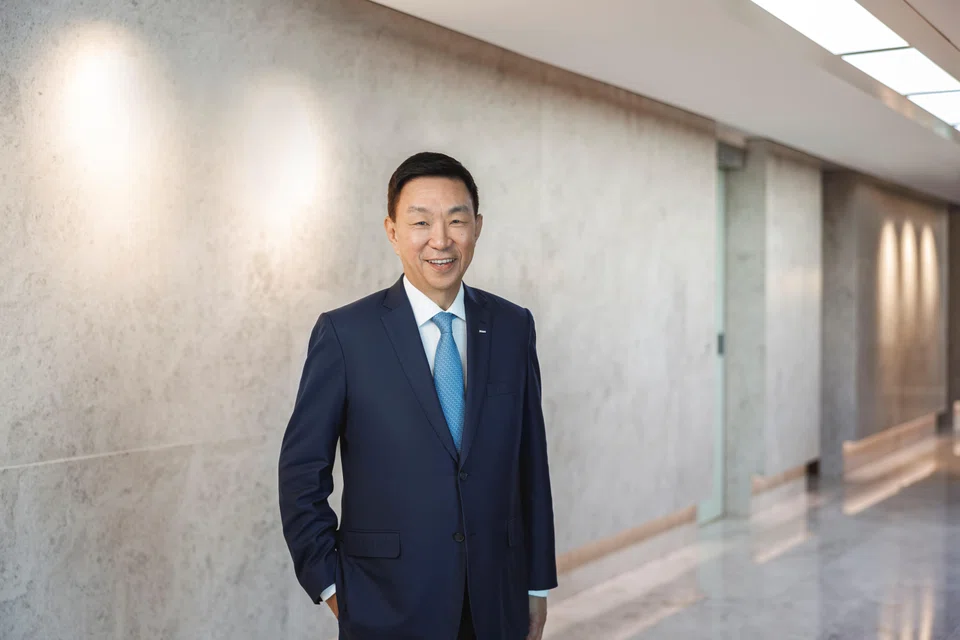
[SINGAPORE] For a company once synonymous with building massive offshore oil rigs, Keppel’s transformation over the last few years has been nothing short of radical.
With its metamorphosis into a global asset manager now nearly complete, Keppel has its gaze firmly fixed on the horizon: a target of S$200 billion in funds under management (FUM) by 2030.
The road to that milestone will be paved by the twin megatrends of artificial intelligence (AI) and the global energy transition, which the group expects will reshape infrastructure demand in the coming years.
Describing AI as “probably the most impactful force since the Industrial Revolution”, chief executive Loh Chin Hua noted that the next phase of value creation will demand integrated solutions that “combine compute, energy and connectivity at scale”.
“To fully harness AI’s potential and create strong competitive advantage, Keppel will not only enable AI infrastructure, but also be an AI-enabled asset manager,” Loh said in an interview published in the company’s latest annual report on Thursday (Mar 26).
This forward-looking optimism is anchored by a fully operational asset-light strategy. The group closed out 2025 with S$95 billion in FUM, putting it firmly on track to cross the S$100 billion mark by the end of 2026.
But getting to S$200 billion by the end of the decade requires more than just aggressive fundraising.
“Scale is earned through performance,” Loh said, pointing to Aermont Capital – a European real estate manager which Keppel partially owns – as illustrative of how strong track records attract progressively larger fund mandates.
“Over time, this creates a flywheel effect,” he added. “Strong performance attracts repeat capital, and larger funds will in turn allow us to originate and execute higher-value and more complex transactions.”
SEE ALSO


This flywheel fundamentally alters how Keppel will fund its future ambitions.
Powering the future
As “New Keppel” scales, growth will be driven alongside third-party capital through private funds. This enables the execution of larger, more capital-intensive projects than its own balance sheet could traditionally support.
Underpinning its digital infrastructure build-out is Keppel’s power and energy business. Upcoming milestones underscore this pipeline.
The hydrogen-compatible Keppel Sakra Cogen Plant – an example of proprietary assets funded through private funds – is slated for generation-readiness in the first half of 2026. Already, it is fully contracted for 2026 and 2027.
Meanwhile, the group has amassed S$7.1 billion in contracted revenues from decarbonisation and sustainability solutions – more than double the level four years ago – to be recognised over the next 10 to 15 years.
Keppel last year also commenced commercial traffic on the Bifrost Cable System, expanded its AI-ready capabilities and grew its Asia Pacific data centre powerbank to over 1 gigawatt.
These, Loh believes, will reduce execution risk, support disciplined scaling under its asset-light model and build a pipeline of assets to support FUM growth.
There is more to come in the first half of 2026, including the development of a floating data centre project.
“Looking ahead, demand for reliable power, cleaner energy and grid decarbonisation will continue to expand, particularly with the rise in digitalisation and AI,” Loh said.
“Our early positioning in expanding generation capacity, cross-border renewable energy imports and low-carbon energy vectors gives us strategic relevance in the energy transition and also strengthens Keppel’s ability to support power-intensive sectors, such as digital infrastructure.”
While the future trajectory is its primary focus, Keppel’s FY2025 scorecard provides the necessary proof of concept for investors. Core operations – stripped of legacy assets – delivered a 39 per cent year-on-year surge in net profit to S$1.1 billion, while return on equity improved to 18.7 per cent.
To keep the momentum going, the group aims to substantially monetise its remaining S$13.5 billion non-core portfolio by 2030, freeing up more capital to fuel its new engines.
As Keppel enters the third year of its new incarnation, the narrative has shifted. The question is no longer whether the industrial conglomerate can successfully pivot, but how fast its new asset-management engines can run.
”All our engines are firing – from raising and deploying capital to executing complex projects and operating assets profitably at scale,” Loh said. “I am confident the foundations are in place for Keppel to continue progressing onwards and upwards in the years ahead.”
Shares of Keppel have climbed 20.3 per cent in the year to date, closing at S$12.45 on Wednesday.
Decoding Asia newsletter: your guide to navigating Asia in a new global order. Sign up here to get Decoding Asia newsletter. Delivered to your inbox. Free.
Copyright SPH Media. All rights reserved.