

Keppel: hard to call bottom but troughs approaching
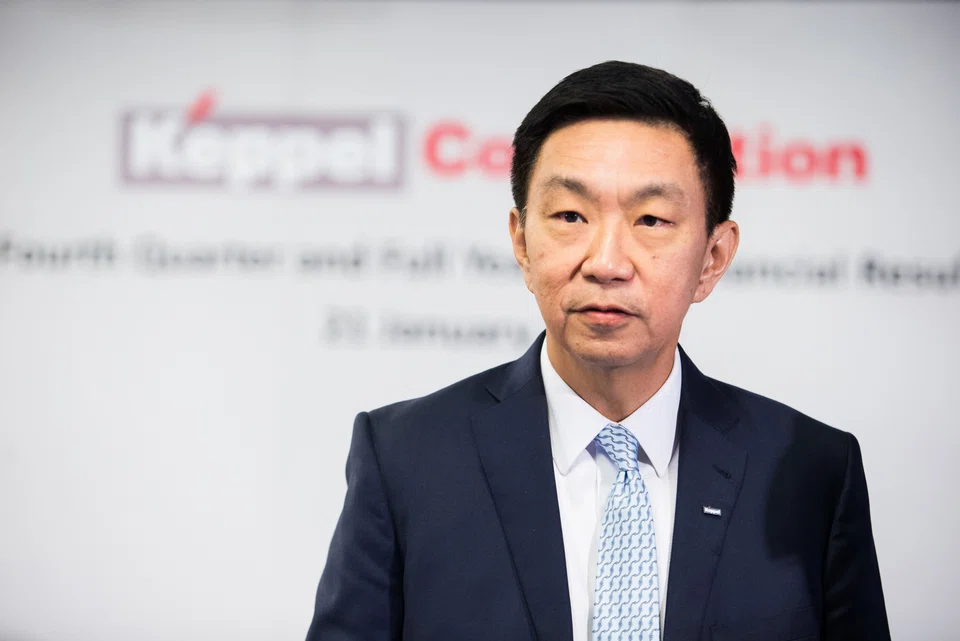
IN hindsight, Keppel Corporation's big bet to take subsidiary Keppel Land private a year ago is proving to be a smart move.
Keppel Land's multi-billion-dollar property portfolio is one pillar of strength that investors can cling to in a world drowning in cheap oil.
With prime office assets in Singapore held in its 45-per-cent subsidiary Keppel Reit, and a string of homes and offices to be launched in China and South-east Asia, investors can still count on some kind of hard asset value existing or being created.
This is especially pertinent if Keppel's current S$9-billion offshore and marine order book falls to near zero for many years to come, like a stretch in the low-oil 1990s when there was nary a jack-up rig order in sight.
Amid the uncertainty brought by the oil price rout, coupled with China's stock market jitters, Keppel's stock price has plummeted from S$9 a share a year ago to under S$5 a share now.
At current prices and based on 1.8 billion shares in issue, Keppel is worth under S$9 billion. Its property segment alone, by contrast, already has net assets of S$9.2 billion.
As future property development can be uncertain, investors who are too lazy to individually value every single development project and completed property can apply, say, a 30 per cent discount to book value. This is what Keppel Land's closest peer, CapitaLand, is currently trading at.
Yet one can argue a bigger discount is warranted. Property market conditions in Singapore have deteriorated since Keppel Land was taken private. In times of extreme uncertainty, oversupply, recession and capital outflows, a justified discount to book can even be 50 per cent or more. Property values get revalued downwards instead of up, exacerbating the pain.
A 50 per cent discount to Keppel's property portfolio would value the property segment at S$2.54 a share.
If Keppel's price falls below even that, we can say investors are throwing out everything else - offshore and marine, infrastructure, fund management, the 15 per cent deemed stake in telco M1 - and valuing Keppel Corp purely based on a drastic discount for its properties alone.
Investors looking for a way to figure out how much Keppel is worth should thus start with its property arm.
How much is "everything else" worth?
Non-property and non-offshore and marine assets amount to at least S$1.2 billion, or more than S$0.60 a share, based on current market valuations.
Adding that to our "bottom" estimate for Keppel's property segment, it might be that in a crisis situation, Keppel will hit a trough in the S$3 region, which is more than 30 per cent below current levels. As a comparison, Keppel's global financial crisis low was an adjusted S$3.20 a share.
In a less distressed environment, Keppel's property segment, at a 30 per cent discount to end-2015 book, is already worth S$3.56 a share.
How much the offshore and marine segment is worth is anyone's guess. Fear of impairments has caused some analysts to write the entire segment off. But assuming it can complete and deliver even one-third of its S$9-billion order book on a 10 per cent net margin, we can already add another S$300 million (S$0.17 a share) to Keppel's value.
Add on its other infrastructure investments (S$0.60) and applying a 10 per cent conglomerate discount, Keppel's value is at S$3.90.
Bear in mind we are still assuming that there is absolutely no more conversion, repair or other non-drilling work for Keppel's world-class shipyards beyond what is currently ordered, forever, and that its existing yard assets are completely worthless.
There is still Keppel's relatively smaller power plant engineering, procurement and construction business that is not part of its listed trusts, and its fund management business.
All in all, given current information, the conglomerate looks attractive below S$4.
Investors just need to look at pages 249-268 of Keppel Land's 2014 annual report, and pages 52-59 of Keppel Corp's latest results slides, to see a long list of projects the conglomerate owns or has yet to sell.
But, in the absence of other information, investors are expected to take Keppel's S$9.2 billion net asset valuation of its property arm at face value.
More fine-grained information on valuations by major cities, along with capitalisation rates used and price trends, for example, can help investors figure out how much the property portfolio is really worth and whether a bigger or smaller discount is warranted.
It is a mug's game to call for a bottom, but trough levels are approaching. Any good news on the offshore and marine front, or oil prices, could lead to a rebound.
Given how important the property segment is, it will be useful if Keppel could provide more data, which in all probability will paint a more promising picture of itself.
Here's looking forward to its 2015 annual report.
TRENDING NOW

Knight Frank’s Tan Tee Khoon leaves firm, Nicholas Keong takes over auction business
Keppel Energy, Sembcorp Utilities and Tuas Power to supply biomethane in pilot project

GovTech retrenches another 38 staff in second round of layoffs
Take-up of new private homes dives 45% in Q3 as prices accelerate with 1.4% rise

