TOPLINE

Keppel Reit eyes diversification into retail with focus on Singapore

Keppel Reit remains anchored in Singapore despite its foray into Australian retail

Summarise
Navene Elangovan
Published Mon, Dec 22, 2025 · 07:00 AM
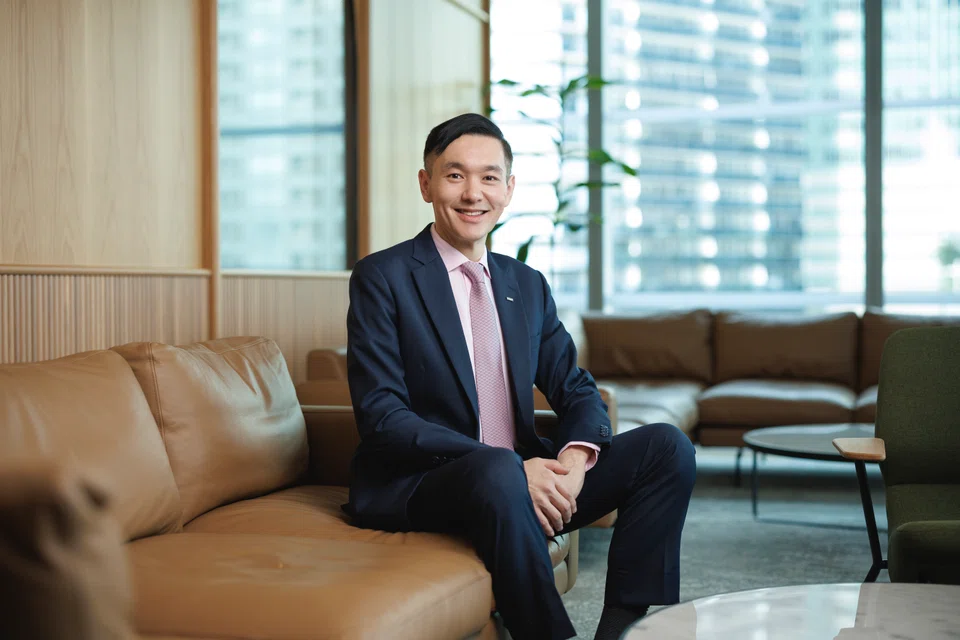
    • Chua Hsien Yang was appointed the chief executive officer of the manager of Keppel Reit on Jan 1, 2025.
    • Chua Hsien Yang was appointed the chief executive officer of the manager of Keppel Reit on Jan 1, 2025. PHOTO: KEPPEL REIT

    [SINGAPORE] Keppel Reit is charting a more diversified growth path that allows for retail assets to account for up to 20 per cent of its office-heavy portfolio.

    But Singapore will remain its anchor market.

    The strategy reflects a careful balancing act for the Singapore-listed real estate investment trust (S-Reit) by tapping opportunities in a recovering retail sector to broaden income streams, while meeting long-standing investor preference for Singapore-focused assets.


    The pivot took a concrete step in October this year, when Keppel Reit acquired its first pure-play retail asset – Top Ryde City Shopping Centre in Sydney – for A$393.8 million (S$334.8 million). The deal lifted the Reit’s retail exposure to about 4 per cent of the portfolio as at Oct 31 and marked a notable shift for the business that has spent the past two decades focusing largely on the office space.

    Chief executive officer of the Reit manager, Chua Hsien Yang, who took the helm on Jan 1, 2025, told The Business Times that the move into retail was timely, coming against a backdrop of improving market sentiment with interest rates easing from recent highs.

    “We really needed to capitalise on the improving market sentiment following the drop in interest rates. So we changed our strategy a little bit (and) we went into retail,” said Chua.

    Retail pivot amid easing rates

    Chua’s return to Keppel Reit is itself something of a homecoming.

    From 2008 to 2014, he was head of investments at the Reit, a period during which several cornerstone assets were acquired, including stakes in Ocean Financial Centre and Marina Bay Financial Centre. Subsequently, he moved to Keppel DC Reit as its CEO.

    The operating environment today, however, has improved compared to a few years ago when interest rates were high, said Chua. Interest rates have come down and in Singapore’s Central Business District (CBD), limited new office supply has coincided with a “flight to quality” offices by tenants post-pandemic.

    “Tenants are also increasingly trying to consolidate their staff into a central location. So the demand for CBD (offices) has actually increased,” said Chua. Even as some tenants are seeking larger floor plates, he noted that Keppel Reit has limited space to meet that demand.

    Investors have also expressed growing interest in the commercial sector beyond offices, particularly retail.

    While Keppel Reit’s mandate covers the commercial sector, it has largely focused on offices over the past two decades as the sector’s yields were higher.

    Chua noted that retail yields have risen from around 2 per cent pre-Covid to about 4 per cent, even as office yields remained steady at around 3 per cent.

    “So at this point in time, there is this opportunity for us to be able to acquire retail at higher than office yields,” he said.

    He added that there are “strong tailwinds” in the retail sector, as early concerns over the negative impact of e-commerce on physical malls have proven unfounded. “And in places like Australia, for example, e-commerce is still not popular because delivery fees are very expensive. People will physically go to the stores to buy stuff,” said Chua.

    Chua said the Reit manager had explored opportunities across both the office and retail sectors in the Asia-Pacific. But while there was a sufficient pipeline of assets to acquire in both, retail provided meaningful diversification.

    In Australia, incentive levels for office leases are above 30 per cent, significantly higher than those for retail, which are below 20 per cent. Incentives refer to the value of benefits that landlords offer to attract tenants.

    Overseas diversification

    Chua said Top Ryde City Shopping Centre was acquired for the demographic profile of the surrounding catchment. Residents in the area have higher-than-average incomes compared with the New South Wales population, and there is a high proportion of Asian residents.

    He added that Asians tend to spend more time and money at shopping centres, and the Reit manager sees scope to improve both income and income resilience by curating the tenant mix to better cater to Asian shoppers.

    Nevertheless, he acknowledged that investors generally prefer Singapore assets.

    “There’s nothing against Australia, but they prefer Singapore. I think that is something that we have also taken note of. And of course, if the opportunity arises for us to be able to buy a mall in Singapore, we will definitely look at it,” said Chua.

    One key concern investors have with overseas assets is foreign exchange risk. Currencies such as the Australian dollar have weakened against the Singapore dollar, which would negatively impact distributions.

    “Investors want Keppel Reit to be more Singapore-focused. So that is something we have taken on board, and we have assured investors that we will try our best to add Singapore assets to the portfolio,” said Chua.

    Although the Reit’s sponsor, Keppel Limited, owns two commercial assets that Keppel Reit does not currently hold, the manager has not engaged the sponsor about acquiring them. Office building Keppel South Central only opened this year and will take time to stabilise, while shopping centre i12 Katong is still in the midst of improving its tenant mix and revenue following asset enhancement initiatives.

    However, Chua said the Reit manager might “potentially” acquire i12 Katong in time to come.

    Retail exposure, he stressed, will be capped at 20 per cent of the portfolio, up from about 4 per cent as at Oct 31 following the Top Ryde acquisition.

    “Of course, there are always going to be people who don’t like our retail strategy,” said Chua. “But in general, the investors are happy.”

    Still, Keppel Reit has continued to strengthen its office core. On Dec 11, 2025, it acquired an additional one-third interest in Marina Bay Financial Centre Tower 3 at an agreed property value of S$1.45 billion from Sageland, a subsidiary of Hongkong Land Holdings.

    The acquisition has likely pushed the proportion of retail exposure down which means more acquisitions could be in the offing.

    Financial performance

    For the first nine months of its financial year, Keppel Reit posted distributable income of S$159.6 million, down 0.6 per cent from the previous corresponding period, while net property income rose 8.6 per cent year on year to S$161.3 million.

    Chua said the slight dip in distributable income was due to the manager taking 25 per cent of its management fees in cash. On a like-for-like basis, distribution would have increased 6.7 per cent year on year. (* see amendment note below)

    While operating revenues are rising and borrowing costs are easing, Chua noted that the Reit will only feel the full impact of lower interest rates as its loans mature. He added that Keppel Reit is particularly well-positioned to benefit from stronger rental growth due to tight CBD office supply.

    Ultimately, Chua said the success of the Reit’s diversification strategy will be reflected in its unit price.

    “That is actually critical because without the investors continuing to support us, we don’t have the capital to make acquisitions,” he said.

    Chua noted that units hit the manager’s S$1-per-unit target in September this year, and are up nearly 14 per cent year to date, closing at S$0.99 on Friday.

    As at Dec 31, 2024, Keppel Reit’s net asset value (NAV) per unit, excluding distributable income, stood at S$1.24.

    Chua said: “We have already reached our first milestone of S$1 per unit. So for our next (milestone), we are aiming for an NAV such that there is no discount.”

    * Amendment note: An earlier version of this article stated that the manager took 35 per cent of its management fees in cash. It has been revised to reflect the correct figure.